Appendix 7
Cycle 1: A Selection Of
E-Mail Messages
In
most cases pseudonyms or position titles replaced personal names to ensure
anonymity.
1. Subject:
e-mail
From: Graphic Designer.
Date
sent: Thu, 5 Oct 1995 15:39:12
+0200
To: philip.uys@wnp.ac.nz
Subject: e-mail
I've
read everything. I don't believe you do sleep! Very exciting.
...
Cheers,
Graphic Designer.
2. Subject:
design doc/HYDI
From: Graphic Designer.
Date
sent: Mon, 9 Oct 1995 18:25:35
+0200
To: philip.uys@wnp.ac.nz
Subject: design doc/HYDI
Here
is the first draft of our design document.
Design
Document for Wellington Polytechnic Homepage
The design guidelines as set down in the
signature document for the
Wellington
Polytechnic will be followed, for the Would Wide Web homepage.
However,
there are certain considerations and constraints when dealing in a
cross
platform electronic digital format.
Typefaces:
In
the signature document the typeface Helvetica is listed as an
alternative
for Futura. In the case of a Windows environment
Aerial is the
copywrited name of the Helvetica font.
This will be the body copy font.
Colours:
The
two PMS colours; PMS 280 ( Blue) and PMS
320 (Green) will be used for
bullets,
highlighting, and window dressing.
Computer
terminals use RGB colour. The RGB version of the signature colours
are
as follows:
Colour RGB
Blue 0/0/100%
Green 10%/100%/60% (out of 255:25/255/153)
Master
signature:
The
Wellington Polytechnic master signature will be used with adherence to
specifications
in terms of minimum area of isolation,
reversal, and misuse
or
rearrangement of elements.
Cheers,
Graphic Designer.
3. Subject:
Thursday Meetings
From: "Bob"
<DIRECTORATE/BOB>
Organization: Wellington Polytechnic, NZ
To: DIRECTORATE/PHILIP
Date
sent: Tue, 10 Oct 1995
08:15:25 +1200
Subject: Thursday Meetings
Information
Sessions on Plans for our WWW Page and our Project "HYDI", electronic
media based education.
Two
Sessions have been planned
Session
1 Thursday 12 October at 7.00am, Coffe and
eats provided!
The Project Group plus invited people: PA, BP,
TK, JO, AF, GI, BB
Session
2 Thursday 12 October at 8.30am
The first 15 minutes of the SMG meeting will
be set aside for an introduction
to "HYDI"
and the WWW page project.
Please
comment and correct any misunderstandings
Bob
4. Subject:
Presentation by Philip Uys
From:
.....................................
Organization: Wellington Polytechnic, NZ
To: ......................
Date
sent: Tue, 10 Oct 1995
15:07:56 +1200
Subject: Presentation by Philip Uys
Copies
to: DIRECTORATE/PHILIP
Philip
will be making a presentation on Thursday 12 October, in T23,
at
a time to be confirmed, between 12 & 3.00pm. The subject is
"..using
hypermedia in distance education".
This will take
40minutes.
Please
email me by return asap, your availablility
to attend the
presentation,
and include what 40 minute/flexible/ options
between
12
& 3pm best suit.
Thank
you
.....................
5. Subject:
hypermedia presentation by Philip Uys
From: ..................
Organization: Wellington Polytechnic, NZ
To:
........................
Date
sent: Mon, 16 Oct 1995
15:13:22 +1200
Subject: hypermedia presentation by Philip Uys
Copies
to: DIRECTORATE/PHILIP
For
those of you who were unable to attend either presentation last
week
- Philip will be arranging another session after Labour Weekend
-
to be advised.
..............
6. Subject:
HYDI etc.
Date
sent: Tue, 17 Oct 1995 13:52:37
+1100
To: Team member B.
From: UserId@opennet.net.au
(Real Name Unknown)
Subject: HYDI etc.
Copies
to: philip.uys@wnp.ac.nz
Hi
Good
day from Perth !
Trust
that everything is going well.
How's
the transfer of files from the Mac going ?
A
few things that I've been thinking of :
…
Greetings
to the team !
Philip Uys
7. Subject: Meeting on Friday
Date
sent: Wed, 18 Oct 1995 20:42:26
+1000
To: c.latchem@info.curtin.edu.au
From: UserId@opennet.net.au
(Philip uys)
Subject: Meeting on Friday
Dear
Colin
Good
meeting you and Helen at the conference in Bunbury.
Thank
you very much for your availability to discuss issues of common
interest
in the open learning arena and for setting up these meetings.
The
following areas are of specific interest to me. Please evaluate and
decide
whether we can't use the time more effectively, if you could for
instance
point me to an URL or literature that discusses these ISP Rep.ers,
so
that
we rather concentrate on areas which is not in text format !
Category
A : General ISP Rep.ers
^^^^^^^^^^^^^^^^^^^^^^^^^^^^
*
at the leading edge : philosophy, developments and terminology
*
infrastructure required in the "Open Learning Unit" at tertiary
insitutions, both internally and
externally within good role model
organisations
relating to :
- people
- IT
- procedures
*
good contacts in open learning :
- international organisations
- universities/polytechnics as good AND
growing role model organisations
- specifically polytechnics
- specifically institutions in NSW, QLD and
WA in Australia
*
key educational elements to be addressed in open learning
eg collaborative work, high discovery
component, interactivity etc.
*
current limitations and hurdles in open learning
*
critical success factors in addressing the needs of
- the part-time market
- students in other cultures in other
countries
*
collaboration among tertiary institutions nationally and internationally
*
international opportunities
*
URL's or literature that is really "spot-on" (!)
Category
B : Technical Issues
^^^^^^^^^^^^^^^^^^^^^^^^^^^^^
*
preferred media trends eg hypermedia, interactive video etc
* prefered hardware and network trends eg Web, CD-Rom, text
etc
*
overcoming bandwidth and other technical limitations
Category
C : OLA (more in Helen's court)
^^^^^^^^^^^^^^^^^^^^^^^^^^^^^^^^^^^^^^^^
*
nitty gritty issues of managing the screening and selection process of
universities
and their courses
*
vision for extension and growth strategy
*
key factors in OLA's successes and
*
what can be learnt from OLA's difficult patches.
This
is my wish-list - please address whatever you feel is more important.
Can
you please confirm the approximate time of the appointments and
where
I should arrive.
…
Looking
forward to your confirmation and meeting with you on Friday.
Regards
Philip Uys
8. Subject:
Re: Important HYDI decisions on the strategic level
From: "Bob " <DIRECTORATE/BOB>
Organization: Wellington Polytechnic, NZ
To: "Philip Uys" <DIRECTORATE/PHILIP>
Date
sent: Fri, 3 Nov 1995
09:30:50 +1200
Subject: Re: Important HYDI decisions on
the strategic level
Philip,
We
will be discussing this issue again at next weeks SMG meeting.
Currently
my thinking is that our BEd would benefit most from being
the
first HYDI project. Will keep you
informed
Bob
>
From: "Philip Uys"
<DIRECTORATE/PHILIP>
>
Organization: Wellington Polytechnic, NZ
>
To: Bob
>
Date: Tue, 31 Oct 1995 19:06:31
+1200
>
Subject: Important HYDI decisions
on the strategic level
>
Bob
>
>
We actually have to have another talk soon, but because of the time
>
commitments that both of us have, I would like to try and discuss one
>
or two things with you by e-mail which is within the strategic
>
domain.
>
>
Can you please arrange for the following agenda points on next week's
>
SMG meeting to read something like :
>
>
1. "Formulating the criteria for the selection of the first hypermedia
course
> to be developed in 1996 for distance
education"
>
> It is essential that this process starts NOW
so that the course can
> be selected later this year or very early
next year, because a lot
> of extra work will go into the first course
that can obviously be replicated
> for other courses.
...
>
Regards
>
>
Philip
Uys
>
Senior Lecturer : Computer Studies
>
Project Manager : Hypermedia in Distance education
9. Subject: WP Home Page
From: Team member C.
Organization: Wellington Polytechnic, NZ
To: All heads of schools
and heads of departments
Date
sent: Fri, 17 Nov 1995
09:07:34 +1200
Subject: WP Home Page
Copies
to:
philip@directorate.wnp.ac.nz
As
most of you know, the WP Home Page includes the following
headings:
Why
study at the School of...?
Why
Study at the Dept of...?
New
developments/events( School)
New
developments/events ( Dept)
Background
on us (School)
Background
on us (Dept)
Please
could each School and Department put together material
suitable
for inclusion under the above headings and let me have it as
soon
as possible as it needs to be added to the Home Page in time for
the
next draft viewing by Schools on Fri 24 November.
(The
Home Page goes live on 4 December)
Many
thanks for your help and I look forward to hearing from
you
Team
member C.
10. Subject:
Re: Something for the future ......
From: Vice-President
Organization: Wellington Polytechnic, NZ
To: "Philip Uys"
<DIRECTORATE/PHILIP>
Date
sent: Sun, 19 Nov 1995
12:43:24 +1200
Subject: Re: Something for the future
......
I
RAISED THIS ISSUE WITH THE SMG SOME 6 M0NTHS AGO
BUT
THERE IS A RELUCTANCE TO LEAVE PAPER BASED
COMMUNICATION.
IT IS ALSO TRUE THAT MANY STAFF
DON'T
HAVE COMPUTER ACCESS. HOWEVER IT WILL COME
AND
WE AGREED TO LOOK AT THE ISSUE EARLY IN 1996.
THERE
IS THE POTENTIAL TO SAVE SEVERAL THOUSAND
DOLLARS
FROM OUR COPYING BILL.
THANKS
FOR THE THOUGHT.
11. Subject:
Structure of launch
From: Self
<DIRECTORATE/PHILIP>
To: Bob,Executive
Director
Subject: Structure of launch
Date
sent: Wed, 29 Nov 1995 17:57:06
Bob
and Executive Director
Please
advise whether you agree on the structure of the launch as
discussed
by the HYDI team at our final meeting before the launch:
#12:00
- 12:15
Background music and people arriving (we will
have a nice picture
/ animation of the screen going about the
launch)
Everybody receives a "Launch
brochure" as they come in (and can read
a bit if they
want to before 12:15)
#
12:15 - 12:25
Bob welcomes those present and explains
- the value of having a Homepage on the
Internet
- what is the Internet, and the growth of it
# 12:25
- 12:30
"someone" (please advise who,
since we need to invite that person)
registers the first official hit on our
homepage and makes a very
short "launch" speech
The person I was thinking of is Prof. Suave
Lobodzinski, a
FullBright scholar
currently at Auckland University, who ran
the hypermedia workshop (organised and
hosted by the Research Committee) in
August this year.
At that workshop I got excited about
hypermedia and based on that workshop
I proposed the HYDI project! So in a real
way, he was instrumental in getting
the whole process going.
Maybe we can combine his visit with a
follow-up workshop on
Tuesday if the Research Committee has any
funds left?! (I will
arrange the visit and workshop if you agree)
#12:30
- 12:45
I will take our visitors on a 15 minute tour
through our Homepage.
#12:45
- 12:50
Bob thank those present and invite to the light
refreshments in the
Student Common Room
Also invite staff (who do not have suitable
computers in their
offices) to browse through our Homepage on
the two computers in the Library foyer and the
one computer in the Staff Room on H-floor
that will be available for the week
#1:00pm
to 1:30pm
Light refreshments served in the Student
Common Room and visitors
can browse through the Homepage on a few
computers that are there
Please
comment on the above a soon as it is possible for you
Thanks
12. Subject:
Personal invitation
From: "Philip Uys"
<DIRECTORATE/PHILIP>
To: #everyone
Date
sent: Sun, 3 Dec 1995
09:58:36 +1200
Subject: Personal invitation
Hi
Have you entered 12:00 for 12:15
******************************************
TODAY : Monday 4
December 1995
******************************************
in your diary?
IT IS THE LAUNCH OF YOUR HOMEPAGE ON THE
INTERNET
----
Yes,
EVERY Department, Unit and School is represented in the
Wellington Polytechnic Homepage.
Light refreshments will be served after
the launch
From
today, your Department, Unit and / or School will be visible to 50 million
Internet
users representing students of all ages, mothers, fathers, academics,
business
people, health staff, government officials, etc etc.- from most of the
developed
and developing countries of the world.
The
program is as follows :
12:00 - 12:15
You
will receive a "Launch Brochure" and enjoy the background music
12:15 - 12:20
You
will be welcomed by the Principal, Bob
12:20 - 12:25
Dr Mimi
Recker, lecturer in educational technology at VUW and software
engineer
on the original INTERNET project in the 1970's, will address you
on
the growth of the Internet, the opportunities for education in using the
Net,
and the significance of having a Homepage
12:25
- 12:30
Prof.
Suave Lobodzinski, Fullbright scholar from California
and currently at
Auckland
University will address you (via LIVE video / teleconferencing from
Auckland)
on hypermedia in distance education and using the Internet
12:30 - 12:35
Mr
Devon Sutcliffe, Chairman of the Council, will register the first official hit
on
our
Homepage
12:35
- 12:50
Philip Uys, Project Manager:Hypermedia
in Distance Education, will
take
you on a 15 minute tour through the Homepage and answer
questions
from the floor
12:50 - 12:55
Bob will introduce you to the development team
and
direct
you to where the light refreshments will be served
The
chairperson for the launch of this new INFORMATION service is
Elizabeth
Griffiths, our Librarian.
Can
you please also invite colleagues who are not as privileged as those of
us
who have electronic mail.
After
the launch, you will be able to browse through our Homepage (and other
interesting
sites) on your OFFICE computer by using Netscape.
There
are also two computers in the Library foyer and one computer in
the
Staff Room on F-floor which are set up for this purpose (it will be
available
for the whole week - compliments of CSG and the Library).
We
are looking forward to welcoming you at 12:00 today,Monday,
4
December in LT200.
See
you there!
Kind
regards
Philip Uys
Senior
Lecturer: Computer Studies
Project
Manager:Hypermedia in Distance Education
Appendix 8
Memo: REPORT ON USA VISITS
AND ED-MEDIA AND ED-TELECOM CONFERENCE
To : Bob Bubendorfer
Principal
cc …..
Operational adviser : HYDI
…..
External relations adviser : HYDI
…….
Academic adviser : HYDI
From : Philip Uys
Project manager : HYDI
Date : 15 July 1996
REPORT ON USA VISITS AND ED-MEDIA AND ED-TELECOM
CONFERENCE
Thank
you for your support of the HYDI project and for allowing me to visit
educational institutions in the USA as well as to attend the ED-MEDIA and
ED-TELECOM conference.
The
visits at MIT and California State University at Long Beach proved to be
particularly helpful since the people I saw are all working actively in this field and have solid
practical experience.
The
conference overall proved to be very valuable with excellent tutorials, good contacts
and a large number of good sessions; unfortunately there were also some papers
of a low quality and which touched only on the very basics of what we are
doing.
The strategic initiative
of the development of hypermedia
courseware at Wellington Polytechnic as a way of utilising modern computer
technology in education and as a means to increase student numbers, has undoubtably been validated at the conference and the
visits.
Attached please find a report on the visit and a list
of the conference sessions attended.
Comprehensive
tutorial notes were provided as well as two sizeable volumes that contain the
papers presented at the conference (1274 pages).
…
With gratitude
Philip Uys
REPORT ON USA VISITS AND ED-MEDIA AND ED-TELECOM
CONFERENCE
1. Introduction
Most of the
aspects discussed in this report is not the result of a single session,
tutorial or visit but rather a thread through a number of presentations, or
different aspects in various presentations that together pointed to a specific
aspect. The report is therefore structured around these aspects rather than
each specific session.
2. Findings and recommendations
2.1 Blend of courses
The resources available for
hypermedia courseware development in other institutions (like MIT and Military Academy) are huge in comparison to
what we currently have (due to a number of acceptable and good reasons).
All our resources in the
next year or two can easily be tied up in the development of the B.Ed alone
which will yield a limited income.
Furthermore the hypermedia
course development should reflect the nature of the offerings at Wellington
Polytechnic which are both full formal courses as well as shorter courses.
Recommendation:
That short courses for niche
markets be selected based on thorough market research and that these be
developed in parallel to the core formal courses.
2.2 Hypermedia course
development
The
institutions who have demonstrated the most advanced usage of hypermedia in
education like the UC, have made a firm decision and commitment towards this at
a strategic level.
California
State University :
n
small group of lecturers have reached a level where they are able to
develop computer-based courseware themselves
n
the New Media Lab (part of Academic Computing Services) :
¨
runs short training courses in incorporating multi-media in courses,
use of the Web and the Internet for academic staff
¨
assist lecturers on a one-to-one basis in the production of
computer-based courseware
¨
produce computer-based courseware for
lecturers
MIT :
n
a large group of lecturers have the ability to develop computer-based
courseware themselves
n
the Academic Computing Services unit
¨
they use the Web extensively as a delivery platform
¨
produce computer-based courseware for
lecturers - only in exceptional cases
ED-MEDIA and
ED-TELECOM:
n
in general, after initial familiarisation with multi-media and the Web,
a section of academic staff seems to be developing courses themselves for their
students - often not in a distance education fashion!
n
training and multi-media /
hypermedia support seems to be either from a specific unit or from particular
lecturers who have a personal interest and experience with it
n
the Open University (UK) naturally have formalised all the processes
for developing computer-based courseware and have different formal departments
responsible for the development, marketing and maintenance of courses as well
as student support
n
the Hong Kong Polytechnic University has a unit within their academic
development department that provides lecturers either with assistance to
develop multi-media courseware or that does the development of multi-media
courseware for the lecturers. They also act as consultants in this field to
lecturers.
At most
institutions (including MIT, California State University and Hong Kong
Polytechnic University) a dedicated unit or department is responsible for
assisting lecturers in these activities and developing courseware for them.
These units
also run short training courses on incorporating multi-media in courses, use of
the Web and the Internet for academic staff , act as consultants to academic
staff and assist them on a one-to-one basis in the production of computer-based
courseware.
One of the
key functions of these units is ongoing research in the appropriate application
of information technology in education.
Recommendation:
The
hypermedia project should be placed on a firmer footing from 1997 to achieve the
goals of this venture as specified by the Principal. It is felt that the
current structure does not provide adequate focus and potential for the
achievement of these goals.
A unit could
be formed, perhaps to be called “The New Media Unit”, that will be serving all
the schools in the Polytechnic and will as such be a general support unit like
the Library and the Education Development department.
In 1997 this
unit could still consists of staff that
have vertical reporting lines in their current appointed units eg schools.
It’s mission
could be : To research and implement appropriate new information technology in
appropriate curricula at the Wellington Polytechnic.
Its main
activities could be to:
·
research new educational information technologies for feasibility of
use in curricula at Wellington Polytechnic
·
develop hypermedia courses
·
train academic staff in the use
of IT, and specifically hypermedia, in
the preparation, delivery and assessment of courses
·
provide consultation on a one-to-one basis
·
maintain the Wellington Polytechnic Homepage.
This unit
will combine and balance the principles of education and of information
technology to achieve its goals. Therefore it is felt that such a unit could
reside within EDD, on its own (like EDD and the Library) due to its general
support function or linked in some or other way with the computer development
group (with the Academic Registrar).
Due to the
above reasons, it is felt as first preference that the unit should function as
an independent general support unit, and as second preference due to the
educational basis of the activities, that it could be part of EDD.
2.3 Database
It is clear
from the development of data management in the history of computing, that using
a proper database is the most appropriate way to store information.
Some
organisations like California State University has an established practice in
this regard and use an object-oriented database (ILLUSTRA) for this purpose.
One of the tutorials
I attended was on another object-oriented database called HYPER-G (which has
now been renamed to HYPERWAVE), which is free to educational institutions but
is more risky since it is not a commercial product in the true sense.
Quite a few
of the institutions with the most impressive developments in hypermedia
courseware development, including the University of Calgary which has a large
number of files manage, uses directory structures - like us - to store files.
Recommendation:
That we
acquire either ILLUSTRA or HYPER-G in 1997 / 1998 for more appropriate
management of the courseware data. We will also have to employ someone with
database management skills on the project to fulfil this function.
2.4 Specific aspects of hypermedia courseware
2.4.1 In Tutorial 3 the use
of scripts to make the hypermedia more interactive was explained and
demonstrated. The possibility of having an area on the screen where a student
can make personal study notes that are kept on their own computers should be investigated.
2.4.2 In general, pages should be longer so that a
student can already start reading the top of the page while it is loading the
rest of the page. This approach is faster for the student than having to wait
for a larger number of smaller pages that must each be loaded.
2.4.3 In Tutorial 6 the emphasis was placed on
having adaptive educational hypermedia which, although complex to achieve,
should be a key design goal in hypermedia development at Wellington Polytechnic
from 1997 onwards. This means that educational material is presented in a
specific and perhaps unique way for each student on the basis of a user model
that is created for each student; this is one of the basic advantages of
hypermedia learning above the traditional classroom method. A skilled
programmer in some or other scripting language eg JAVA or PERL would be
required.
2.4.4 A
search tool where students can enter a search word / phrase should be
incorporated in each hypermedia course.
2.4.5 As
demonstrated by the University of Twente, students can actually develop
valuable hypermedia “text books” as part of their course assignments which can
be used by future students.
2.4.6
Distance education via hypermedia delivery has been validated as an important
delivery medium. In eastern Canada the government of a province and all the
tertiary education providers has joined forces to make hypermedia delivery to
most homes over high-bandwidth networks a reality.
2.4.7 Huge
resources are required to translate a large proportion of courseware into
hypermedia for distance education delivery and therefore a number of
institutions represented at the conference has entered into collaborative
research and development agreements with other institutions. Collaboration with
other institutions in New Zealand should be sought eg Victoria University,
Auckland University and others.
2.4.8 The
Western Australian telecentre network had a
presentation on developments there, which re-emphasised the opportunity we have
through them and the UK Telecentres organisation (with whom good contact were
made in November in Brisbane) for marketing and support for our courses.
2.4.9 “Electronic Data Systems” emphasised the
importance to have a clear hypermedia development methodology which includes
assisting the content providers to formulate clear training goals, training
programs and markets. A WELLINGTON POLYTECHNIC hypermedia development manual
should be constructed based on knowledge and experience gained so far for use
from 1997 onwards (naturally to be altered as required).
2.4.10
Eventually
back-end application should be developed to enhance the administration of hypermedia courses including assessment (an
excellent assessment application was demonstrated by the US Air Force Academy
and the Indiana and Purdue Universities).
2.4.11
Hypermedia
is not specifically related to distance education and can be used to enrich the
traditional classroom activities in a variety of ways eg to present material in
class, to publish student notes, to publish important notices as well as to
publish results (with appropriate anonymity) on an intranet / the Internet. A
presentation by the University of Quebec identified five models of hypermedia
learning : the enriched classroom, the virtual classroom (what the HYDI project
currently focus on), the information base, the teaching media and the
communication channel.
2.4.12
The
University of Twente illustrated how hypermedia courses can include examples
of previous students’ work as a learning
resource for future students. This approach also worked very well at UC;
students did not - as expected - copy materials from previous years but rather
used it as a base to create their own projects.
2.4.13
The University of New South Wales described a
paperless system for the collection, testing and assessment of assignments.
This is achievable through hypermedia courses and can be implemented through the use of the Internet.
2.4.14
Taking cultural differences and preferences
into account in the design of courseware was re-emphasised in a paper by the
National Chengchi University, Taiwan. They discussed
how Taiwanese students would interpret certain codes of communication eg
humour, colours etc. Our target markets will have to be well researched to
establish any specific cultural preferences.
2.4.15
The use of virtual reality was also dealt with
in various sessions. In a panel discussion on this topic, Veronica Pantelides, explained how virtual reality can enhance the
learning experience of students because it allows the learner to proceed
through an experience at their own pace, it encourages active participation and
the lecturer can more accurately illustrate some features, processes etc. than
by other means.
2.4.16
Our design philosophy of having all the various
learning and communication tools as an integrated set within easy reach to
students, has been confirmed by the work being done by the Chung Yuan Christian
University and telecommunication Laboratory of Taiwan.
2.4.17
Prof Hiroshi Ishii of MIT demonstrated some of
his work on collaborative learning environments which is a future development
to take note of. These systems allow users which are physically removed to work
together on a “white board” as if they are in the same room.
2.4.18
Prof Mitchel Resnick discussed the creation of intellectual stimulation
in children through various practical experiments with objects of computer
intelligence. This illustrated “learning by discovery” which the World Wide web
can support so powerfully.
Appendix 9
Hypermedia Projects
Progress
report to SMG : March 1996
By Philip Uys, Project Manager :
Hypermedia in Distance Education
1. Sampler hypermedia course
completion date : 30 June 1996
goal : to convince the Internet users and their families that
Wellington Polytechnic is the right choice for hypermedia distance
education
progressing well according to plan
contains two learning outcomes of
101 (“Introductory course to Adult learning”)
process :
cyclic prototype approach ie each content chunk is taken through
analysis, design, coding, testing, implementation (hidden)
testing : local and international students will experiment and
feedback
multi-media students in Computer Studies will do the majority of the
technical production (5 groups of 3 or 4 students) as their project
we will have a four hour, intensive
workshop where all the role-players will participate on Monday
good news : the first two
content chunks are ready for production
2. Wellington Polytechnic Homepage
ongoing development
goal : to promote the Wellington Polytechnic and its programs both
nationally and internationally
steady hit rate of approximately 300 hits per day
new info and freshness drastically required! : events, text,
ownership, photographs, more e-mail addresses (contact Content provider )
fortnightly statistics is available under Netscape by typing as URL
file:///i:/users/HYDI/homepage/stats
and then selecting the .htm file which
interests you
(the date in the name of the file is the
last day of the stats
period eg "96-03-25.htm" contains
the stats from 11/3/96 to 25/3/96)
Netscape 2.0 has been installed by CSG
256 colours : please let CSG know about your requirement!
3. Wellington SIG on Educational Hypermedia
being formed
4. Wellington Polytechnic represented on speaker panel at the
annual NZEIL Conference (April
1996)
project manager invited as speaker on “The Internet : how to make
it work for you!”.
Appendix 10
Hypermedia Projects
Progress report to SMG : May 1996
Philip Uys, Project Manager : Hypermedia in Distance Education
1. B.Ed Sampler : first Internet course
¨
completion date : 30 June 1996
¨
progressing well: content of the three “chunks” completed and construction
and design now under way (first two “chunks” already in html)
¨
would need additional testing time before deployment
¨
involvement of students not as effective as would have liked
¨
also creating a “virtual campus” which will link to the Homepage; the
virtual campus will contain all the services available to “cyber students”
(meetings this coming week with all the support departments)
(lecturers
are called “cyber guides” in one Internet course!)
¨
model :

 Homepage Virtual campus
1997 : Other
standard courses
|
|
|
|
1997 : Niche
market short courses
|
|
2. Wellington Polytechnic Homepage
¨
included in the Government’s Blue On-line pages
¨
steady hit rate of around 300 hits per day
¨
still early days; it is a living document!
¨
promotion of our address http://www.wnp.ac.nz needed; on brochures etc.
¨
more direct e-mail response facilities have been added
¨
new info and freshness still required : please revise the info under your departments
¨
proposal: compile a small homepage action group of interested people in
your school / each department to take initiative on developing your school’s
image on the Internet?
¨
work of students work can add some dynamics to your school’s homepage
(approached by student in School of Design)
¨
save on Internet cost : rather access the local mirror image at
file:///i:/users/HYDI/homepage/index.htm
3. Internet developments
¨
more possibilities opening up for animation, video-clips and real time
voice communication over the Internet : will be using some of this in the B.Ed
sampler.
Appendix 11
Cycle 2: A Selection of
E-Mail Messages
In
most cases pseudonyms or position titles replaced personal names to ensure
anonymity.
1. Subject:
Re: Launch of the sampler!
From: "Bob Bubendorfer"
<DIRECTORATE/BOB>
Organization: Wellington Polytechnic, NZ
To: "Philip Uys"
<DIRECTORATE/PHILIP>
Date
sent: Wed, 14 Aug 1996 07:27:24
+1200
Subject: Re: Launch of the sampler!
Hi
Philip,
The
idea appeals to me, lets do it.
Bob
>
From: "Philip Uys"
<DIRECTORATE/PHILIP>
>
To: Bob
>
Date: Tue, 13 Aug 1996 22:11:42
+1200
>
Subject: Launch of the sampler!
>
Bob
>
>
We are working very hard towards finalising and testing the sampler
>
to be ready on 31 August.
>
>
I do not propose a glamorous event at all, but I would like to
>
suggest that we have a formal launch of the sampler in LT200 in the
>
first week of September.
>
>
This could simply consists of myself and Nick / Alison
>
demonstrating the sampler and yourself having a word about the
>
significance of launching our very first hypermedia course on the
>
Internet into the national and international market.
>
>
Maybe we could have a small 'celebration' afterwards with the HYDI
>
team, directorate and The Head of Business and Information Systems School
attending?
>
Regards
>
>
Philip
Uys
>
Senior Lecturer:Computer Studies
>
Project Manager:Hypermedia in Distance education
2. Subject:
HYDI and the fact that you are leaving next year
From: "Bob Bubendorfer"
<DIRECTORATE/BOB>
Organization: Wellington Polytechnic, NZ
To: "Philip Uys"
<DIRECTORATE/PHILIP>
Date
sent: Mon, 12 Aug 1996 07:30:36
+1200
Subject: Re: HYDI and the fact that you are
leaving next year
Copies
to: nick
I
already am.
Bob
>
From: "Philip Uys"
<DIRECTORATE/PHILIP>
>
To: Bob
>
Date: Sun, 11 Aug 1996 12:51:16
+1200
>
Subject: HYDI and the fact that you
are leaving next year
>
Cc: nick
>
Bob
>
>
As the sponsor and principal support behind HYDI, I am
>
concerned about its future when you leave at the end of 1997 and
>
believe that we should take an appropriate step from January 1997.
>
>
A future which not only you and I see as important for the
>
Wellington Polytechnic, but which Nick Zepke and Alison Viskovich
>
strongly shares.
>
>
I had a serious discussion with Nick about this last week and we both
>
are convinced that it would provide continuity to this development
>
(while not being a permanent structure) if the project can be located
>
in 1997 closer to where it *might* reside in future.
>
>
The request is thus to consider the above in the light of two
>
factors : yourself leaving next year as well as the importance of
>
the HYDI project, and to move the reporting structure of the project
>
and the budget to either EDD, or alternatively to myself as project
>
manager reporting to someone like Vice-President.
>
>
Since the second alternative is less likely for 1997, the proposal is
>
for the HYDI project - as a *project* - to be located within EDD.
>
>
I trust that you will seriously consider this issue - thanks.
>
Regards
>
>
Philip
Uys
>
Senior Lecturer:Computer Studies
>
Project Manager:Hypermedia in Distance education
3. Subject:
Re: Thanks and management
Date
sent: Thu, 6 Jun 1996 13:01:21
+1200 (NZST)
To: "Philip Uys"
<philip@directorate.wnp.ac.nz>
From: J_Lennon@cs.auckland.ac.nz
(Jennifer Lennon)
Subject: Re: Thanks and management
Hi
Philip.
>,
I'm very interested in just HOW you are organised in
>terms
of positions and people please?
It
was very interesting for me to see the differences too. All of our personel
are only
partime since we earn our bread and butter with various projects such as the
MONZ work. We have:
A
Director - me
A
Projects manager
A
programmer
A
graphics programmer
Our
conclusion was certainly that we were under financed both with personnel and
Hardware and software.
...
So,
best wishes with your project,
Jennifer.
>Since
our project is still in an experimentation phase, it is being
>run
with the principal's development fund and with keen and interested
>people
(although some of us have a lesser teaching load this year) !
>We
have people in the positions of
>-
project manager (myself)
>-
educational director
>-
content director (rotating from project to project)
>-
computer specialist (we need more skills and time in this area)
>-
graphic designer (we're seriously short on this aspect at the
> moment)
>-
online media developers (use multi-media students via their
> projects in this regard but not totally
satisfactory).
>
>How
about you?
>
>Kind
regards
>
>
>Philip Uys
>Senior
Lecturer : Computer Studies
>Project
Manager : Hypermedia in Distance Education
>Wellington
Polytechnic e-mail : philip.uys@wnp.ac.nz
>Private
Bag 756
voice : +64 4 801-2794 x8926
>Wellington fax : +64 4 801-2696
>New
Zealand
internet: http://www.wnp.ac.nz
----------------------------------------------------------------------------
Jennifer Lennon
Director
HyperMedia Unit
University
of Auckland
Ph +64 9 3737-599 x7625
4. Subject:
RE: Nice to hear from you :-)
From: kirkwood@dec.usq.edu.au
(Jannette Kirkwood)
To: philip@directorate.wnp.ac.nz (Philip Uys)
Organization: University of Southern Queensland,
Toowoomba, AUS
Date
sent: Fri, 10 May 1996 14:58:31
+1000
Subject: RE: Nice to hear from you :-)
Hello
Philip
…..
I
am putting in the mail to you a document which outlines our flexible
delivery
committee. Hope this helps you.
Regards
Jannette
----------
From:
Philip
Uys
To:
Jannette Kirkwood
Subject:
Nice to hear from you :-)
Date:
Friday, 9 February 1996 1:10PM
From:
"Philip Uys" <philip@directorate.wnp.ac.nz>
Organization:
Wellington Polytechnic, NZ
To:
kirkwood@dec.usq.edu.au (Jannette Kirkwood)
Date:
Fri, 9 Feb 1996 13:10:30 +1200
Subject:
Nice to hear from you :-)
X-mailer:
Pegasus Mail for Windows (v2.21)
Message-ID:
<6A5B853663@directorate.wnp.ac.nz>
Jannette
>
When you mention 'hypermedia' I am not sure what you include in this
>
category.
A
very simple definition we use for "hypermedia" = multi-media over a
wide
area network (like the Net).
>
We have established here a University Flexible Delivery Committee to
promote
>
and organise the use of new technologies.
Very
interesting!
Part
of my vision and responsibilities is to ensure that appropriate
organisational
structures are established for the long term continuity of
the
project eg the reporting structures, the type of management structures, whether
it should be a separate unit or project
teams etc.
> We are encouraging and supporting
>
staff to implement the use of CMC, WWW, IMM and CDROM. At this stage most
>
of the projects are fairly new.
Kind
regards
Philip Uys
5. Subject:
CTAG Committee Meeting
From: "Nick Zepke"
<nick@directorate.wnp.ac.nz>
Organization: Wellington Polytechnic, NZ
To: CTAG COMMITTEE
Date
sent: Fri, 22 Nov 1996 16:31:25
+1200
Subject: CTAG Committee Meeting
AGENDA
The
CTAG Committee will meet on Monday 25th November at 11am in the
Registry
Meeting Room opposite the Library.
1.
Apologies
2.
Introductions.
3.
Terms of Reference
4.Working
Style
5.Operating
Environments for Teaching in 1997(Document to be tabled)
6.New
Media Group Concept (Document to be tabled)
7General
Business.
I
look forward to meeting with you.
6. Subject:
Computing Advisory Committee
From: MIS director
Organization: Wellington Polytechnic, NZ
To: …………………….
Date
sent: Thu, 15 Aug 1996 17:02:27
+1200
Subject: Computing Advisory Committee
Dear
CAC Members
I
have scheduled the next meeting of the CAC for
WEDNESDAY 4th SEPTEMBER
3-5 PM (THE ONLY TIME WE CAN MEET)
ROOM 7C07
Please
mark in your diaries (hopefully this is enough notice !). I
will
circulate an agenda closer to the day, but any suggestions for
it
would be welcome now (I will be away the week of 26-30 August, so
don't
expect anythin then).
The
MIS director
7. Subject: Re: JAVA
Courses
From: Self <DIRECTORATE/PHILIP>
To: Computer Specialist,lecturer
in Computer /Studies
Subject: Re: JAVA Courses
Copies
to: the Head of Business and Information Systems School
Date
sent: Thu, 22 Feb 1996 11:44:24
+1200
Computer
Specialist and Lecturer in Computer Studies
Especially
after Monday's seminar, I am hesitant about initial Java
use,
although we definitely need to keep a close eye on developments in this
regard
- especially when Progress and others let you develop in their 4GL
environment
and then just export as Java applets field or html.
8. Subject: Update on Hypermedia projects
From: Self
<DIRECTORATE/PHILIP>
To: <group>
Subject: Update on Hypermedia projects
Date
sent: Fri, 23 Feb 1996 17:11:00
+1200
Hi
The
success of the hypermedia seminar on Monday by prof. Suave Lobodzinski
seems
to have created a higher level of interest in the hypermedia projects of the
Wellington
Polytechnic (both internally and externally - staff from NZEIL, APNZ,
VUW
and the Careers Service also attended)!
I
have included you in this special mailing list of Polytech
staff who are
interested
in the hypermedia ("HYDI" for short) projects at this Polytechnic
because
of a personal interest that you have expressed in the past in
educational
hypermedia, your role at this Polytech or because of
your current
involvement
in these projects.
However,
if you would not like to receive periodical (planned for
about
forthnightly) info on the hypermedia projects at this
Polytechnic through this
mailing
list, please let me know and I will happily remove your e-mail id
from
this special list :-)
Some
news and a request :
At
this stage, there are two HYDI projects in action and two other
lower
priority projects
#
the Homepage HYDI project :
----------------------------------------
- moving from development to on-going operation
- a lot of design changes and language style
re-work for the target
audience is required to make the homepage
more inviting
- schools and departments will hopefully start
to take more ownership
now
- averaging around 300 hits per day during the
last week (12-18/2)
- *NEW*
the weekly stats is available under Netscape
by typing as URL
file:///i:/users/HYDII/homepage/stats
and then selecting the .htm file which
interests you
(the date in the name of the file is the
last day of the stats
period eg "96-02-18.htm" contains
the stats from 12/2/96 to 18/2/96)
-
Team member A will launch a major content refresh cycle next week
-
needs :
* "software specialist" and
"creative director" roles currently vacant
* more interested people to support core team
PLEASE
#
the B.Ed HYDI project
-------------------------------
- target
dates : Sampler by end of first semester 1996
-
first full course and appropriate support structures in place for
delivery in second semester 1996
-
the B.Ed HYDI team has just started and is already working hard
towards our goals
-
needs :
* software specialist and creative director
roles currently vacant
* more interested people to support core team
PLEASE
#
possible CD-ROM for the Polytech
-------------------------------------------------
-
lower priority
-
by end of 1996 (if required)
-
there might be other ways to learn the CD-Rom technology
required for the development of the Web
courses
#
another sampler?
------------------------
-
lower priority
-
there might be a possibility for another sampler in the second
semester eg in Journalism
I
would like to invite you, if you are not part of the two core development
teams,
whether
you would like to assist in some or other way in these projects?
We
would be most thankful for additional help in these projects which
are
undoubtably at the forefront of the new technological
waves in
education.
Looking
forward to your reply!
9. Subject:(Fwd) Hypermedia at the Wellington
Polytechnic
From: Self
<DIRECTORATE/PHILIP>
To: directorate/Bob
Subject: (Fwd) Hypermedia at the Wellington
Polytechnic
Copies
to: directorate/the Head of
Business and Information Systems School,directorate/HYDI
Ext Adviser,directorate/Vice-President,directorate/nick
Date
sent: Tue, 27 Feb 1996 09:06:21
+1200
Bob
Suave's message after the seminar - for your information.
( I
actually found the conference he mentions through Yahoo at
http://aace.virginia.edu/aace/conf/edmedia.html)
-------
Forwarded Message Follows -------
Date: Mon, 26 Feb 1996 23:54:33 +1300
(NZDT)
To: "Philip Uys"
<philip@directorate.wnp.ac.nz>, slobo@cs.auckland.ac.nz
From: suave lobodzinski
<slobo@cs.auckland.ac.nz>
Subject: Hypermedia at the Wellington Polytechnic
Dear
Philip,
Thank
you very much for inviting me again to the Wellington Polytechnic. I
would
like to congratulate you on your very ambitious hypermedia program. As
I
mentioned at the seminar, it may be beneficial to the Polytechnic to start
participating
in an international conference called Ed Media that is totally
devoted
to educational applications of Hypermedia. You'll find the
information
about EdMedia and other conferences at
http://www.websoc.org.
Best
Regards
Suave
Lobodzinski
10. Subject: How you
organise yourselves
From: Self <DIRECTORATE/PHILIP>
To: c.latchem@info.curtin.edu.au
(Colin Latchem)
Subject: How you organise yourselves
Date: Mon, 11 Mar 1996 09:29:29 +1200
Colin
Very
good to hear from you :-)
…..
I
have to start planning the formal structures for the hypermedia
projects
at this Polytechnic eg a kind of department, the reporting
lines
(internal and external), the different position outlines, base
documents
etc. and would not like to re-invent the wheel.
I
would appreciate it immensely if you can find the time to pass on
your
expertise in this regard by
*
the way that you at Curtin has organised yourself for the
production of distance education courses
* contact
info of one or two Universities (anywhere in the world) where you believe
they are doing it "right" …..
11. Subject: Re:
Addressing the full HYDI team on Monday
From: Self
<DIRECTORATE/PHILIP>
To: "Bob Bubendorfer"
<DIRECTORATE/BOB>
Subject: Re: Addressing the full HYDI team on
Monday
Date
sent: Fri, 29 Mar 1996 14:34:32
+1200
Bob
>
Yes I would like to meet and talk to the HYDI team.
Thanks
for your willingness and support.
Your
PA said 3:30pm on Monday and that will be just great!
12. Subject: THANK YOU
From: Self
<DIRECTORATE/PHILIP>
To: Bob
Subject: THANK YOU
Date
sent: Thu, 5 Sep 1996 12:39:56
+1200
Bob
Thank
you for the talk yesterday at the launch and sponsoring the
meal
afterwards - much appreciated!
BTW
:
Had
an hour discussion with MIS director today about on-line
application
issues from January 1997 and the future of HYDI in terms
of
the homepage maintenance and of the possible future placing of the
"HYDI
unit".
13. Subject: New Media
Unit / Centre / Lab
From: Self
<DIRECTORATE/PHILIP>
To: nick
Subject: New Media Unit / Centre / Lab
Date
sent: Thu, 10 Oct 1996 12:11:06
+1200
Nick
Regarding
a name for the new section / group within EDD, some observations:
The
following four models is a basis for the concept of a New Media
group
that could be called
New
Media Lab (emphasising research and development) or
New
Media Centre (or perhaps Unit) or
New
Media Section (which minimises a bit what has to be achieved).
MIT
in Boston has a New Media Lab (called the Media Lab)
http://www.media.mit.edu/
which
predominantly does research.
MIT
also has an Academic Computing group
that
seeks to promote and enable technology-based educational
improvement
at MIT at
http://web.mit.edu/org/a/acs/www/acs.html
Theses
two activities should be addressed in a New Media Unit.
Teaching
and Learning Group at Curtin University
http://www.curtin.edu.au/curtin/dept/tlg/
wants
to create a New Media Group. This will
also involve
their
Computing Centre and some of the schools. The purposes of
this
group will be teaching innovation, research, product and technological
development.
California
State Univ (where Suave is) at
http://www.csulb.edu/ua/ua-frame.html
has
an
Academic
Computing Services Group which offers general academic computing
support
at
http://www.csulb.edu/ACS/
and
within it a New Media Centre that offers a wide range of state-of-the-art
new
media services, consulting and equipment for faculty and students.
The
Learning Systems group at Edith Cowan
Univ (Oz)
http://www.cowan.edu.au/lrn_sys/lshompag.htm
has
two groups that constitute their "New Media Unit":
Flexible
Learning Production Services and an
Educational
Resources Development Centre.
Some
other places have an "Educational Technology" unit which does
similar
things.
I
personally prefer "New Media" since it is not restrictive and yet
definitive.
14. Subject: Feedback
on sampler course (1)
Date
sent: Thu, 29 Aug 1996 00:13:42
-0400
From: <no@mail>
To: philip.uys@wnp.ac.nz
Send
reply to: no@mail
Subject: Feedback on sampler course
...
Look,
Feel and Missing -> Section Five
viewfeel -> Some of the text chunks are a bit of an eye-sore as there is
some
much text but generally it was good to use and was help-
ful
to my training topic
missinginLCS -> I feel that it needs a few more questions but is generally
alright
to use
comperewithprinted -> More interactive (by way of questions)and
easy to learn from
as
you can consolidate your learning as you go by answering
the
questions
Send
-> Send
15. Subject: Feedback on sampler course (2)
Date
sent: Thu, 29 Aug 1996 00:21:35
-0400
From: <no@mail>
To: philip.uys@wnp.ac.nz
Send
reply to: no@mail
Subject: Feedback on sampler course
...
Look,
Feel and Missing -> Section Five
viewfeel -> I think that it is a good product however it could do with more
graphical
directons, the links could be more pronounced and a touch more space between the
choices so mistakes could be minimised missinginLCS
-> the oppurtunity to use graphics to help users
could be utilised and to make it more interesting
webincorporate -> aspects that could make it more exciting might be use of
advertising for course specific requirements ie. stationary, online plytech association? etc
comperewithprinted -> much more interesting and involving to the
user, makes you want to use it
Send
-> Send
16. Subject: Feedback on
sampler course (3)
Date
sent: Thu, 29 Aug 1996 00:13:11
-0400
From: <no@mail>
To: philip.uys@wnp.ac.nz
Send
reply to: no@mail
Subject: Feedback on sampler course
...
Look,
Feel and Missing -> Section Five
viewfeel -> I did get a bit lost the further I got into it.
May
be more interesting if we had the pictures and their
colours
to look at to, but from looking at it now it was
just
lots of text, page after page The idea of the discussion page was interesting
and no doubt quite helpful to those enrolled
Lots
of jumps within jumps etc (hence got lost), but the
information
is quite thorough within each jump
missinginLCS -> Why not give some background on the tutors rather than just
their
name, address??
comperewithprinted -> obviously much easier to keep up to date
more
interactive for off-campus students
Send
-> Send
17. Subject: Feedback
on sampler course (4)
Date
sent: Thu, 22 Aug 1996 22:59:22
-0400
From: <no@mail>
To: philip.uys@wnp.ac.nz
Send
reply to: no@mail
Subject: Feedback on sampler course
Feedback
on sampler course
...
Look,
Feel and Missing -> Section Five
viewfeel -> There was too much text.
I did not have any/much fun, which is an essential
learning
element for me. I have no doubt that a
lot of work has gone into this production.
What I have seen so far is basically very good.
comperewithprinted -> I am not sure that a comparison can be
made. It is a different medium which
takes some time getting used too. I have
only just learnt how to read books quickly!
Send
-> Send
18. Subject: Update for
sampler evaluation
Date
forwarded: Wed, 5 Jun 1996 13:02:20
+1200
From: "Philip Uys"
<DIRECTORATE/PHILIP>
Organization: Wellington Polytechnic, NZ
To: directorate/graphic designer,
Computer specialist, directorate/alisonv,
directorate/nick,
directorate/……, directorate/…., nurseadmin/……, directorate/computer specialist,
Computer Specialist@……..co.nz,
directorate/Team member
Date
sent: Wed, 5 Jun 1996 12:53:16
+1200
Subject: Update for sampler evaluation
Hi
We
are entering an exciting phase - soon we will see and
experience
the draft sampler and virtual campus!
After
our meeting last week, here is an update regarding the
steps
we are taking now:
1. The
creative director will select the best chunk1 and chunk2 from
the student work by Wednesday, 5 June and
will comment on the
selected chunk2 - to be communicated to the
student on Wed eve
2.
The students involvement in the sampler project will end on
Wed evening, 5 June.
3.
Chunk3 will be constructed and tested by
the graphic designer and
creative director.
4.
On Thu, 6 June the creative director and graphic designer will
have chunk1, chunk2 and chunk 3 ready as a
draft (Philip will
transfer it to the Web) to be tested
individually by each HYDI project member
( a draft "evaluation guide" that
can assist will be circulated shortly for comments and
alterations).
Computer specialist will also have the draft
virtual campus ready on Thu, 6 June
to be evaluated with the sampler.
5.
A collaborative evaluation session of the sampler for all HYDI
project members will be held in 5A20 from
11:30am to 1:00pm
(it will be great if we all can individually
have a look at the sampler before this
session)
BTW
: welcome to Graphic designer (HYDI graphic designer) to the e-mail
world<g>
who now can be contacted at directorate/graphic designer
Regards
Philip Uys
Senior
Lecturer:Computer Studies
Project
Manager:Hypermedia in Distance education
19. Subject: (Fwd) HYDI
progress report and design ideas
From: Computer specialist
Organization: Wellington Polytechnic, NZ
To: "MA200, Group Five
(HYDI)" <Computer Specialist>, "MA200, Group Four (HYDI)"
<Computer Specialist>,
Others Interested in MA200/HYDI
things <Computer Specialist>, "MA200, Group One (HYDI)"
<Computer Specialist>,
"MA200, Group Six
(HYDI)" <Computer Specialist>, "MA200, Group Two (HYDI)"
<Computer Specialist>
Date
sent: Wed, 15 May 1996 16:19:44
+1200
Subject: (Fwd) HYDI progress report and design
ideas
Send
reply to: Computer specialist
Only
one group has given me a Project Plan.
Where are the others
please??????
Tonight:
……
*)
At 6:30 our Creative Director is going to come to meet
everyone. Please be there then. He will talk a little bit about
what
plans he has.
...
20. Subject: Regular
meetings/promo ISP Rep.ers.
From: "Team member " <Team membert@directorate.wnp.ac.nz>
Organization: Wellington Polytechnic, NZ
To: philip@directorate.wnp.ac.nz
Date
sent: Thu, 21 Nov 1996 12:01:22
+1200
Subject: Regular meetings/promo ISP Rep.ers.
Philip
I think
that there would be mutual benefit in having regular meetings
re
promotional issues and initiatives as I do believe that the H/Page
is
a promotional tool that we increasingly need to use.
...
If
WP is to undertake effective promotion,
it is essential that
there
are not too many people trying to reinvent the wheel or develop
different
"looks" or "images" for the institution - whether on paper
or
electronically. I therefore feel that there is a need for you/your
staff
to be aware of what is being done "in the mainstream" and to
fit
in with it. The institution must speak with one voice...
Maybe
we could meet and discuss the possibilities and alternatives.
Tks, Team member
21. Subject: Re: Our
WWW pages ..where to?
>
From: <…..@eng.wnp.ac.nz>
>
To: Computer
Specialist@directorate.wnp.ac.nz
>
Date sent: Fri, 9 Feb 1996 18:01:58
+1200
>
Subject: Our WWW pages ..where to?
>
Since our HOD has moved on, I've become the HYDI
>
contact here in E & C.S. Considerable
scope exists to revamp/compact
>
the Polytech's WWW home page ! Points made to me for
passing on
>
include...
>
>
* After the initial Dec 4th "planting" (garden style), no weeding or
> pruning has been done- surely crucial to
update staff/courses etc
> ( Thought => set up in house
email/staff newsletter slot for
> material submission & perhaps
train/EMPLOY someone for this job
> rather than heaping it on the goodwill of
stressed academics!
>
> * Current pages ( approx.280 !) are FAR too
long winded
> ... even
staff here can NOT *find* their teaching subjects.
> ( Solution => REORGANISE layout into
"magazine" rack choices)
>
>
* Although some 380 hits daily , this only translates to several
> email enquiries weekly (with Tea) at the
Course Info. Centre
> ( Improvement => hot link teaching staff email addresses )
>
>
* Local (on campus) students are now often aware of our Internet
> presence, but have NO WAY to easily view
what we offer. ( Perhaps
> a WWW accessing PC should be at least set
up in the C.I.C.)
>
>
* Although we are seen to be "preaching" the Info. Highway, NO
> ( on campus) STUDENT WWW ACCESS POLICY is in
place. Of course
> issues such as security/abuse/costing need
to be addressed, but
> currently staff goodwill has to be tapped
for even genuine student
> browsing ( file downloads etc). Solution => setup an Internet
> connected PC in the WePSA
Computer room, where the supervisor
> (Lynne) can charge ( say $1 for
10 minutes) as part of normal duties
> - offers costs recovery,removes
onus from Polytech & is supervised!
>
>
I am happy to co-ordinate ideas, personally viewing this technology as
>
one of THE most important educational/computer developments
>
imaginable! ( ……. & I have an
innovative Internet delivered
>
teaching project - unrelated to HYDI - planned later this year as it
>
happens). Lecturer in Elect. Eng)
Appendix 12
NEW MEDIA GROUP - CONCEPT
18 November 1996
MISSION
Enabling technology-based
educational improvement and innovation for open and flexible learning.
FUNCTIONS
¨
PROMOTION:
promote technology-based education
¨
TRAINING:
train academic staff in the use of technology-based education
¨
DEVELOPMENT:
develop multi-media, hypermedia and on-line courses and course
materials including the Wellington
Polytechnic homepage
¨
RESEARCH:
on-going research in this area
¨
SUPPORT:
offering a wide range of state-of-the-art new media services,
consulting and equipment for academic staff
Appendix 13
Cycle 3: A
Selection of E-Mail Messages
In most cases pseudonyms or position titles replaced
personal names to ensure anonymity.
1. Subject: HYDI - virtual teams
From: Alison Viskovic <DIRECTORATE/ALISONV>
Organization:
Wellington Polytechnic, NZ
To: philip
Date sent: Wed, 5 Nov 1997 14:28:34 +1200
Subject: HYDI - virtual teams
Send reply to: a.viskovic@wnp.ac.nz
Dear Philip
I have mentioned to Nick that I was concerned that
Virtual Teams did not appear to exist as an approved course, and that this
could cause glitches when it came to be ready for students to join on the
Net.
He suggests that one of the questions you should ask
in future, when people want a course developed via HYDI, is what its approval
status is. If it is just an alternative occurrence of an existing course (as
our EDD ones have been) then there is no problem. But if it is a new idea, then
it needs to be approved by Academic Board (via the Programme Committee for
whatever programme it would attach to) before it can have any SEARS status for
enrolments and funding etc. Possibly an
exception could be made for a very small -course+ that was the equivalent of a
one-day seminar.
Alison
Alison Viskovic
Educational Development Department
2. Subject: CTAG: Next meeting
From:
Self <DIRECTORATE/PHILIP>
To:
"Nick Zepke" <nick@directorate.wnp.ac.nz>
Subject:
Re: CTAG: Next meeting
Date:
Mon, 17 Nov 1997 11:48:24
Hi Nick
Below my item for the CTAG agenda - as promised:
> 1.2. Philip would like to create a group
to conceptualise the
> further development of distributed
on-line education. I
> think a subgroup of CTAG might be suitable for this.
> 2. If
you have any items for a formal agenda, please let me know. I
> will
circulate an agenda towards the end of next week.
Forum For
Enabling Distributed On-line Education
Mission: To
conceptualise and enable the further
development of distributed on-line education.
Definitions:
1.
Distributed on-line education (D.O.N.E): education (teaching,
learning,
research) done via the Internet or an intranet.
It deals
with education that involves both on-campus students and
distance
students.
2. Forum: a
relatively open discussion group operating in a fairly
informal
way.
Objectives:
1. To
create a theoretical framework for distributed on-line
education both now and for the future
2. To
identify practical issues involved in distributed on-line education and
propose
effective and efficient systems to deal with it
Composition:
1. CTAG
members who are interested
2. Invited
members proposed: …
3. Other
clearly interested staff members who will commit to
project
teams and probably monthly meetings
Operation:
1. Probably
monthly work meetings which can be brainstorm-type
meetings
2. Identify
specific targets and projects
Deliverables:
1. Formal
reports to CTAG
2. Other
reports (as it sees fit)
3. Subject: [unilearn]
Digital Diploma Mills Part 2
Date sent:
Sat, 28 Mar 1998 09:02:15 +1000 (EST)
To:
unilearn@UWS.EDU.AU
From:
Peter.Hanley@JCU.EDU.AU (Peter Hanley)
Subject:
[unilearn] Digital Diploma Mills Part 2
Send reply to:
unilearn@UWS.EDU.AU
With the commoditization of instruction, teachers as
labor are drawn into a production process designed
for the efficient creation of instructional commodities, and hence become
subject to all the pressures that have befallen production workers in other
industries undergoing rapid technological transformation from above. In this
context faculty have much more in common with the historic plight of other
skilled workers than they care to acknowledge. Like these others, their
activity is being restructured, via the technology, in order to reduce their
autonomy, independence, and control over their work and to place workplace
knowledge and control as much as possible into the hands of the administration.
As in other industries, the technology is being deployed by management
primarily to discipline, deskill, and displace labor.
Once faculty and courses go online, administrators
gain much greater direct control over faculty performance and course content
than ever before and the potential for administrative scrutiny, supervision,
regimentation, discipline and even censorship increase dramatically. At the same time, the use of the technology
entails an inevitable extension of working time and an intensification of work
as faculty struggle at all hours of the day and night to stay on top of the
technology and respond, via chat rooms, virtual office hours, and e-mail, to
both students and administrators to whom they have now become instantly and
continuously accessible. The technology also allows for much more careful
administrative monitoring of faculty availability, activities, and
responsiveness.
Once faculty put their course material online,
moreover, the knowledge and course design skill embodied in that material is
taken out of their possession, transferred to the machinery and placed in the
hands of the administration. The administration is now in a position to hire
less skilled, and hence cheaper, workers to deliver the technologically
prepackaged course. It also allows the
administration, which claims ownership of this commodity, to peddle the course
elsewhere without the original designer's involvement or even knowledge, much
less financial interest. The buyers of this packaged commodity, meanwhile,
other academic institutions, are able thereby to contract out, and hence
outsource, the work of their own employees and thus reduce their reliance upon
their
in-house teaching staff.
Most important, once the faculty converts its
courses to courseware, their services are in the long run no longer required.
They become redundant, and when they leave, their work remains behind. In Kurt
Vonnegut's classic novel Player Piano the ace machinist Rudy Hertz is flattered
by the automation engineers who tell him his genius will be immortalized. They buy him a beer. They capture his skills
on tape. Then they fire him. Today faculty are falling for the same tired line,
that their brilliance will be broadcast online to millions. Perhaps, but
without their further participation. Some skeptical
faculty insist that what they do cannot possibly be automated, and they are
right. But it will be automated anyway, whatever the loss in educational
quality. Because education, again, is not what all this is about; it's about
making money. In short, the new technology of education, like the automation of
other industries, robs faculty of their knowledge and skills, their control
over their working lives, the product of their labor,
and, ultimately, their means of livelihood.
None of this is speculation. This Fall the UCLA
faculty, at administration request, have dutifully or grudgingly (it doesn't
really ISP Rep.er which) placed their course work -
ranging from just syllabi and assignments to the entire body of course lectures
and notes - at the disposal of their administration, to be used online, without
asking who will own it much less how it will eventually be used and with what
consequences. At York university, untenured faculty have been required to put
their courses on video, CD- ROM or the Internet or lose their job. They have
then been hired to teach their own now automated course at a fraction of their
former compensation. The New School in New York now routinely hires outside
contractors from around the country, mostly unemployed PhDs, to design online
courses. The designers are not hired as employees but are simply paid a modest
flat fee and are required to surrender to the university all rights to their
course. The New School then offers the course without having to employ anyone.
And this is just the beginning.
Educom, the academic -corporate
consortium, has recently established their Learning Infrastructure Initiative
which includes the detailed study of what professors do, breaking the faculty
job down in classic Tayloristic fashion into discrete
tasks, and determining what parts can be automated or outsourced. Educom believes that course design, lectures, and even
evaluation can all be standardized, mechanized, and consigned to outside
commercial vendors. "Today you're looking at a highly personal
human-mediated environment," Educom Bob Robert Heterich observed.
"The potential to remove the human mediation in some areas and
replace it with automation - smart, computer-based, network-based systems – is
tremendous. It's gotta happen."
Toward this end, university administrators are
coercing or enticing faculty into compliance, placing the greatest pressures on
the most vulnerable - untenured and part-time faculty, and entry-level and
prospective employees. They are using the academic incentive and promotion
structure to reward cooperation and discourage dissent. At the same time they
are mounting an intensifying propaganda campaign to portray faculty as
incompetent, hide-bound, recalcitrant, inefficient, ineffective, and expensive
– in short, in need of improvement or replacement through instructional
technologies. Faculty are portrayed above all as obstructionist, as standing in
the way of progress and forestalling the panacea of virtual education allegedly
demanded by students, their parents, and the public.
The York University faculty had heard it all. Yet
still they fought vigorously and ultimately successfully to preserve quality
education and protect themselves from administrative assault. During their long
strike they countered such administration propaganda with the truth about what
was happening to higher education and eventually won the support of students,
the media, and the public. Most important, they secured a new contract
containing unique and unprecedented provisions which, if effectively enforced,
give faculty members direct and unambiguous control over all decisions relating
to the automation of instruction, including veto power. According to the
contract, all decisions regarding the use of technology as a supplement to
classroom instruction or as a means of alternative delivery (including the use
of video, CD-ROM's, Internet websites, computer-mediated conferencing, etc.)
"shall be consistent with
the pedagogic and academic judgements and principles
of the faculty member employee as to the appropriateness of the use of
technology in the circumstances." The contract also guarantees that
"a faculty member will not be required to convert a course without his or
her agreement." Thus, the York faculty will be able to ensure that the new
technology, if and when used, will contribute to a genuine enhancement rather
than a degradation of the quality of education, while at the same time
preserving their positions, their autonomy, and their academic freedom. The
battle is far from won, but it is a start.
The second set of implications stemming from the
commoditization of instruction involve the transformation of the university
into a market for the commodities being produced. Administrative propaganda
routinely alludes to an alleged student demand for the new instructional
products.
At UCLA officials are betting that their high-tech
agenda will be "student driven", as students insist that faculty make
fuller use of the web site technology in their courses. To date, however, there
has been no such demand on the part of students, no serious study of it, and no
evidence for it. Indeed, the few times students have been given a voice, they
have rejected the initiatives hands down, especially when they were required to
pay for it (the definition of effective demand, i.e. a market). At UCLA,
students recommended against the Instructional Enhancement Initiative. At the
University of British Columbia, home of the WEB-CT software being used at UCLA,
students voted in a referendum four-to-one against a similar initiative,
despite a lengthy administration campaign promising them a more secure place in
the high tech future. Administrators at both
institutions have tended to dismiss, ignore, or explain away these
negative student decisions, but there is a message here: students want the
genuine face-to-face education they paid for not a cybercounterfeit.
Nevertheless, administrators at both UCLA and UBC decided to proceed with the
their agenda anyway, desperate to create a market and secure some return on
their investment in the information technology infrastructure.
Thus, they are creating a market by fiat, compelling
students (and faculty) to become users and hence consumers of the hardware,
software, and content products as a condition of getting an education, whatever
their interest or ability to pay. Can all students equally afford this
capital-intensive education?
Another key ethical issue relates to the use of
student online activities. Few students realize that their computer-based
courses are often thinly-veiled field trials for product and market
development, that while they are studying their courses, their courses are
studying them. In Canada, for example, universities have been given
royalty-free licenses of Virtual U software in return for providing data on its
use to the vendors. Thus, all online activity including communications between
students and professors and among students are monitored, automatically logged
and archived by the system for use by the vendor. Students enrolled in courses
using Virtual U software are in fact formally designated "experimental
subjects." Because federal monies were used to develop the
software and underwrite the field trials, vendors were compelled to comply with
ethical guidelines on the experimental use of human subjects. Thus, all
students once enrolled are required to sign forms releasing ownership and
control of their online activities to the vendors. The form states "as a
student using Virtual U in a course, I give my permission to have the
computer-generated usage data, conference transcript data, and virtual artifacts data collected by the Virtual U software. . .
used for research, development, and demonstration purposes. "
According to UCLA's Home Education Network Bob John
provider Korbara, all of their distance learning
courses are likewise monitored and archived for use by company officials. On
the UCLA campus, according to Harlan Lebo of the Provost's office, student use
of the course websites will be routinely audited and evaluated by the
administration. Marvin Goldberg, designer of the UCLA WEB-CT software
acknowledges that the system allows for "lurking" and automatic
storage and retrieval of all online activities. How this capability will be
used and by whom is not altogether clear, especially since websites are
typically being constructed by people other than the instructors. What third
parties (besides students and faculty in the course) will have access to the
student's communications?
Who will own student online contributions? What
rights, if any, do students have to privacy and proprietary control of their
work? Are they given prior notification as to the ultimate status of their
online activities, so that they might be in a position to give, or withhold,
their informed consent?
If students are taking courses which are just
experiments, and hence of unproven pedagogical value, should students be paying
full tuition for them? And if students are being used as guinea pigs in product
trials masquerading as courses, should they be paying for these courses or be
paid to take them? More to the point, should students be content with a
degraded, shadow cybereducation? In Canada student organizations have begun to
confront these issues head on, and there are some signs of similar student
concern emerging also in the U.S.
In his classic 1959 study of diploma mills for the
American Council on Education, Robert Reid described the typical diploma mill
as having the following characteristics: "no classrooms,"
"faculties are often untrained or nonexistent," and "the officers
are unethical self-seekers whose qualifications are no better than their
offerings." It is an apt description of the digital diploma mills now in
the making. Quality higher education will not disappear entirely, but it will
soon become the exclusive preserve of
the privileged, available only to children of the rich and the powerful. For
the rest of us a dismal new era of higher education has dawned. In ten years,
we will look upon the wired remains of our once great democratic higher
education system and wonder how we let it happen. That is, unless we decide now
not to let it happen.
(Historian David Noble , co-founder of the National
Coalition for
Universities in the Public Interest, teaches at York
University. His books
include "The Religion of Technology",
"America by Design" and "Forces of
Production". . He is currently writing a book
on this subject entitled
Digital Diploma Mills).
Notes
* Tuition began to outpace inflation in the early
1980's, at precisely the moment when changes in the patent system enabled the
universities to become major vendors of patent licenses. According to data
compiled by the National Center for Educational Statistics, between 1976 and
1994 expenditures on research increased 21.7% at public research u universities
while expenditure on instruction decreased 9.5%. Faculty salaries, which
had peaked in 1972, fell precipitously during the
next decade and have since recovered only half the loss.
** Recent surveys of the instructional use of
information technology in higher education clearly indicate that there have
been no significant gains in either productivity improvement or pedagogical
enhancement. Kenneth C. Green , Director of the Campus Computing Project, which
conducts annual surveys of information technology use in higher education,
noted that "the campus experience over the past decade reveals that the
dollars can be daunting, the return on investment highly uncertain."
"We have yet to hear of an instance where the total costs (including all
realistically amortized capit al investments and
development expenses, plus reasonable estimates for faculty and support staff
time) associated with teaching some unit to some group of students actually
decline while maintaining the quality of learning," Green wrote. On the
ISP Rep.er of pedagogical effectiveness, Green noted
that "the research literature offers, at best, a mixed review of often
inconclusive results, at least when searching for traditional measures of
statistical significance in learning outcomes."
>>
4. Subject: US server access
From:
Computer consultant
Organization:
Wellington Polytechnic, NZ
To:
…..
Date sent:
Mon, 11 Aug 1997 17:24:12 +1200
Subject:
US server access
Copies to:
philip
Hi ISP Rep.
Ages ago you mentioned it was possible for me to update
scripts on the US server. This would actually be
very useful
as I could do my own troubleshooting.
Can you please set up the special account mentioned below.
Thanks
Computer consultant
Wellington Polytechnic
New Media Centre
> > > Is there a way to upload scripts to
both servers simultaneously?
> > > This is vital to us for testing.
>
> Not presently - however if it is urgent that
you have scripts setup
> on both machines we can facilitate this for
you. Just let us know
> what your requirements are - if necessary we
could setup a special
> account that will just give you access to your cgi-bin directory
> on the US site.
5. Subject:
Course 204 for HYDI
From: Alison Viskovic <DIRECTORATE/ALISONV>
Organization:
Wellington Polytechnic, NZ
To: PHILIP
Date sent: Tue, 8 Apr 1997 11:39:55 +1200
Subject: Course 204 for HYDI
Dear Philip
This is to let you know that I have passed on my
illustrations ideas for this course to the Graphic designer. I did ring you
first, intending to go through you, but as you were out I talked direct to
Graphic designer. I have where possible used existing elements, but did need a
few new ones.
Have tried to propose new elements that will be
useful again in other areas, ie not unique
to this course. The Graphic designer says he
understands what I want and considers it reasonable and workable.
Over the weekend I did rework the file 204Hist, which
does not have new links but does now have more subheadings to break up the
text, and is a bit longer. Will tomorrow's meeting be soon enough to give it to
you on disk? Cheers, Alison Viskovic Educational Development Department
6. Subject: Clothing and Textile
>Date: Wed, 05 Mar 1997 17:54:35 -0600
>From: ...
>Mime-Version: 1.0
>Subject: Clothing and Textile
>X-Url:
http://www.wvu.edu/~womensu/
>
>Dear Sir or MComputer consultante,
>
>Do you know of any distance learning school that
offers
>programs in clothing and textile(fashion
design)?
>I would like to learn how to design and make
clothes of all
>sorts. There are many good schools in Texas but
I can't use
>them because their classes are offered during
the day while
>I am at work.
>
>Thank you for your assistance.
>
>Sincerely,
>...
7. Subject: wn2560/2 HYDI student enrol fees
From:
MIS Director
Organization:
Wellington Polytechnic, NZ
To:
philip@directorate.wnp.ac.nz,
…
Date sent:
Mon, 17 Feb 1997 17:42:42 +1200
Subject:
wn2560/2 HYDI student enrol fees
Philip, …
Vice-President has agreed that international
students can
technically be allowed to enrol in this qual and I
have made that
change. I have also altered the international tuition
fees to $6765
per 1EFTS, the standard amount for quals that are predominantly 'a'
funding category (in the absence of a specific int fee approved by
Council, this is the approach we use).
MIS Director
8. Subject:
Re: "Paris"
Date sent:
Fri, 22 Aug 1997 14:14:07 +1200 (NZST)
To:
"Philip Uys" <PHILIP@directorate.wnp.ac.nz>
From:
info-nzcs@nzcs.org.nz (NZCS)
Subject:
Re: "Paris"
Philip
We have received your email for the booking of the
"Breakfast in Paris".
Sorry it has taken so long to confirm this
reservation.
Could you please advise us of where you would like
the invoice to be sent
for this.
Kind Regards
…..
>Dear …..
>
>"Breakfast in Paris"
>>The purchase order# is: W55917
>>Table for seven please - one NZCS member.
>>Total: $240 excl GST
>>Names:
>>…..
>
>Please confirm reservation - thanks!
>>Kind regards
>
>Philip Uys
>Senior Lecturer: Educational New Media
New Zealand Computer Society
PO Box 10044
Level 12, Paxus House
73 Boulcott
Street
WELLINGTON
Ph: 04 473 1043
Fax:04 473 1025
9 . Subject: For Wednesday's HYDI meeting
at 8:30am
From:
Self <DIRECTORATE/PHILIP>
To: @LIST2059.PML,nick
Subject:
For Wednesday's HYDI meeting at 8:30am
Copies to: davidp
Date sent:
Fri, 26 Sep 1997 12:59:07
Hi
We meet again this coming Wednesday, 1 October at 8:30
Trust you all got copies of the article yesterday in
the Evening
Post (page 43) on Wellington Polytechnic's
distributed on-line
education? Although the "journalistic
freedom" again is evident,
overall it looks ok - what do you think?
A few pages prior, there is mention of how Massey
students can use
e-mail to communicate with each other; also with
having most of their
extra-mural material on paper, it signals that we
might be able to
and/or called upon to serve the wider Massey
institution with research
and consultancy in their desire to grow the area of
on-line education.
Can we please discuss the following (any other major points? -
e-mail them thru plse):
1. Arranging the joint evaluation meeting of the
current courses and
the
on-line campus - please bring your diary along?
2. using a public listserver
and hypermail board on the Web for
national
and international discussions on "Distributed On-line
Education" (do you know of any newsgroup. listservs
or hypermail
boards
dealing exclusively or particularly with this topic?)
3. how the HYDI Educational New Media Centre can
serve the
wider, new
Massey institute if the merger occurs as expected
For this
discussion, you can have a browse through the updated
HYDI Web
site (www.wnp.ac.nz/HYDI) as well as Massey's College
of
Education at www.massey.ac.nz/~wweduc/
and Massey's
Extramural Open University Study
www.massey.ac.nz/~wwcues/
and their
Extramural On-line Handbook
www.massey.ac.nz/~wwcues/adminh/welcome.htm
4. The "Virtual teams" short course
We will also quickly look at
1. status of download zip files
2. database support
3. Meeting with ISP Rep. (technical fundi at WebNZ)
If we can start at 8:30 sharp and come with
proposals ready for
action, we'll be finished by 9am!
Please browse through www.wnp.ac.nz/HYDI
if you havn't had a good
look in the last two weeks?
See you :-)
10 . Subject: Staff memo item please
From:
Self <DIRECTORATE/PHILIP>
To: Vice-President
Subject:
Staff memo item please
Copies to: …..
Date sent:
Mon, 25 Aug 1997 11:59:06
Vice-President
Can we please announce in the Staff memo that the Polytech's first
commercial on-line courses for student enrolment is
on the Web?
Something like?:
+++++++++++++++++++++++++++++++++++++++++++++++++
"Polytech launches its
first commercial on-line courses on the Web!
-----------------------------------------------------------------
Our first two commercial on-line courses for student
enrolment were
launched on the Web last Monday. These courses are
part of the B.Ed
and is initially targeted for enrolment by New
Zealand students.
EDD Staff and the HYDI Educational New Media Centre
worked (among
other things!) since March to create a highly
interactive and
visual learning experience. Message boards,
hypermail, on-line
publishing facilities,e-mail
and a constructivist learning
approach are key aspects of these hypermedia courses
which is
part of our On-line Campus.
Real-time communication facilities over the Net
including voice,
video, Relay Chat, shared white boards as well as
short courses in
areas like Nursing, Virtual teams, Statistics and
Web delivery is in
the pipe line for release later this year.
Have a look, by taking the link to the Wellington
Polytechnic
On-line Campus from our homepage, or go directly
locally to
file:///f:/homepage/onlinec/virtcamp
or on the Web to
http://www.wnp.ac.nz/onlinec/virtcamp
+++++++++++++++++++++++++++++++++++++++++++++++++
I am also discussing a press release re the above
with the marketing officer which Nick, ……. and I will be involved in.
Thanks!
11 . Subject: (Fwd) Microsoft/Apple Alliance
From:
Self <DIRECTORATE/PHILIP>
To: ……………….
Subject:
(Fwd) Microsoft/Apple Alliance
Date sent:
Thu, 7 Aug 1997 12:12:00
For your info - some interesting news.
---------------------------------------------------------------------------
Microsoft and Apple Affirm Commitment To Build Next
Generation
Software for Macintosh
* Companies
Announce Patent Cross-License Agreement
* Microsoft
Announces Office 98 for Macintosh
* Apple
Announces Internet Explorer To be Bundled with Mac OS.
* Product
Commitment Backed Up With $150M Microsoft Investment in Apple
Computer
BOSTON - Aug. 6, 1997 - In a keynote address delivered
today at MacWorld
Boston, Apple Computer Inc. director and co-founder
Computer specialist Jobs and
Microsoft Corp. chairman and CEO Bill Gates
announced a broad product and
technology development agreement between Apple and
Microsoft including the
following:
•Microsoft will develop and ship future versions of
its popular Microsoft
Office productivity suite, Internet Explorer and
other Microsoft tools for
the Mac platform.
…..
Appendix 14
Extracts
from the three-year plan 1998 - 2000 of the Educational Development Department
DRAFT
THREE-YEAR PLAN 1998 - 2000
Contents Page
Vision 4
Proposals
for Action 6
Earnings 6
Programmes 7
Delivery 8
Resources 9
Marketing 15
Risk
Management 20
|
CONTEXT
|
|
…
¨
Competition
…
¨
The Australian universities with their distance
capability, are serious competitors and market aggressively, particularly in
the Auckland area.
¨
Competitive Advantage
…
¨
Our HYDI delivery gives us a considerable competitive
advantage among people with Internet access.
¨
Internal
…
¨
The Internet provides a great opportunity for
distance delivery of both BEd and MEd programmes. The Intranet will offer new opportunities
for staff development.
|
|
VISION
|
|
While retaining and
strengthening its central service functions, EDD will try to get out of
central overhead funding as much as possible by increasing its own income by
¨
earning EFTS by offering a portfolio of programmes
ranging from a top-of-the-line MEd to the Framework Level 4/5 courses. Planning for a PhD will begin towards the
end of this planning period.
¨
earning external consultancy fees in,
particularly, curriculum design for distance delivery on the Internet,
assessment methods and capturing a proportion of the public good research
dollar.
...
EDD will over the
years 1998-2000 define and develop a number of specialist consultation
portfolios. These will probably
include -
¨
contract research - with particular reference
to curriculum theory and design
¨
assessment and recognition of prior learning
¨
human relations and communication
¨
distance education via the Internet and
Intranets
...
Two specific
development costs associated with the vision
¨
...
¨
investment in programme/course development via
the Internet and Intranet* to achieve national and international distance
delivery capability
*
like the Internet using Internet software to
service in-house corporate computer networks
|
PROPOSALS FOR ACTION 1998-2000
To achieve the vision
and its strategic objectives requires the polytechnic to make decisions about
the following proposed actions.
1.
About Structure
1.1.
Structurally, EDD needs to remain a central
service unit. The synergies between its teacher
education and educational development functions are great.
...
2.
About Programmes
2.1.
Bachelor of Education
…
2.2.
Master of Education
The early part of the triennium will see changes resulting
from the Accreditation exercise, the Bachelor of Education Review and the usual
changes resulting from new programme glitches.
By the end of 1998 all MEd courses should be available by distance,
including the Internet.
...
3.
About Delivery
3.1 Distance Delivery
EDD’s
three-year growth projections depend on its capacity to deliver programmes at a
distance. It is envisaged that the
following two modes will dominate.
(a)
Delivery at Other Sites
The very practical 5100-level courses of the BEd will continue to be delivered
in face-to-face mode at other sites.
While co-ordination is done from Wellington for the various consortium
partners, we have assumed teaching will be done by local educators who have
joined the already established EDD College of Teacher Educators.
(b)
Other distance education will be centred on the
Internet although advanced courses will also be readings-based. It is intended to have all suitable courses
in the BEd and MEd available for distance delivery by the beginning of 1999.
3.2.
Teaching Resource Development
(a)
The New Media Centre, established in 1996, will
be crucial to the development of a full distance teaching capacity. Its services must, therefore, continue to be
available to EDD. It would facilitate
the development and maintenance of distance courses by providing the technical
services needed for distance course development. A separate strategic plan is under
development for the New Media Centre.
3.2 The Teaching Resource Centre is intended
to operate as at present. However, there
may be synergies between its work and that of the New Media Centre. Possible synergies will be explored during
1998 to ascertain whether the functions of the Teaching Resource Centre and the
New Media Centre can be combined.
...
Marketing
1.
SWOT Analysis (TOWS, actually)
1.2 Opportunities abound.
...
Technological Developments: EDD staff
have the experience to use distance learning technologies in delivering teacher
education programmes. Embryo developments through HYDI give Wellington Polytechnic
a substantial advantage also in South East Asia.
1.4 Strengths
Wellington Polytechnic has extensive
experience in teacher education. Its
staff are respected and have the potential to become leaders in the field.
...
2 The
Market
The environmental scan has exposed much marketing
information. In summary:
higher qualifications are in high
demand
the BEd/MEd catchment area is New
Zealand wide
there is considerable potential to
expand offshore via the Internet
The biggest limiting factors are:
the market is very small and niche
potential students are dispersed
throughout New Zealand
2.1 Market Trends
...
The vast majority of students will be
part-time; small scale part-time at that.
...
Potential students will look for
maximum flexibility in starting times and places of learning.
…
Appendix 15
Extracts
from the 1997 Performance Agreement
of the HYDI educational consultant who is a Educational
Development Department staff member
Alison R Viskovic
1997 Performance Agreement:
Meet Position Outline primary objectives, ie:
…
5. Work with Schools of the Polytechnic to meet
their specific lecturer education needs, providing consultation, short courses,
seminars etc as requested, within available resources.
In 1997: focus on support for project HYDI related
consultation etc
…
8. Provide consultation / advice on teaching and
learning ISP Rep.ers to the academic staff of
Wellington Polytechnic, and to external clients of Wellington Polytechnic - as
requested, within available resources. In 1997: focus on support for Project
HYDI-related consultation.
….
10. Carry out research
related to tertiary teaching and learning:
…
• Major: Participate in interdepartmental “Project
HYDI”, focussed on developing distance delivery using Internet world wide web,
CD ROM, etc, commenced late 1995.
Continue in 1997 - focus on completing Course 6204 and
developing 6206 .
…
Appendix 18
First Draft
Guidelines and Regulations for On-line Education
9
October 1997
Rough draft
This
document provides principles and guidelines concerning on-line educational
(teaching and learning) materials on both the intranet and the Internet.
It
deals with the responsibilities of
·
academic staff
·
the HYDI Educational New Media Centre
Principles
1. A clear distinction is made between:
1.1 Putting teaching and learning accessories on-line on the
intranet eg class notes, examples, results, announcements
1.2 Distributed on-line education (teaching and learning) on the
intranet or Internet: as a supplement to classroom education or as a dedicated
on-line course
2. The approach is one of support, service and opportunity
within a framework of training, guidelines and necessary regulations.
A. Guidelines relating
to aspects 1.1 and 1.2
·
HYDI is available to provide informal or formal consulting and training
·
HYDI is responsible to spearhead and coordinate the use of new media in
education at Wellington Polytechnic to enable
technology-based educational improvement and innovation for open and flexible
learning
·
the general guidelines on how to publish on-line in paper and digital
format should be consulted by academic staff
·
on-line education is to be incorporated in the Introductory Teaching and Learning course (101) for new academic
staff , as well as in 102 : Learning and
Teaching
·
a new core course on the 100 level in the Diploma for Tertiary
Education dealing with On-line Education
needs to be developed and introduced
·
…
B. Putting teaching and
learning accessories on-line on the intranet (1.1)
·
learning accessories are materials like static class notes, examples,
results, announcements
·
academic staff use contents, formats and processes as per personal
preference within the wider guidelines and regulations of the institution and
department
·
..
·
......
C. Guidelines relating to
distributed on-line education (teaching and learning) on the intranet or
Internet (1.2)
·
distributed on-line education include
Þ
supplements to classroom education: case studies, links to Web sites,
...
and
Þ
complete on-line courses
·
these materials needs to be prepared, developed and placed on-line in
conjunction with HYDI
·
academic staff need to negotiate time-frames, educational processes and
templates with HYDI
·
HYDI provide the specific graphic design directives formats which
include preferences of the content provider
·
HYDI assists in the creation of graphical elements; this could be
advice and training or the actual construction of these elements
·
HYDI is responsible to place these items on-line (on the intranet and
Internet)
·
·
......
D. Regulations
·
all teaching and learning materials relating to Wellington Polytechnic
courses will reside on the official Polytechnic Web site or intranet
·
....
Appendix 19
PART A P O S I T I
O N O U T L I N E 1997
|
OVERVIEW:
|
|
Position Title: Senior Lecturer: Educational New Media
Department: Education Development Department
Position Summary:
Is responsible to spearhead and coordinate the use
of new media in education at Wellington Polytechnic to enable technology-based educational improvement and innovation
for open and flexible learning by directing the activities of the HYDI
Educational New Media Centre.
…
Person Specification:
…
|
|
REPORTING RELATIONSHIPS:
|
|
Responsible
to:
Head
of Education Development Department
Responsible
for:
Approved Members of New Media project teams (including the Hypermedia
in Distance Education Programme Team) whilst they are working on these
programmes/projects.
|
|
REQUIRED LIAISON/ WORKING
RELATIONSHIPS:
|
|
Within Wellington Polytechnic: (other than immediate colleagues):
EDD staff
“Computers in
Teaching Group” members
CSG staff
Other staff
whose activities relate to New Media programmes/projects.
Outside Wellington Polytechnic:
Authorities in the area of
New Media including directors of Hypermedia and New Media units both in New
Zealand and overseas.
|
PRIMARY OBJECTIVES OF THE
POSITION:
1. Research and develop the use of new media
in teaching and learning at Wellington Polytechnic.
This includes:
·
promotion: promote technology-based
education both internally and externally
·
liaison: liaise with known
authorities in these areas
·
planning: plan to introduce New Media
projects
·
training: train academic staff in the
use of technology-based education
·
development: develop multi-media,
hypermedia and on-line courses and course materials including
the Wellington Polytechnic homepage
·
research: on-going research in this
area
·
support: offering a wide range of
state-of-the-art new media services, consulting and equipment for academic staff
2. Managing the development of hypermedia
on-line courses (the project is titled “HYDI”).
This includes activities which are generic for all new
media projects:
à
obtain the Head
of EDD’s agreement for specified outcomes
à
negotiate and
establish project time frames
à
develop annual goals and objectives for
Hypermedia in Distance Education
à
negotiate
approval for participation in Hypermedia in Distance Education by appropriate
Wellington Polytechnic staff
à
identify the work required and assign tasks to
appropriate personnel
à
coordinate the
activities of the project team
à
negotiate the
purchase of equipment needs
à
ensure that the
project costs remain within budget
à
accept
responsibility for all equipment purchased
à
ensure that time
frames are met
à
undertake
appropriate publicity within Wellington Polytechnic as well as arranging
external advertising and marketing
à
behave
appropriately in the external environment to ensure that Wellington Polytechnic
maintains its competitive advantage within this field
à
ensure that all
Wellington Polytechnic and Department rules, procedures and policies are
complied with
à
prepare an
Annual Report on Hypermedia in Distance Education.
The Project Manager for Hypermedia in Distance
Education is the link between those involved in this programme and the Senior
Management of Wellington Polytechnic. He/she accepts responsibility for all
administrative ISP Rep.ers relating to these
activities and ensures that the interests of Wellington Polytechnic in general
are always protected. The Project Manager will attend regular meetings with the
Head of EDD to facilitate processes.
3. Assist the
Head of EDD with administration including the preparation of data for the
annual report and business plan, on-going budgetary controls and marketing of
relevant programmes and courses.
Appendix 20
Media Release 4 September 1997
Wellington
Polytechnic Offers Degree Courses On-line
Wellington
Polytechnic has enrolled its first students on courses over the Internet which are part of the polytechnic’s
Bachelor of Education degree.
The
courses were launched on the Internet two weeks ago and are thus immediately
available worldwide, although the courses were designed with New Zealand
students in mind, according to senior lecturer in Educational New Media, Philip Uys.
The
polytechnic’s distributed on-line courses, which is part of the Wellington Polytechnic On-line
Campus, aim to combine the flexibility of distance learning with the benefits of
‘real-time’ social interaction, although the initial focus is on the
asynchronous (‘any time’) mode of learning, says Mr Uys.
Students
are currently able to apply for enrolment on-line and then study in the
same way as for conventional distance learning, but can contact polytechnic
tutors whenever they want
using electronic discussion boards, hypermail and email. They are also able to submit and publish their work directly
on to the World Wide Web.
On-line
communication among students are supported and encouraged through electronic
discussing boards and hypermail.
Later
this year, the Educational New Media Centre will implement ‘real time’ visual, audio and drawing methods such as
video conferencing and shared white boards over the Internet to enable students
to exchange information and receive instant feedback in ‘real time’.
Learning on-line means students can
enrol for courses at any time throughout the year and complete the courses
according to their schedules instead of being restricted to a specific time
schedule on campus.
The
two current courses being offered are Curriculum Design and Development and
Introduction to Educational Research. On-line short courses on nursing,
statistics, virtual teams and
Web delivery will also be offered in the next few months. A free Sampler
course is also available in the on-line campus.
Wellington Polytechnic’s on-line
campus

can be reached from:
http://www.wnp.ac.nz
For
further information please contact: Philip Uys, senior lecturer Educational
New Media, phone 04 801 2794 ext. 8926; fax 04 8012697, email philip.uys@wnp.ac.nz
Appendix 21
MEMORANDUM
TO: HOS’s / HOD’s / All academic
staff / Others interested
FROM: Philip
Uys
Project
Manager: HYDI
DATE: 30 April 1997
INVITATION
TO PROPOSE A SHORT ON-LINE COURSE FOR WEB DELIVERY
We would like to invite you
to join in the exciting venture of delivering courses via the World Wide Web to
an international audience, by proposing a short
course in your academic area which you believe will:
Ö
have a wide international
audience and success (this will hopefully enable us to offer it at a modest
fee)
Ö
be a short course not more
than the equivalent of 4 or 5 credits
(40 - 50 total learning hours).
We will provide the
following support:
·
two opportunities to attend an information session for interested staff
in 5E17 on Monday, 5 May or Wednesday, 7 May at 12 noon
·
educational and technical information on how to design a course like
this
·
conversion of the content,
photographs and graphics into Web documents
·
linking the course to the Wellington Polytechnic On-line Campus
·
assistance in marketing the course on-line.
What we would require from
the content provider is
·
the content in electronic form (word-processed)
·
teaching / learning structure that will provide navigational ideas
·
assessment strategy
·
editing and testing the course
·
a commitment to keep to an agreed schedule of development.
The first step is to attend
one of the information sessions in 5E17 on Monday, 5 May or Wednesday, 7 May at
12 noon (if you can) or to contact us for a form which will assist you in
preparing your proposal.
Proposals will be
prioritised, and we hope that development of the first short course will start
early June. All proposals will not
necessarily be accepted for development. (Follow up discussions might be needed
to determine the order in which on-line courses will be developed).
Courses that might be
successful in this regard include
·
on-going professional development courses eg "New techniques in
..."
·
seminar type courses
·
a shortened version of some current part-time programmes or
introductory courses.
Feel free to request more
information from Alison Viskovic or myself.
Looking forward to your
participation
Philip Uys
Appendix 22

BUSINESS PLAN
August 1997
TABLE OF CONTENTS
Page Nos.
Introduction
1 Terms of reference 2
2 The Three Year Plan 2
3 The Annual Capital and Operating Budget with notes 2
Part One : The Three Year Plan
1 Executive Summary 3
2 Vision 4
3 Goals 4
4 Critical success factors 5
5 Overviews 6
6 SWOT Analysis 7
7 Strategies and actions 1997/1998/1999 9
8 Marketing and Promotion 11
9 Staff 11
10 Resources required 11
11 Revenue 11
12 Glossary 12
Part Two : Capital And Annual Operating Budget With Notes 13
INTRODUCTION
1 Terms Of Reference
Compiled by Philip Uys, Senior Lecturer and
Project Director : Educational New Media.
This document refers to the
HYDI Educational New Media Centre which has a mission of spearheading and
coordinating the use of new media in education at Wellington Polytechnic from
an integrated management, educational and technical perspective to enable technology-based educational
improvement and innovation for open and flexible learning.
It started in September 1995
as the “HYDI research project” and has been establishing itself as a growing
research centre in the area of educational new media.
2 The Three Year Plan
This is a strategic overview
of the functions of the HYDI Educational New Media Centre.
As it is looking into the future
and involves concepts, it will be narrative in form and general in description.
3 The Annual Capital
And Operating Budget With Notes
This section deals with the
1998 budget.
PART ONE:
THE THREE YEAR PLAN
1 Executive Summary
and Mission
The HYDI project is establishing itself as a growing
research centre in the area of educational new media and became the HYDI
Educational New Media Centre in 1997. Its main area of research and development
currently is in on-line education for both distance and on-campus delivery.
On-line delivery, whether more targeted to distance
(extra-mural) or on-campus delivery, is not seen as an end in itself, but is
based on sound educational and business principles to enhance learning and
increase student numbers. The term that we use to describe this kind of
learning and teaching is: “distributed on-line education”.
It is envisaged that on-campus delivery will
increasingly make use of hypermedia and Web technologies on an intranet(s).
Five main responsibilities have been emerging and
will be more formally established over the next three years to fulfil the
mission of this centre.
They are:
·
research
Þ formal ie leading to formal qualifications, publications and
presenting papers
Þ informal ie generic as well as specific scanning of the applicable
environments
·
education and training
Þ the project director will do formal teaching on the B.Ed. and M.Ed
Þ staff development in the form of seminars and
workshops
·
consulting
Þ internally assisting academic staff
Þ external ie as an entrepreneurial activity to non-competitors
·
development
Þ
various projects: main focus for the next three years will be on
developing distributed on-line courses
Þ
internal: support the development of
distributed on-line courses for both distance and on-campus education
Þ
external: assist non-competitors with distributed on-line education as
an entrepreneurial activity
·
promotion and liaison
Þ
internally: promote the appropriate use of educational new media
Þ
externally: promote the activities of the centre to generate external
consulting, research and development projects as well as establishing external
links.
These responsibilities in
the next three years will progress from
¨
less formal to more formal structures
¨
experimentation to more
structured research
¨
small scale development of distributed on-line courses to large
scale development
¨
ad-hoc staff involvement to full-time involvement
¨
research funding only to
research funding and own income generating through consulting and research
projects, central funding for both staff development as well as for assisting
academic staff to increase student EFTS by developing distributed on-line
education courses.
2 Vision
The HYDI
Educational new Media Centre is to spearhead and coordinate the use of new
media in education at Wellington Polytechnic from an integrated management,
educational and technical perspective to
enable technology-based educational improvement and innovation for open and
flexible learning.
A key
focus is on combining hypermedia on the World Wide Web and on intranets as a
learning and teaching medium with current educational strategies, to provide quality
education to on-campus, other New Zealand and overseas students in an open and flexible manner. This
teaching and learning approach is called “distributed on-line education”. The
aim is to offer both formal qualifications and shorter courses for certain
niche markets in this mode.
In conjunction with traditional delivery strategies, the centre aims to
use the Internet and intranet(s) to facilitate the development and deployment
of courses and services of Wellington Polytechnic to students
¨
at their choice of place
¨
at times of their choosing
¨
at their own pace
¨
in a variety of ways.
Distributed on-line education can take on a variety of forms but often
includes:
¨
hypermedia presentations on the Web or intranet
¨
asynchronous and synchronous on-line communications through
technologies like electronic mail, message boards, on-line real time meetings
¨
visits by lecturers to major centres/pockets of on-line students or
bringing students on-campus for periods
to conduct:
- student group work
- present key lectures and
- address learning problems.
¨
The centre is also responsible for developing a conceptual framework
for distributed on-line education and to ensure a smooth implementation of it.
6 Goals
6.1 To grow research, education and training, consulting,
development, promotion and liaison in the area of educational new media.
6.2 To build a reputation
for
technical innovation
quality of products
client focussed services
in a global education
market.
6.3 To investigate and
propose strategies for internal and external clients covering a range of areas
including:
¨
development of distributed on-line courses
¨
graphic design for on-line delivery
¨
video and voice applications for the Web
¨
internal promotion
¨
appropriate development methodologies
¨
appropriate software and hardware for both the institute and students
¨
on-line instructional design
¨
roles and responsibilities of the on-line educator
¨
student support systems eg library services, socialisation
opportunities, on-line communication
¨
effective administration procedures
¨
training of on-line educators
¨
effective marketing of on-line courses
¨
security and access
¨
intellectual property right and copyright issues.
6.4 To research, develop and
facilitate on-line (ie via the Internet and Intranet) hypermedia programmes for
distance and on-campus education at the Wellington Polytechnic, with an aim to
increase
¨
educational opportunities
¨
profit
¨
quality of learning
¨
student numbers and
¨
staff productivity.
7 Critical success
factors
7.1 Senior management
support
7.2 Central research funding
as a strategic investment to establish the use of educational new media at
Wellington Polytechnic.
7.4 Continued national and
international research and development in this rapidly expanding educational
area.
7.3 Effective national and
international marketing of the services of the centre.
7.4 Expanding links with
local and international experts and bodies in the area of educational new
media.
7.5 Strategic alliances with
approved educational institutions within New Zealand and Australia who are
working in this field to enhance the development of on-line courses.
7.6 Controlling physical and
educational access to on-line educational materials.
7.7 Bridging the gap of ESL
and EFL to penetrate the Asian and other similar markets.
7.8 Finding effective niche
markets.
7.9 Obtaining appropriate
resources (people, finances, procedures).
7.10 Thorough
planning and management of the centre.
3 Overviews
3.1 1995/1996
The hypermedia project
started on 8 September 1995 when a project proposal presented by the current
project director was accepted by the Principal at that time, Mr Bob
Bubendorfer.
The
first pilot project to develop the Wellington Polytechnic Homepage was
successfully implemented on the Internet on 4 December 1995 with a project team
of interested individuals from various schools and departments.
We
defined the roles within the project and compiled the core project team:
·
sponsor : supports the progress of the project (Bob Bubendorfer)
·
operational adviser : advises on resource ISP Rep.ers
and controls the development budget (HYDI Ops Adviser)
·
external contacts adviser : advises on external relations and
implications (HYDI Ext Adviser)
·
academic adviser : advises on all academic ISP Rep.ers
(Vice-President)
·
project director : directs the project (Philip Uys)
·
content director : organises and ensures the quality of the content
(EDD : Nick Zepke and Alison
Viskovic)
(Homepage : …. - academic content)
·
creative director / graphic designer : responsible for all visual
aspects including the production of graphical elements (……… and ………)
·
computer specialist : advises on and supports all relevant software,
hardware and networks (……….. in 1995; ………… in 1996)
·
educational director : ensures sound educational processes (Alison
Viskovic).
We formulated
a project management philosophy based on effectiveness and goal achievement.
We initiated
contact with visionaries, developers and educationalists in hypermedia both in New
Zealand and internationally via electronic mail and the following conferences:
“World Conference on Educational Hypermedia and Telecommunications" in
Boston, USA (June 1996), a conference in Brisbane, Australia on "On-line
Commerce" (October 1995) and the "Australian National Telecentres
Conference" in Bunbury, Western Australia (October 1995).
We
obtained most of the short and medium term equipment required for the project.
We created the Wellington Polytechnic On-line Campus accessible from:
http://www.wnp.ac.nz
The first on-line course was
developed as a sampler titled: “Teaching Techniques for Adult Learning”.
At the start of 1996, the
project director’s duties regarding teaching as a senior lecturer in the
Computer Studies Department was reduced to 70% to allow 30% time towards HYDI.
3.2 1997
At the start of 1997, the
HYDI project was established as a centre within the Educational Development
Department. At the start of 1997, the project director’s duties regarding
teaching as a senior lecturer in the Computer Studies Department was further
reduced to 50% to allow 50% time towards HYDI. At the same time the project
director changed departments: from Computer Studies to Educational Development.
The first two commercial on-line courses for student
enrolment were launched on the Web on 18 August 1997. These two courses, “Curriculum Design and
Development” and “Introduction to Educational Research”, are part of the B.Ed
and are initially targeted for enrolment by New Zealand students. The course convenors
are Alison Viskovic and Nick Zepke of the Educational Development Department.
Academic staff worked with the HYDI Educational New
Media Centre to create a highly interactive and visual learning
experience. Message boards, hypermail,
on-line publishing facilities, e-mail, and a constructivist learning approach
are key aspects of these hypermedia courses which are all part of the
Wellington Polytechnic On-line Campus.
The
project director presented two international papers at the “18th World ICDE (International Council for
Distance Education) Conference" in Pennsylvania, USA (June 1997) titled
"Supporting Cyber Students Over The Web: The On-line Campus of Wellington
Polytechnic" and "Managing a
Hypermedia Courseware Development Project: Dynamics and Conclusions". He
was also a member of two panels that dealt with : “An Infrastructure to Support
the Use of Education Technology for
Sustainable
Development” and “Moving Course materials from Paper-Base To Screen-Base”.
In
July 1997 the Web administrator in MIS took over the Wellington Polytechnic
homepage maintenance.
4 SWOT Analysis
4.1. Strengths
·
The principal was the sponsor when the centre was a project in 1995 and
1996
·
In 1997 the Vice-President,…………, publicly stated that the work of the
centre has become a strategic direction for Wellington Polytechnic
·
At the start of 1997, the HYDI project was established as a centre
within the Educational Development Department which provided more permanence
for the centre and also highlighted its strong educational base and focus
·
Since the beginning of 1997, the project director’s duties regarding
teaching as a senior lecturer in the Computer Studies Department was reduced to
50% to allow 50% time towards HYDI
·
Since the start of 1997, the centre operates an own budget which is
centrally funded
·
People involved are internally motivated, committed and hardworking
·
The centre demonstrated an ability to be both innovative and pragmatic
by successfully delivering on its vision and goals
·
Suitable equipment for all basic requirements has been obtained.
4.2. Weaknesses
·
The Internet and related technologies are developing at an exponential
rate
·
A research centre is new to Wellington Polytechnic (in fact to most
Polytechnics in New Zealand and abroad) and fits more easily into a university
environment
·
The financial resources limit the research outcomes severely,
especially in not being able to employ a computer technician for a substantial
number of hours per week
·
Most people involved in the centre has other stronger commitments in
their working day
·
The operational processes within this centre is often different than
the processes within vertical departments and schools due to its nature as a growing
research centre and entrepreneurial focus
·
Marketing and promotion of the services of the centre is not adequate
·
Students desiring to do on-line courses might not have adequate
computing facilities
4.3. Opportunities
·
A research centre of Wellington Polytechnic will enhance its academic
status and assist it in its move towards university status
·
On-line education is a new and fast developing field
·
The Internet is a very prominent national and international development
·
A large number of tertiary institutes in New Zealand and
internationally is embarking on on-line education and require assistance and
advice
·
Most academic staff at Wellington Polytechnic will require training in
this area in the next three years
·
Most people in full-time jobs find on-line learning more attractive
than attending evening classes
·
In a large number of countries -
especially developing countries in Asia, Africa and South America -
there is a tremendous need to obtain quality education where they live.
4.4. Threats
·
A large number of educational institutes in New Zealand and
internationally are entering the field of distributed on-line education
·
A larger proportion of income needs to be generated externally
·
The centre needs to be more widely accepted in the organisational
structure of the Polytechnic
·
Information Technology can become out-dated and redundant very quickly.
8 Strategies and
actions 1997/1998/1999
Rest of 1997
1. The first on-line short course, “Virtual
Teams: Meeting On-line” is to be launched in November 1997 for national and
international delivery. The course convenor is David Pauleen of the Department
of Communications.
2. The first teaching and learning resource of
the On-line Campus is to be launched in November 1997 and comprises a
comprehensive set of evaluated and categorised links to statistical
organisations, resources and statisticians across the world. The compiler of
this resource is Misha Lovrich
of the Computer Studies Department
3. The project director will
highlight some of the key trends and developments in Cyberspace education
(distributed on-line education) in a paper at the "Virtual Technologies in
Tertiary Education: A Vision for New Zealand?" conference to be held 11-12
October, 1997.
1998 and 1999
1.
The project director has accepted an invitation to contribute a chapter
for a book on "The Electronic University" with researchers from the
University College of London, to be published in August 1998 by Springer-Verlag.
2.
The project director will deliver a paper in Tours, France in April
1998 at the "Towards the Global University: Strategies for the Third Millennuim" conference titled: “New Educational Technology And The Global Village: Key Management Issues In Higher Education“.
3.
The project director has accepted an invitation by the Knowledge Media
Institute of the Open University in the UK to hold a seminar regarding the work
of the centre in April 1998.
4.
The project director has also been invited to hold a seminar on the work
of the centre at the Open University of the UK (en route to the conference in
France).
5.
Grow external consulting, research and development projects in
1998 and extend in 1999. The project director has been invited by the Technikon
Pretoria in South Africa to lead a project in 1998 to establish on-line
education in the institute.
6.
Broaden the interest base in on-line education at Wellington
Polytechnic by establishing a "Forum for Distributed On-line
Education" as a sub-committee of CTAG
7.
Document guidelines for the on-line course development process in 1998
8.
Investigate and experiment with real-time communication facilities over
the Net including voice, video, Relay Chat, shared white boards in 1998
9.
Design and implement database support for on-line course generation in
1998.
10.
Establish a marketing strategy in 1998 to include:
- key target markets
- key target market needs
- strategies to achieve it
11.
Establish effective administrative services in 1998 for:
- registration
- international fees
- payment of fees
- assessment procedures
- security and access to
courseware
- logistics of visits to centra
-
logistics of visits to Wellington Polytechnic
12.
Create on-line communication facilities for all the M.Ed courses in
1998.
13.
More BEd degree courses on-line in both 1998 and 1999
14.
More short niche market courses.
Short courses in Nursing, Virtual teams, Web delivery and Business
Writing are in the pipe line for release in 1998
15.
Other degree courses and parts of programmes. A course in Statistics is
planned for 1998
16.
The project director will teach formal courses on distributed on-line
education as part of the BEd in 1998
17.
Having a range of seminars and workshops on distributed on-line
education. For 1998 the following workshops are being planned: “How to use the
Intranet for teaching”, “Finding Things on the Web Fast”, “Developing courses
for on-line delivery”.
18.
Ensure continual quality assurance and effective management of new
media developments and products
19.
Extend educational contacts in international markets to provide local
support for students (wherever required).
20.
Forge closer links with institutes, organisations and individuals
conducting research and development in this area
21.
Conduct our own continual research into this area via the above
contacts, the limited number of publications in this area, conferences,
experimentation
22.
Document course and technical design principles ie how our on-line
courses are being designed from a educational and technical perspective (1999)
23.
Document HTML programming standards (1999)
24.
Extend and implement appropriate organisational structures, physical
structures and facilities to support this centre
25.
Establish effective educational support services for students through
negotiations with the applicable managers, specifically library facilities and
Learning Support
26.
Create internal and external awareness of the services of the centre
27.
Further research and publications. Nick Zepke has published in the area
of on-line instructional design, Alison Viskovic in teaching and learning in
general, and Philip Uys in the development
of on-line courses and management of such developments.
9 Marketing and
Promotion
8.1 On the Internet : extend
the HYDI Website, promote on search engines, guides, newsgroups and related
sites
8.2 Develop a brochure for
external promotion
8.3 Inform other educational
institutes of our services
8.4 Target specific markets
- including tertiary institutes in New Zealand and in developing countries
8.5 Advertise in educational
publications like the Educational Gazette
8.6 Internal marketing
within the Polytechnic.
10 Staff
The HYDI team for 1997 and
1998:
Philip Uys : Project Director
Alison Viskovic :
Educational Director
….. : Computer Specialist
….. : Creative Director /
Graphic Designer
….. :On-line media developer
…..: On-line media developer
In 1998, ……, will join the
HYDI team as a consultant in the area of virtual teams.
Content Director: the course
convenor of an on-line course
(The Web administrator in
MIS took over the Wellington Polytechnic homepage maintenance in July 1997)
…
11 Revenue
11.1 Central research funding to
grow the research centre as a strategic Wellington Polytechnic direction.
11.2 Central funding for staff
development.
11.3 Own income generated
through external consulting and research projects.
11.4 Central funding for
assisting academic staff to increase student EFTS by developing distributed
on-line education courses. (If central funding is not possible, it is envisaged
that a costing system will be put in place to generate income for the HYDI
Educational New Media Centre from the content provider’s department paying for the development of on-line courses.)
11.5 Create high on-line
readership (“traffic”) areas within the on-line campus to generate income
through external banner advertising.
Appendix 23
MEMORANDUM
TO: Philip Uys
FROM: Nick Zepke
DATE: December
1996
TOPIC: Your ‘Home’ for 1997 and Beyond
======================================
Bob, the Vice-President, the
Head of the School for Business and Information Systems, Head of the Computer studies
Department and I met on 4 December to discuss where you might be most
effectively placed in 1997 and beyond.
The following summarises the discussion.
1. It was agreed that HYDI and
the development of ‘new media’ involving computer mediated learning is very
important for the polytechnic. Such
development work needs both a ‘home’ and the facility to train other staff as
polytechnic-wide initiatives are envisaged.
2. It was decided that the
Educational Development Department (EDD) was a suitable ‘home’ for a ‘new
media’ initiative.
It was agreed that the work of
coordinating ‘new media’ developments would grow to a full-time load from 1998
and that the polytechnic would commit itself to funding such a full-time
position from 1998. (The polytechnic
will review the programme from time to time as it does with all its
programmes.)
3. It was agreed to ask you to
join EDD as HYDI leader and to spearhead the further development of computer
mediated learning across the polytechnic. For 1997 it is envisaged that you
work 0.5 FTE on HYDI or its successor and 0.5 FTE for the School of Business
and information Systems, as agreed with your Academic group leader, for an
average of nine hours teaching per week.
There was discussion that for some of your BIS work you might consider
developing trial computer mediated packages.
From 1998 it is envisaged that you will work full-time on the ‘new media’
development programme. In addition to
programme leadership you would teach staff to become self-sufficient developers
as well as teach courses (probably within the BBusInf)
about computer mediated learning.
4. Accommodation was
discussed. It was agreed that for 1997
the present accommodation provisions would most likely prevail. From 1998, however, EDD will be responsible
for housing the new media work.
5. It was agreed that from 1997
performance ISP Rep.ers will be administered by EDD
with input from BIS.
6. It was agreed that going to
international conferences was important for a ‘new media’ leader and that the
arrangement with your Academic group leader to release you in early June to
give papers in the United States should stand.
If there is anything that is
not clear, you know how to find me. We
don’t expect an immediate response.
However, this proposal shapes up similarly to the way new media is
developed overseas and is in line with some of our previous discussions.
….
Appendix 24
Cycle 4: A
Selection of E-Mail Messages
In most cases pseudonyms or position titles replaced
personal names to ensure anonymity.
1. Subject: Re: Meeting with
Vice-President
From:
Self <DIRECTORATE/PHILIP>
To:
nick
Subject:
Re: Meeting with Vice-President
Date sent:
Wed, 21 Jan 1998 15:02:30
Hi Nick
…
I received an e-mail from Pretoria Technikon on
Friday that
1. they
have meeting this Friday, 23 Jan where they will make a final
decision on
their inivitation to me to lead an Internet teaching
project for
them (duration etc.) 2. the possible start date that they
wanted to
know if it will be ok for me - I indicated positively - is
end of Feb
(which will effectively be mid- Feb so that I can set things
up before
the project starts)
…
2. Subject: Connecting
From:
…….
Organization:
University of Botswana
To: philip.uys@wnp.ac.nz
Date sent:
Sat, 18 Apr 1998 15:03:14 GMT+2
Subject:
Connecting
Hi Philip.
How very nice to meet you in Tours.
…..
I am interested in knowing when you will be coming
to South Africa to do
some work and what time frame you might have to stop
by Botswana.
…
If we can afford you, then we can chat about what is
the most
important for us...we have a need to have some
expertise to help with
technology planning, to help design training
programs for staff, to
perhaps do a workshop or two for academic staff on
what this new technology
is all about as it impacts a new approach to
teaching.
Look forward to hearing from you.
3. Subject: Web course graphics
From:
…..
Organization:
……. Polytechnic
To:
p.uys@wnp.ac.nz
Date sent:
Thu, 28 May 1998 15:30:54 GMT+12
Subject:
Web course graphics
Kia ora Philip
Ive just been given the graphic
designer’s name by Alison Viskovic - when I
was talking with her this morning about …… first
online
course.
I would like to make contact with him as soon as
possible - would you
please tell me how I can? I'd also like to have a
chat with you sometime
about your HYDI project.
…….


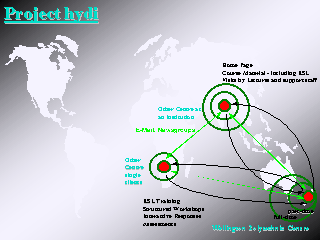
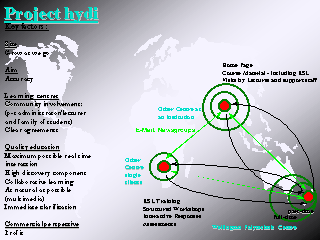
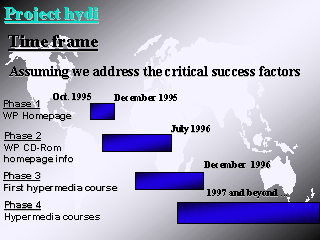


 FOR WELLINGTON POLYTECHNIC HOME PAGE