Uys, P.M. (2000). Towards the Virtual
Class: Key Management Issues in Tertiary Education. Unpublished PhD thesis,
Victoria University of Wellington, New Zealand. Available online: http://www.globe-online.com/philip.uys/phdthesis
CHAPTER 2
LITERATURE
REVIEW
Chapter one
provided an introduction to this research study. In view of the research
problem and the two research questions, Chapter two presents a review of
relevant literature, using the MIT90 schema (see Figure 1.3). This review of the literature focuses on the
following, each of which will be discussed subsequently:
2.1 external technological
environment
2.2 external socio-economic
environment
2.3 management processes
2.4 strategy
2.5 roles and skills of individuals
2.6 structure and
2.7 technology.
2.1 External Technological Environment
This
section accentuates the virtual class
as the most pertinent aspect of the external
technological environment in relation to this research.
Farrell's (1999:2) perception of virtual education
aligns itself to the definition of
The virtual
class can thus be seen as an educational experience of real people in a virtual
dimension. In the virtual class, teaching and learning is performed without the
movement of physical objects (eg getting students and lecturers into a physical
venue). The virtual class is thus primarily based on the movement of bits of
information in contrast to the movement of atoms (Negroponte, 1995) which forms
the central base of conventional education.
The promise of
the global information infrastructure that is coming into place and its
manifestation today in the Internet is that the critical components of
education: teachers, students, knowledge and its applications can come together
not as atoms but as bits of information.
The
specific manifestation of the virtual class referred to in this study is the virtual class predominantly based on Internet or intranet
technologies. The author describes this expression of the virtual class with
the term: networked education.
Networked education emphasises the high level of connectivity across space and
time that is enabled through creating a network between student and student,
student and teacher, student and resources, teacher and resources as well as
the past and the present (through availability of on-line resources of one
course occurrence for a next occurrence).
It also indicates that the education is network-based (Internet or intranet)
and computer mediated, that it includes teaching, learning and research
(“education”), and highlights the distribution
both of the control of learning and of the on-line learning and teaching
materials among the students and teacher(s).
Networked
education has a global dimension to it since the Internet in 1996 (Wizards,
1997) was represented in 129 countries (through domain names) and in July 1999
in 252 countries (Internet Software Consortium, 1999b). The Internet
representation spans a diversity of nations, philosophies, cultures, stature,
size and development stages of countries and groups as illustrated by the
following list of countries (with their domain names): Ascension Island (.ac), Antarctica (.aq),
Liechtenstein (.li), Viet Nam (.vn), Gabon (.gn), New Zealand (.nz), Cuba (.cu),
Japan (.jp), South Africa (.za), China(.cn), Lao People's Democratic Republic
(.la), Israel (il), Syrian Arab Republic (.sy), Vatican City State (Holy See)
(.va) and Saudi Arabia (.sa). Tapscott (1996:xiii) describes this ability of
students in networked education to access
other students, lecturers and resources globally in paradigmatic terms:
A new medium of human
communications is emerging, one that may prove to surpass all previous
revolutions – the printing press, the telephone, the television – in its impact
on our economic and social life... Interactive multi-media and the so-called
information highway, and its exemplar the Internet, are enabling a new economy
based on the networking of human intelligence... Such a shift in economic and
social relationships has occurred only a handful of times before on this
planet.
Farrell (1999:2) describes the problematic use of the term virtual in a broad context:
The
label virtual is widely and
indiscriminately used around the world…. Furthermore, it is used in some
regions to refer to systems that combine broadcast and interactive
teleconferencing technologies that operate in real time. With such broad use of
the term, you need to know what the information and communication technology
applications are in order to know what virtual education means in any given
context.
Various
terms are used to describe networked education, for example “distributed
learning” (Dede, 1995 July), “tele-learning” (Collis, 1996), "virtual
education" (Farrell, 1999; Butterfield
et al., 1999 July), “networked learning” (Gundry and Metes, 1997)
as well as ones that are "…frequently used interchangeably with other
labels such as open and distance
learning, distributed learning, networked learning, Web-based learning, and
computer learning" (Farrell,
1999:2).
Holmberg (1977:9) formulated an enduring definition of distance education as “… the various forms of study at all levels which are not
under the continuous, immediate supervision of tutors present with their
students in lecture rooms or on the same premises, but which, nevertheless,
benefit from the planning, guidance, and tuition of a tutorial
organisation”. Networked education is
different from distance education in that networked education is solely enabled
through the Internet and intranets, that a telepresence can be created among
teacher and students (Mason, 1999 July) and that it represents a paradigmatic
focus on the educational needs of the information society (Tiffin, 1996b November). This research further deals with conventional tertiary
education that excludes single distance mode or dual mode educational
institutes.
Distance education nevertheless has to contend with
various aspects in networked education. Like networked education, distance
education has to bridge geographical (Garrison, 1989:119) and transactional
distance (Moore, 1993), explore innovative uses of communication systems
(Garrison, 1989:17; Henri and Kaye, 1993), cater for individualised learning (Garrison, 1989:27; Peters,
1993:46), use communications technology (Bates, 1984b; Garrison, 1989:2),
procure sustainable commitment of students to their studies (Garrison,
1989:99), address the needs of adult learners (Garrison, 1989:103) and lifelong
learning (Garrison, 1989:107).
Lewis
(1992:14) defines “open learning” as a conglomeration of educational approaches
that aims to transcend the traditional barriers of conventional tertiary
education, namely physical, educational, individual and financial barriers.
Lewis points out that specific locations and times, sequencing of the content
and method of delivery, lack of awareness of what is available and costs of
course materials are some of the examples of these barriers that open learning
needs to address. Lewis further points to the learner centred nature of open
learning. The virtual class can identify with open learning, as it also has to
address these barriers.
Tiffin and Rajasingham (1995:10) distinguish the
concept of the virtual class from that of the “virtual classroom” originating
with Hiltz (1986), since the former concept “... suggests that the place a
virtual class is held is an electronic simulation of a conventional classroom”, while for Hiltz (1986:95) the latter was the
use of computer mediated communications “...to create electronic analogue of
the communications forms that usually occur in a classroom including discussion
as well as lectures and tests”. A software product, the Virtual Classroom,
based on Hiltz’s (1995, March) work, was in fact created and is described by
her as a teaching and learning environment that is constructed in software to
support collaborative learning among students who participate in a flexible
manner through computer networks.
Chambers
(1998:9) shares the reservations about using the metaphor of a ‘virtual
classroom” when he states that "today we make the same kind of mistake
when we glibly speak of the ‘virtual classroom’. This metaphor conjures images
of students who soon shall congregate in cyberspace to receive their lectures
from the electronic semblance of some sage professor". Chambers then
explains that "the idea of the ‘virtual class’ is misguided because
emerging telecommunications and information technologies promise something far
greater than forming classrooms in cyberspace: the new technologies enable
quality universities to provide one-on-one tuition cost effectively".
The virtual
class can lead to fully virtual institutes as Butterfield et al. (1999, July) could foresee. Although the term 'virtual
institution' is not yet well defined, it is an attempt to capture the sense of
a further dispersion. The word 'open' came to be prefixed to the word
'university' to qualify an institution that in some ways resembled a
'traditional' university but not in other ways; likewise the word 'virtual' in
relation to an institution signals a further difference: the students and staff
are likely to be in distant locations and hence the programmes are provided and
serviced primarily on-line through some form of computer mediated communications.
Furthermore, the staff who develops programmes may not be the ones to support
or assess them. As an institution
without a campus, it may be dubbed 'virtual'. Virtual education is not just
distance education: there are many fundamental differences, including changes
in the role of students, academic staff and support staff.
The
external technological environment needs to be contextualized within an even
wider system, namely that of the emerging information or knowledge society.
Tiffin (1996 February) regards the virtual class as an Information Technology
system for education and training in an information society, one whose function
could be likened to that of the conventional classroom in an industrial
society: as the core communication system for preparing people for the society
in which they live. For
The
information society is, however, not a universal state of societies: "everyone talks about the information
society. Yet there is evidence that global communication has led more to
divergence and division than to unity” (Frederick, 1993:267). This view is
supported by Negroponte (1997, June) who highlighted as a contributing
factor to divergence within the information society the fact that the Internet (on which networked education is based) is
a decentralised phenomenon that encourages diversity
This
information society in which the virtual class and tertiary education operate
at the beginning of the new millennium is exceptionally dynamic and volatile.
This can be attributed largely to the emergence of a global information or
knowledge society, which many view to be
“… as significant as the previous displacement of the agricultural age
by the industrial age” (Tapscott, 1996:43). Drucker (1989) draws an analogy between the introduction of computers in
education and the advent of printing by contending that a revolution of similar
or even greater proportions in education is occurring. Even the
nature of the change process from conventional education to the virtual class
itself is not stable; Morrison (1995) even describes this evolutionary process
dislocations, dilemmas and uncertainties rather than progression from 'what is'
to 'what is needed'.
Ponder and
Holmes (1999) similarly comment on the turbulence of the marketplace and the
adaptive management structures this environment requires of the school system,
which also seems to be highly relevant to conventional tertiary education. They claim that new technologies and
scientific break-throughs will cause a constant reshaping of the 21st-century
marketplace, and the ideal school system will be capable of rapidly reinventing
itself to accommodate this continuously changing world. Therefore educational institutions and
structures will be malleable and constructed in a way that allows them to be
easily and quickly reorganized and rebuilt.
When our Virtual Classes had
communication problems we tended to blame the technology in front of us rather
than looking at the wider system in which it operated. We were trying to
operate as though we were in an information society when in fact we were still
in an industrial society.
The virtual
class needs to further contend with information availability that is
exponentially increasing. There are estimates that “information is doubling every
eighteen months and that by the year 2012 it will be doubling every day. A
significant new insight in human knowledge is made every 60 hours” (Nugent, 1996:264).
The growth
in the Internet on which the virtual class is based is dramatic (see Figure 1.1). There are furthermore
sustained, revolutionary changes in the ICT that underpin the virtual class
(Bates, 1995:45; Szabo et al., 1997).
The computer per se has expanded from
being an information management tool to being a communications instrument (Tapscott,
1996). Some thinkers say that in a decade from now the technologies used in the
virtual class will be superseded – already there are pointers to a hyper class
being constructed in hyper reality (Tiffin, 1997 April).
The external technological environment can therefore
be seen as one that is becoming increasingly digitised, volatile, transitory
and divergent. It demands an appropriate response from conventional tertiary
education in terms of its processes and the way in which it is managed. However,
the information society is not yet fully established, and hence the virtual
class - also in its management - needs
to contend with a high level of immaturity, instability and change in many of
its underlying systems.
After an
examination of literature on the external technological environment and
specifically the virtual class, which is referred to as a new educational
paradigm (Tiffin, 1996b November), the focus now turns to the conventional
educational paradigm as the core of the relevant external socio-economic environment.
2.2 External Socio-economic Environment
The
socio-economic environment in which this research occurred is that of
conventional tertiary education in general and New
Conventional
tertiary education in this study describes post-compulsory public educational
institutes that are funded predominantly through the state to which it also has
a central reporting responsibility. These institutions normally adhere to
public sector financial accountability processes and are controlled by their
own council. “Tertiary education is generally understood to mean a level of
studies beyond secondary schooling that is broader than higher education
traditionally associated with the universities” (Ministry of Education, 1997 June). Rebore's (1985:36) description
of secondary schools in the United States as “service rendering public sector
organizations” aptly describes conventional tertiary educational institutes.
Conventional
tertiary educational institutes normally have clearly defined administrative
and academic components that are subdivided into units often called
departments. Conventional tertiary education, for the purposes of this
research, does not differentiate between students on a cultural or racial base
and furthermore has its main focus on face-to-face education where learning and
teaching occur physically “on-campus”. This study therefore excludes autonomous
(or single distance mode) and mixed (or dual mode) institutes as described by
Garrison (1989:115):
Autonomous institutions are
those totally committed to distance education while mixed institutions are
those distance education deliverers found within conventional tertiary
education institutions”.
Conventional
tertiary education is still a description of the predominant way of tertiary
education internationally (Garrison, 1989:121) – and certainly in
Universities
have a long and established tradition. Johnston and Challis (1994:72), after
having studied the changes in the working lives of a few academics who moved
from teaching a Master's degree course in a traditional face-to-face tutorial
format to one in which they also taught the same program in a distance mode,
commented on the concern that the changing patterns of teacher workload and
student participation associated with distance education “...might undermine
the whole tradition of a university as a group of scholars discovering
knowledge by a process of discussion and interaction”.
Van der
Molen (1996) also points to the long tradition of universities when describing
a concern of the liaison committee of the Rectors Conferences of the European
Community (EC) and the Standing Conference of Rectors, Presidents and
Vice-Chancellors of the European Universities (CRE) on the memorandum on Higher
Education in the European Community, in which they identify “values which over the centuries have been
associated with universities, such as independent judgment, creativity,
cultural and ethical dimensions”.
Moreover,
Laurillard (1993:4) identifies the pursuit of scholarship and research, the
advancement of learning, and academic freedom that is the freedom to conduct a
radical critique of knowledge, as being shared by academics across the world.
Collis (1998) identifies four values shared by universities:
1. Values related to academic
moulding (or developing of intellectual expertise)
2. Values relating to good
teaching
3. Values related to the
interaction of local and global perspectives and
4. Values related to the
university being a focal point of knowledge and expertise.
The
similarity among tertiary education institutes internationally allows
researchers like Rajasingham (1988:5) to write about a global problem in
conventional education:
“
Universities have changed very little and seem to be
resistant to change. Patterson (1997:7) studied the university’s evolutionary
dimensions and suggests that
The historic continuity of the institution is unbroken, and many of the medieval
university’s unique features remain characteristic of today’s universities:
features, for example, such as the university’s status as an autonomous
corporate body; its legal identity; recognition by others leading to the award
of recognised degrees or diplomas; the degree structure and levels, e.g.
bachelors leading to masters, and doctorates; testing by examination; and
structures of governance, such as the division of major branches of learning
into faculties, and the hierarchical positions such as deans, chancellor and
rector.
Trow (1996)
also provides a picture associated with typical university life: Remarkably
conservative and enduring institutions, in some important respects very much
like their medieval ancestors, where learned seniors spend their time reading
books and talking to young men (and now young women), lecturing to them in
large halls and talking more informally with them in small seminar rooms close
to collections of books. The teachers - masters and doctors today as in the thirteenth
century - are organised in groups of specialists around bodies of knowledge or
professional practice, in what in many places are still called ‘faculties’;
departments came later.... Universities are still largely governed by the guild
of teachers - the masters or professors
- with a rector (or chancellor, vice-chancellor or president) presiding over
the institution and managing its relations with its environment and its sources
of support.
There are, however,
also commentators pointing to diversity among modern universities such as Cass
(1996:10) who believes in the context of postmodernity that at least in
Australia "no single idea of the university is possible any longer” and
that we need “… plural ways of thinking about them.” Weber (1996:46) refers to “… how diverse
universities in different countries can be...” based on his experience of
having taught at universities in different countries.
These
comments are seemingly not representative of the predominant view that
institutes in tertiary education are very similar in their governance,
structure, mission and finance. Chambers (1998) points to contemporary
universities as institutions that still bear a close resemblance to their
antecedents of centuries past where classroom lectures have reigned supreme,
while Trow (1996) comments on how American higher education is still remarkably
"similar in basic structure, diversity, mission, governance and finance to
the system at the turn of the century.”
The
investigation now turns to tertiary education in New Zealand, which is defined
by the Ministry of Education (1994b) as consisting of universities,
polytechnics, colleges of education, and wananga (focusing on Maori tradition
according to Maori custom) which serve both the school leavers and those
already in the work force.
According
to the Ministry of Education (1994c), polytechnics (45%) and universities (49%)
had comparable shares in 1993 of the tertiary sector in
A guide by
the Ministry of Education (1997, June) provides a concise overview of tertiary
education in
Arrangements for the
establishment, governance and funding of tertiary institutions are set out in
legislation, and are identical for universities, polytechnics, colleges of
education, and wananga. The distinguishing characteristics of the four kinds of
tertiary institutions are also defined in legislation.
Currently there are seven
universities, 25 polytechnics, four colleges of education, and three wananga,
which between them enrol over 200,000 students each year.
Tertiary institutions are
Crown entities and are required to follow standard public sector financial
accountability processes.
Each tertiary institution is
controlled by its own council, established under legislation intended to
maximise its autonomy consistent with the standard requirements of
accountability for public funding.
Each tertiary institution
determines its own programmes. All matters relating to governance and
management are the responsibility of the council, which represents the
interests of staff, students, and the wider community.
Universities are primarily
concerned with advanced learning, the principle aim being to develop
intellectual independence; their research and teaching are closely
interdependent; they meet international standards of research and teaching;
they are a repository of knowledge and expertise; they have a role as critic
and conscience of society.
There are seven universities
in
Currently over 80,000
full-time equivalent students enrol each year for university study.
Polytechnics provide a wide
range of academic, vocational and professional courses, including vocational
training, which contributes to the maintenance, advancement, and dissemination
of knowledge and expertise and promotes community learning. They also promote
research - particularly applied and technological research - which aids
development.
There are 25 polytechnics in
Currently almost 60,000
full-time equivalent students enrol each year for polytechnic study. Taking
short courses into account, the actual number of students enrolled at
polytechnics is several times this figure.
While most polytechnics
continue to provide traditional trade and basic vocational courses, an
increasing number of professional courses offered at degree level are reducing
the distinction between the respective roles of polytechnics and universities.
Colleges of education
provide teacher education and research related to the early childhood and
compulsory sectors of education and provide associated social and educational
service roles.
There are now four
specialist colleges of education offering courses in early childhood, primary,
and secondary teacher training, situated in
Wananga are teaching and
research institutions that maintain, advance, and disseminate knowledge,
develop intellectual independence, and assist the application of knowledge
regarding ahuatanga Maori (Maori tradition) according to tikanga Maori (Maori
custom).
Three wananga are
established tertiary institutions.
All tertiary institutions
(universities, polytechnics, colleges of education, wananga) are governed by
their own councils.
The main functions of a
council are to set the strategic direction and policies of the tertiary
institution, determine its programmes, set its budget including tuition fees,
and appoint its chief executive officer.
The main functions of a
chief executive officer (who may be alternatively designated a vice chancellor,
director, principal, or president) are to implement council policies and
decisions and to manage the academic and administrative affairs, including the
employment of teaching and support staff.
University degrees are
approved by the New Zealand Vice Chancellors' Committee, and have international
recognition.
Degrees awarded by
polytechnics, colleges of education, wananga and private training
establishments are approved by the New Zealand Qualifications Authority, and
have international recognition.
Not
included in this study on account of the definition of conventional tertiary
education are the wananga institutes in
Conventional
tertiary education in
Most of the
39 tertiary institutes in
The
Wellington Polytechnic itself is a representative conventional tertiary
educational institute in
The Wellington Polytechnic is one of 25 Polytechnics
in
Wellington
Polytechnic strongly focuses on face-to-face education where learning and
teaching happens physically “on-campus”. Only a few courses in the field of
education are being offered at a distance. Its main focus is on
The implementation of the
virtual class in Wellington Polytechnic started in July 1995. This occurred
mainly through the activities of the HYDI Educational New Media Centre (Wellington Polytechnic, 1998 June) that developed the On-line
Campus of Wellington Polytechnic and also networked courses.
The
Ministry of Education (1994a) in
The rapid pace of
technological change, and the explosive growth in communications we have seen
over the last ten years, will accelerate as we enter the new century.
In New
Zealand the importance of the tertiary educational system in preparing school
leavers for the emerging information society is recognised and described
in “A Guide to tertiary education in New
Zealand” published by the Ministry of Education (1997, June):
To prosper,
The goal of preparing school
leavers for this new environment is a challenge for the tertiary education
system.
Successful conventional tertiary education institutes of
the future therefore will need to operate with new levels of flexibility. Beare and
Slaughter (1993:35) indeed believe that in the context of Australian schooling
organisations in the post-industrial economy need to be “… flexible, which can
make quick, strategic decisions, which encourage innovation and
entrepreneurship…” Esquer and
Sheremetov (1999, July:1607) point to an emerging consensus that successful universities of the
future will be those that operate with high flexibility:
The educational institutions seek to obtain strategic advantages by
redesigning the way they educate to reflect the rapidly changing state of the
art in the education domains and tutoring methods and techniques as well. The
emerging consensus is that successful Universities of the next millennium will
be those that embrace continuous change as an education paradigm. Such
Universities will be able both to adapt to changes in the social market for
their students and to lead this market in directions optimal to the society’s
goals by continually adapting their education plans, methods and strategies of
teaching, and educational infrastructures to changes in the environment.
Conventional
tertiary education therefore needs to have more open boundaries with boundary
management becoming more relevant as “… the external environment has impinged
more directly on university operations...” (Middlehurst, 1993:56).
Conventional
tertiary education in general and in
The
relationship between the virtual class and conventional tertiary education
therefore seems a complex and unlikely one. This is especially true when the
management processes within conventional tertiary education are examined.
2.3 Management
Processes
Conventional
management can be described as the process of planning and decision making,
organising, leading and control of an organisation’s human, financial and
information resources to achieve the objectives of an organisation in an
effective and efficient manner (
Many
writers like Boone and Kurtz (1984), Newman, Warren and McGill (1987),
Schultheis and Sumner (1989) and Van Dyk, Palmer, Smit, Vrba and De Klerk
(1991) divide the management process into four functions namely planning (decide what must be done),
organising (decide how it must be done), leading (ensuring that it is done) and
control (determine whether instructions have been followed). Other writers
identify additional functions of management for example staffing and
communication (Koontz and Weirich, 1990). Van Dyk et al. (1991) state that the following dimensions of management are
also included in, and are present in all management functions: communication,
decision-making, coordination and negotiation. Mintzberg (1973) postulates that
a manager has interpersonal, informational and decisional roles. Mintzberg
includes the leadership function in the interpersonal roles while the
organising, planning and control functions feature in the decisional and
interpersonal roles.
There has
been a clear and consistent call from prominent writers on management and
organizational design like Drucker (1985, 1989, 1995), Senge (1990), Peters
(1988), Marquard (1996), Tapscott (1996), Limerick and Cunnington (1993) to heed the
necessity to practice these functions and dimensions of management in an
entirely new way in the context of the emerging global information or knowledge
society.
2.3.1 Conventional educational management
Management in education is often equated to “administration”
(Rebore, 1985:39). However,
“management” in this research does not refer only to administration within
tertiary education. To limit the notion of management to administrative practices only and thus exclude the academic area
would be to argue that planning and decision making, organising, leading and
control do not occur in the area of teaching, but only in administration.
Using a
fractal view to analyse management in tertiary education is particularly apt
since academic staff members typically perform their duties like operational
managers instead of operational workers. Academics often operate fairly
autonomously without direct instructions due to their status as being
professionals, the one-to-many relationship between teacher and students and
the principles of academic freedom (Paul, 1990:32).
Management
and its related governance and organisational structures in conventional
tertiary education have remained fairly static and centralised. Patterson (1997:7) studied the university’s
evolutionary dimensions and points out that
The historic continuity of the institution is unbroken, and many of the
medieval university’s unique features remain characteristic of today’s
universities: features, for example, such as … structures of governance, such
as the division of major branches of learning into faculties, and the
hierarchical positions such as deans, chancellor and rector.
Trow (1996)
also highlights the rather stagnant management approaches within conventional
tertiary education.
Universities
are often highly bureaucratic. Garrison (1989:38) points to higher education
when contending that as “…formal education grew in size and complexity,
bureaucracies became the controlling mechanism”, while Paul
(1990:31) shares this view that “…universities exhibit many of the
characteristics of bureaucratic organizations” . A statement by Rebore (1985:33) reflects this
preference also in secondary schooling in the
Line administrators have supervisory responsibilities that emanate from
the superintendent down through the pyramid to the building level. While many
different models have been used, this is the most successful and effective in
school districts.
A
description of school organisation in
… draws upon the factory
model of organisation… Schools abound with the characteristics of bureaucracy,
like hierarchy and positional status; they encourage upward mobility and
promotion through graded ranks; they teem with rules and regulations, with
specialists and division of functions.
In the British universities during the 1990s “…
there has been a steady increase in bureaucracy and a steady decrease in the
amount of time available for core academic activities particularly at senior
levels” (Middlehurst, 1993:189). This is a common complaint from academics
heard in the hallways at national and international conferences.
This
description of management in conventional tertiary education aligns itself
clearly to what Burns and Stalker (1961) call a mechanistic control process in contrast to an organic control process. The mechanistic management structure links
to a stable external environment. According to Daft (1989:61) this structure
has the following characteristics:
(i)
Tasks are broken down in specialized, separate parts.
(ii)
Tasks are rigidly defined.
(iii)
There is a strict hierarchy of authority and control, and
there are many rules.
(iv)
Knowledge and control of tasks are centralized at the top
of the organization.
(v)
Communication is vertical.
In contrast
to the institutional management structures, the teaching and research functions
of academic staff as professionals are typically more client oriented, less
formal and less concerned with hierarchy (Paul, 1990). While institutional
conventional educational management operates on a largely bureaucratic model,
academic staff operate on a “collegial model” (Paul, 1990:32). This collegial
model is under attack as tertiary educational institutes compete with each
other and with private enterprise, and also because of the bureaucratic
environment in which it operates (Paul, 1990).
Another
model operating in universities is the political model which recognises the
“…predominance of power groups’ (Paul, 1990:35), but does not explain the
workings of the university in terms of its governance or collegial aspects.
The
anarchic model (Cohen and March, 1974) depicts the modern university as an
organised anarchy that, according to Paul (1990:37) illustrates such
ambiguities and uncertainties that it renders the traditional forms of
management meaningless or inept. Cohen and March (1974:83) assert that:
Although a college or
university operates within the metaphor of the political system or a
hierarchical bureaucracy, the actual operation of either is considerably
attenuated by the ambiguity of college goals, by the lack of clarity in
educational technology and by the transient character of many participants”.
The
anarchic model has not been without critique (Paul, 1990), and does focus more
on self-management of academic staff
than on the institute as a whole. Cohen and March (1974), in suggesting how to
deal with running an “organised anarchy”, highlight the importance of framing
university operations in academic terms when they satirically propose that
experience needs to be treated as theory, goals as hypotheses, intuition as
real, hypocrisy as transition and memory as an enemy.
It seems,
however, that the bureaucratic elements of conventional tertiary education are
pre-eminent and in constant conflict with the self-management ideals and processes
of academic staff.
Conventional
tertiary education has changed sporadically as it responded to shifts and
movements in society. It again faces the challenge to respond to the
educational needs of the knowledge society - also through entrepreneurship.
Drucker (1985:21) maintains that the “... creation and development of the
modern university” is a case study in entrepreneurship. It was a response to “…
a major shift in the market…” and “… represent entrepreneurship.”
The generic
conventional management paradigm in tertiary education acknowledges the
contrasting ideals of academic self-management and that there are exceptions to
rules.
The
conventional educational management paradigm can thus be described as being largely mechanistic, formal, centralised,
focussing predominantly on the local environment, insular, inflexible, rigid, bureaucratised, with strong
institutional control and segmented, with a
high degree of division of labour, variable participation, and often
politicised.
At the same time there is a need for transformation in
response to the educational needs of the emerging knowledge society and to
alter its management process to effect this transformation. There is little clarity in conventional
tertiary education on how to manage the virtual class as an integrated system.
2.3.2 New forms of educational management
Literature
on tertiary distance education, newer forms of tertiary education and private
enterprise is reviewed to analyse responses in educational management to the
educational requirements of the information or knowledge society.
Tertiary distance education
Management
of distance education institutes may provide pointers to approaches in managing
the operations of the virtual class. Rumble (1992:95) refers to the operations
of distance education as a “highly distributed system” which “looks very
different to the residential or non-residential campus-based university”. Networked education is based on distributed
networks and the management of networked education might therefore correlate
with the distributed nature of the operations of distance education.
The
effective and widespread use of networked education in conventional tertiary
education might facilitate a multiple-mode approach due to its differences with
distance education (as pointed out in 2.1 above). Garrison (1989) restricts
organisational models in distance education to two models. Autonomous (or
single distance mode) institutes are those totally committed to distance
education while mixed (or dual mode) institutes offer distance education as an
integral and important part of their teaching.
There is a
growing awareness in distance education that on-campus and off-campus education
is converging. Bates (1984a) points to a
possible convergence of on-campus and off-campus education through computer
mediated education. Garrison (1989:117) notes that this convergence is “…blurring the boundaries between
conventional and distance education”. Bates (1984a) also suggests that many
dual mode institutes will emerge as conventional education move into distance
education.
The use of ICT in distance education is growing. With reference to the
increasing and widespread use of ICT in tertiary education, and particularly in
distance education Bates (1993b:189) postulated that using ICT, “…‘meetings’ could be held without any staff
having to travel from their desks” (-
foreshadowing the operation of virtual teams in tertiary education.
An
organisational model that moves away from centralised control is possible through
the use of ICT. Bates (1984a) described the organisational model of traditional
distance institutes as being centralised but asserted that these new
technologies offer the possibility of an alternative model to the large,
centralised and specialised distance education system. Garrison (1989:38), in
view of the new technologies and the coming of the information age, postulated
that education “…is experiencing a shift from formal, centralised, and
segmented operations to increasingly complex, decentralised, and integrated
levels of organisation”. He furthermore foresees the potential of computer
based distance education to “…both decentralise education and individualise or
personalise it at the same time” (Garrison,1989:88). Peters (1993:53) contends that in the post-industrial society there will
be in distance teaching institutions a “departure from a highly centralized
organization of the teaching-learning process and a move to small decentralized
units which can be made transparent by the means of new technology”.
Distance education also links to the globalisation possibilities in
education. “Globalization is a feature
of later modernity which has been embraced by distance education, especially as
educational institution and their political bosses and business allies in
developed nations seek to extend their influence and sources of revenue into
developing nations” (Evans and Nation, 1993:213).
Newer forms of tertiary education
The
management of open learning provides pointers to possible management approaches
for the virtual class. By using open universities as case studies, Paul (1990)
provides an integrated proposal for the management of open learning. Paul
(1990:22, 66-68) asserts that it applies in a more generic sense to “knowledge
institutions in a knowledge society” and
suggests that a value-driven leadership approach can address the
different models of educational management discussed above and that in this
approach, leadership is committed to ensure that people find meaning in life
through their work by creating things of value. Paul (1990:22,72) further
argues that an institution dedicated to
the values and practice of open learning needs to have an “open management
style” and that “those responsible for the leadership and management of these
institutions must emulate the principles they espouse in the performance of
their day-to-day activities”. This relates to the hypothesis of this research (see Chapter 1) - and is based on systems
theory - that a new type of management for the operations of the virtual class
is needed due to the radical differences between the virtual and the
conventional class. However, Paul is concerned with “open universities” while
this research looks at tertiary education and specifically at the interplay
between the virtual class and conventional tertiary education.
Paul (1990:66) asserts in the context of employing what he
terms “open management” that a value-driven leadership approach is required to
address the different models of educational management. Paul (1990:71)
highlights the distributed nature of open management when he describes its
operations:
Under such an
approach, the top management team of an institution or business, defines and
articulates a clear set of guiding principles which form the basis for decision
making. However much is subsequently delegated and however decentralized the
distribution of power and authority, it is always the chief executive officer’s
primary responsibility to ensure that these central values drive all decision
making in the organization… a fundamental set of mutually consistent values
which drive all decision making in the institution… The real skill of
management is knowing when - and when not to intervene .
The
distributed nature of open management as energised by value-driven leadership,
has positive pointers to the management required for the operations of
networked education which are based on distributed computer networks and
facilitates distribution of control throughout an institute.
Networking
and collaboration are important aspects of tertiary education. Morrison
(1995:199) asserts that there is a “…need to interact on learning highways
across borders….all nations, in future, will have to design their educational
systems in such a way that they not only have internal coherence but also have
an open architecture - that they can network with other educational and
learning systems”. This also correlates to
one of Fullan’s (1991:349) six themes of educational change namely
"from going it alone to alliances”. He believes that “… some of the most
powerful strategies involve inter-institutional partnerships - between school
districts and universities, businesses and districts, coalition of schools…”. Many universities and colleges are indeed
positioning themselves for effective participation in distance and particularly
networked education through collaborations at the institutional level. Universitas 21 (1999) for instance
comprises 21 universities in Europe, Australasia and north America and includes
Auckland University in New Zealand and plans to develop and use multimedia
technology in education. Another example is the European Consortium of
Innovative Universities (ECIU, 1999)
which is a co-operation of 10 European universities with a focus on the
development of new forms of teaching, education and research. Other examples
are National Universities Degree Consortium (NUDC, 1999), comprising 9
Universities each of which “…was established in response to widespread requests
from potential, non-traditional age students for high quality, integrated,
external degree programs that are delivered in flexible, off-campus formats,
readily available to adults and part-time students” and the Corporation for
Education Network Initiatives in California (CENIC, 1999) which “…will represent
the common interests of California's higher education academic and research
communities in achieving robust, high capacity, next generation Internet
communications services”. ADEC Distance Education Consortium (ADEC, 1999) is an
international consortium of some 59 state universities and land grant
institutions “…providing high quality and economic distance education programs
and services via the latest and most appropriate information technologies”. In
The
collaboration is however wider than just among educational institutes. It could
include private enterprise, entertainment and others. There is “… an increasing
convergence between institutions that have previously remained separate. The
change will not just be technological but organizational, economic and
cultural” (Evans and Nation, 1993:19).
This
networking needs to find expression within a well-designed organisational structure.
Bates (2000) describes an extensive and workable model as a practical
organisational structure to marry centralised and decentralised management.
This model includes a fairly large professional center while each faculty (or
school) or large department will have a small flexible unit of technical
support and generalist educational technology support. The center will operate
on a project management model with many of its staff seconded to work in the
faculties on a continuing basis while the units will provide immediate support
and find appropriate support from the center for bigger projects.
There is a
need for flexibility in technologically based course production. One of the
critical success factors proposed by Daniel
(1998:155) in implementing a technology strategy is that the “…course production-presentation process that
is responsive to curriculum development pressures, and flexible in its
team-building, project management and creative collaboration processes”.
Distance
and networked education provides a mechanism for global education.
ICT has
become an agent in education of the convergence of what has been traditionally
been called on-campus or distance education. ICT therefore creates the
possibility for conventional tertiary education to realise the benefits of
dual-mode institutions. Evans and Nation
(1993:211)) refers to “mixed-mode” or “dual-mode institutions” and the
advantages in “… flexibility of their teaching strategies and the wider range
of courses they can offer”. Lundin
(1993:12) describes this convergence as follows:
It is
now becoming common for the whole field of ODE [open distance education] and
CIT [Communication and Information technologies] to be discussed in terms of
'flexible distributed learning'. That is, the external-internal,
on-campus-off-campus and other categorisation of learners based on modes of
delivery are being abandoned because they no longer represent what is being
practised. All forms of delivery, including face-to-face, are now recognised as
valid options to meet identified needs of learners.
It is
envisaged that the management of education, being based on ICT, would have to contest
with an openness of huge proportions. Garrison (1989:121) theorises that “the
momentum towards greater openness in education and learning will grow as new
communications technology are developed and adopted”. This openness can also
apply to collaborations with other institutes as Forsythe (1984:60) contends:
“….the use of such communication systems is seen as part of a large learning
system that may well be a network of institutions”.
This
openness is also applicable to networking among students, which Hodgson, Mann and Snell
(1987:165) refer to in the context of open learning as “expert networking”.
They perceive the use of “…new technology as a vehicle for the sharing of
discoveries, developments and reference materials among an expert network of peer
specialists”.
It is
however a challenge to create a congruity between centralised and decentralised
management aspirations in tertiary education. Bates (2000:181) acknowledges
this complexity:
When it comes to
organizational structures, the challenge is to develop a system that encourages
teaching units to be innovative and able to respond quickly to changes in
subject matter, student needs, and technology. At the same time, redundancy and
conflicting standards and policies across the institution must be avoided.
Information
is becoming a major building block in distance education. Garrison (1989:39)
also points to the information base of education that matches the needs of the
information age when indicating that these institutes would exercise control through information and communication and
not through bureaucracy.
Students in
the newer forms of tertiary education can be more in control of their learning.
Mason (1998:157) indicates that the new technologies in global education give
prominence to students who construct their own knowledge. Students through
networked education further is “...no longer confined to our campus and its
teachers and students and activities” (
Private enterprise
Private
enterprise is concerned with, and heavily involved in education (Drucker, 1989:243). Corporate universities are
emerging and business and industry in the
Underlying
values in education however might come under threat as private enterprise
become increasingly active in education. Tapscott (1996:36) frames this issue
as a rhetorical question: "as educational activity shifts from schools to
firms, will businesses continue to emphasize social responsibility, humanism,
liberal arts, and political and moral values, or will they shift values to
competitiveness, profit, and materialistic goals?”.
There is a call to more decentralization and less bureaucratic
management approaches. Drucker
(1998:117) asserts that the “…need to organize for change also requires a high
degree of decentralization” in the structure of the “new society of
organizations”. Beare and Slaughter (1993:35) contend that “… a business
which operates on bureaucratic lines cannot compete in a post-industrial
economy…" This clearly calls for a move away from bureaucracy and hierarchical
management in conventional tertiary education.
This decentralization, however, needs to lead to an integrated system.
Porter contends that "competitive industries are clustered … are linked as
customers and suppliers, through people, research institutions, university
programmes and related diversification. This is typical. It is how a
competitive industry is created and sustained” (Caulkin, 1990:53).
Networking has been identified as a new way of
management. Two of the ten major transformations (or megatrends) in
society, which Naisbitt
(1982) identified are a transformation from centralisation to decentralisation
(in effect distribution), and secondly from hierarchies to networking. This
distributed nature of management is supported by
There
is an emerging form of organisational design called a “network structure” in
which a small central organisation links through relationships with other
organisations to perform its essential functions, called “outsourcing” (Robbins and Barnwell, 1998). Drucker (1995:68)
identifies outsourcing as a central example of managing in what he calls the
“networked society” and also (1995) postulates that “…in another ten to fifteen
years, organizations may have outsourced all work that is ‘support’ rather than
‘revenue producing’ ”.
Tertiary education might follow suit in exploiting the distributed nature of
computer networks to outsource some or part of its essential functions like
teaching, learner control, research and administration.
This networked approach also has an internal dimension
to integrate and connect an organisation's functions and activities. The
integrative approach is one that Michael
Porter (Pastore, 1995, October 1:10) regards as critical to competitive advantage in organisations:
Companies
with sustainable competitive advantage integrate lots of activities within the
business: their marketing, service, designs, customer support. All those things
are consistent, interconnected and mutually reinforcing. As a result,
competitors don’t have to match just one thing, they have to match the whole
system. And until rivals achieve the whole system, they don’t get very many of
the benefits.
Management in the information or knowledge society has a strong global
disposition because of its information-base (Drucker, 1989). Globalisation is seen as a
generic feature of later modernity (Evans and Nation, 1993) which is occurring
in areas like the economy (Holland, 1987; Tapscott, 1999)
and communications (
Managing in a global environment calls for knowledge of differences
between cultures and sensitivities for these differences. Woodhouse (1999)
points out that education is definitely not culturally neutral. Management is
embedded within the (internal) culture of an organisation. Drucker (1998:172) states that management is “… deeply
embedded in culture...” because it deals with “... the integration of people in
a common venture…” Gundry and Metes (1997)
postulate that:
Online
communication can unite the organization, but it can also highlight fundamental
cultural differences. Suddenly, people used to working with their countryfolk
can find themselves working closely, online, with people from different
national cultures. These are often cultures in which taken-for-granted
perceptions of communication, time, power and information are quite
different…Training in cross-cultural working is now a necessity, not an option…
Understanding each other's world view, biases, and preferences will be
essential to building trust and shared perceptions, and maintaining the
communication that drives the work.
A new
requirement for management in the information or knowledge society is managing
the dynamics of communication in a virtual
environment (Gundry and Metes, 1997). Tapscott (1996:55) highlights networking
and collaboration as a modern management issue and points to the application in
education:
Networks of networks along the Internet model
are beginning to break down walls among companies – suppliers, customers,
affinity groups, and competitors. We will see the rise of internetworked
business, internetworked government, internetworked learning, and
internetworked health care, to name a few.
Boundary management is becoming more important in newer private
enterprises. Peters (1988a) highlight the importance of boundary management in
the organisation of the future in which the boundaries are described as wavy,
thin and transparent. Boundary management deals with the “… nature of
boundaries between systems and sub-systems, and the levels of dependency and
integration of their transactions and interactions” (Middlehurst, 1993:56). Tapscott (1996:55) contends that the “… boundaries
inside and outside are permeable and fluid” when describing the “Internetworked
enterprise”. Daft (1989571) comments that these “… characteristics induce
regular movement and communication across the boundary in both directions. The
new organization engages customers and suppliers in the production process,
thereby encouraging them to communicate inward. The organization engages in a
partnership with outsiders”. Marquardt (1996:83) describes the learning
organisation as being “boundaryless”, while Limerick and Cunningham
(1993:89) indicate that to “develop your
boundary roles” is an “essential element of effective network management”.
Immediacy
and adaptability are themes of the new economy. Tapscott (1996:63) refers to
these as follows: "the new enterprise is a real time enterprise, which is continuously and immediately
adjusting to changing business conditions through information immediacy”. This
is also the case in networked education as Web based materials (be it on the
Internet or intranet) can be updated continually and immediately. The immediacy
within enterprises facilitates just-in-time (JIT) shipping and manufacturing
(Tapscott, 1996) and might lead to similar approaches in learning, teaching and
administration.
In the
increasingly digitised environment, there is less control and more risk-taking.
Tapscott (1996:v) holds that "far more than the old western frontier, the
digital frontier is a place of recklessness, confusion, uncertainty, calamity
and danger.”
Burns
and Stalker (1961) indicate that an organic
control process, in contrast to a mechanistic
control process, is appropriate in an unstable external environment. According
to Daft (1989:61) this structure, which is appropriate for the modern
organisation operating in a turbulent environment, has the following
characteristics:
1. Employees
contribute to the common tasks of the department.
2. Tasks are
adjusted and redefined through employee interactions.
3. There is less
hierarchy of authority and control, and there are few rules.
4. Knowledge and
control of tasks are located anywhere in the organization.
5. Communication
is horizontal.
In learning
organisations the management needs to be highly adaptive. Marquardt (1996:1) indicates that learning
organisations “enjoy greater knowledge, flexibility, speed, power, and learning
ability to better confront the shifting needs of a new environment, more
demanding customers, and smarter knowledge workers. This new species of
organization will be the learning
organization and will possess the capability to anticipate and adapt more
readily to environmental impacts…”. Marquardt (1996:xv) further contends that
in this “…faster, information-thick atmosphere of the new millennium… ‘old’
companies [cannot] compete with more agile and creative learning
organizations”. A learning organisation has a streamlined, flat hierarchy and
is seamless and boundaryless (Marquard, 1996:83ff). It is further built on networking and
“…realize[s] the need to collaborate, share, and synergize with resources both
inside and outside the company… they provide a company with a form and style
that is fluid, flexible, and adaptable”.
Learning organizations will:
enjoy
greater knowledge, flexibility, speed, power, and learning ability to better
confront the shifting needs of a new environment, more demanding customers, and
smarter knowledge workers. This new species of organization will be the learning organization and will possess
the capability to:
-
anticipate and adapt more readily to
environmental impacts
-
accelerate the development of new products,
processes, and services
-
become more proficient at learning from
competitors and collaborators
-
expedite the transfer of knowledge from one part
of the organization to another
-
learn more effectively from its mistakes
-
make greater organizational use of employees at
all levels of the organisation
-
shorten the time required to implement strategic
changes
-
stimulate continuous improvement in all areas of
the organization. (Marquardt, 1996:1).
Information
plays a central role in virtual operations. Rayport and Sviokla (1995:75) write
about the "marketspace", that is a virtual market place. They
characterise it as being “virtual” because the value adding processes “...are
performed through and with information”. Drucker (1998:101) conceptualises an information-based organisation
where every participant needs to take “information responsibility” –
responsibility both to others and to oneself. Drucker describes the shift from
the command-and-control organisation to the information-based organisation as
the third major evolution in the concept and structure of organisations since
modern business enterprise first arose. Marquardt
(1996:6) states that “information is created continuously in every corner of
the globe, and doubles every three to four years”. Managing
real information overload in the global information explosion has become
essential to function without increased stress
levels induced by the overload of valid, current and relevant information.
Gundry and Metes (1997) points out that information overload, a primary cause
of stress in online workers, is fuelled by electronic communication; therefore
communication protocols, along with filtering devices, are required. Victor (1999, July) furthermore asserts
that information overload can be addressed through the effective use of
information architecture. If we live in an age of “information overload,
marked by increasingly advanced communication tools, including the Internet and
digital telecommunication technologies, which allow us to transmit more and
more information at faster and faster rates, some counter-measure is
needed. A discipline, known variously as
information design or information architecture and embracing such diverse
fields as business administration, computer science, cognitive psychology,
graphic and typographic design, and technical communication, evolved to meet
the challenge of using information in order to provide meaningful
communication.
In private enterprise
there is also a convergence, which Tapscott (1996:58) notes as one of the
themes of the new economy. He holds that "the dominant sector in the new
economy is the new media, which are products of the convergence of computing,
communications, and content industries”. Tertiary education in this context
represents the “content industry” which converges with ICT to form the virtual
class.
Innovation
requires a market focus. Drucker (1985:127) points to the required market focus
of management when asserting that innovation “…always has to be close to the
market, focused on the market, indeed market-driven”.
The characteristics of the management required in tertiary education to
match the educational needs of the information or knowledge society can be
described as being complex, decentralised or distributed and having a strong
team focus. It need to allow for life-long learning, networking of peers, personalised delivery, the student more in control of their
own learning, the content more effectively sequenced, transcending
specific locations and times, addresses lifelong
learning and the costs of course materials for students.
It need to manage a drastically increase in the use of computers and
virtual communications. It needs to deal with networking and collaboration internally and with other institutes, integrates
all its systems towards a common goal, increased boundary management, and an
integration of on- and off-campus learning. It further needs to address open
boundaries with a global aspect to it, different cultures and increased global
competition. Management strategies could include outsourcing and operating in
dual mode. It needs to be highly dependent on information usage and processing,
has to deal with real information overload, and ensures control through
information and communication.
It further has to address a new immediacy, learns more effectively
from mistakes, competitors and collaborators and is highly adaptive and
flexible in a volatile external environment.
Conventional
management of tertiary education therefore struggles between the desperate need
to reform its management because of the external environment but is often
ineffective to do this because of its current management approaches. It seems
from the above that the inefficiency of the current models of managing
conventional tertiary education calls for a meta-model or a new management
paradigm to transcend the discrepancies between these management models. Open
management seems to indicate the way ahead but focuses on higher education not
tertiary education, and does not deal sufficiently with the virtual class - the
new educational paradigm for the information or knowledge society.
The above
are generic characteristics of the
management required in tertiary education to match the educational needs of the
information or knowledge society. It is however not clear how these
characteristics relate to the nature of management of the virtual class. It
is furthermore a challenge to create a congruity between centralised and decentralised
management aspirations in tertiary education that has not been adequately
addressed.
A new
educational management paradigm is sought for managing the operations of the
virtual class. In the context of an emerging information society, the management
of tertiary education needs to guide the activities and policies of the
institute to a proper response to the needs of the information society. The
literature indicates that a proper response to the educational needs of the
information society requires a transformation in the management of conventional
tertiary education on all its levels. It seems from the literature that a
proper response is limited in conventional tertiary education, more evident in
distance education and open learning, and well articulated in private
enterprise. Private enterprise involvement in education however threatens
traditional values found in conventional tertiary education and therefore
necessitates an aggressively response from conventional tertiary education.
Conventional tertiary education needs to respond with a fitting management
approach to meet the real societal needs of the new millennium.
The
need to find a new, comprehensive educational management paradigm for managing
the operations of the virtual class has been indicated above. Conventional
tertiary education however has to deal with another major problem first, which
is to identify appropriate strategies to implement the virtual class within
seemingly incompatible existing management processes and structures.
2.4 Strategy
Strategies
for educational reform, implementing innovation and managing technological
innovations are reviewed.
Educational
change or educational reform is a suitable departure point in reviewing the
literature on managing technological innovation in tertiary education.
Effective implementation of the virtual class infrastructure, as technological
innovation, in conventional tertiary education induces educational reform.
Tillema (1995) asserts that the move to adopt more flexible modes of delivery
is clearly a move to reform the delivery of tertiary education.
2.4.1 Educational
reform
There is no
neatly formulated theory of generic change (Goodman and Kurke, 1982). Cannon
(1986) further points to the absence of a general theory of educational
development and notes that educational developers therefore draw on theories
from other disciplines to inform their educational practice.
Tertiary
educational institutes in general are very conservative and have been highly
resistant to change and reform over the centuries (Evans and Franz, 1998 April;
Richardson, 1979). Educational institutions in general “…which exist to open
minds and challenge established doctrine, are themselves extremely resistant to
change” (Robbins and Barnwell, 1998). Conventional tertiary education can be
described as largely bureaucratic and “…bureaucracies by definition resist
change…” (Tapscott, 1996:36).
Technological
innovation has often been implemented as an isolated, bottom-up initiative of
academic staff for efficiency purposes. In this scenario the wider systems
within tertiary education are often not considered and neither affected by the
innovation. The management of an institute may thus feel justified in disregarding
the innovation. Systems theory calls for an integrated approach to
technological innovation: "a system is a whole that cannot be taken apart
without loss of its essential characteristics, and hence must be studied as a
whole” (Ackhoff, 1972:40). Michael Porter’s
notion of competitive advantage also supports an integrated, strategic
approach: Companies with sustainable competitive advantage integrate a large
number of activities within the business: their marketing, service, designs,
customer support. All these activities then are consistent, interconnected and
mutually reinforcing (Pastore, 1995, October 1).
Technological
innovations have also experienced difficulty in education because of a problem
that Michael Porter calls “metrics” (Pastore,
1995, October 1). Conventional tertiary education, similar to other sectors of
society, has often responded to new ICT applications on the basis of
efficiencies rather than using more strategic considerations.
Porter (Pastore, 1995, October 1) describes
this problem as follows. The traditional
criteria by which IT applications have been chosen have been ones of
operational effectiveness—How many people can we save? How much faster can we
process the paper?—rather than more strategic measures, such as how much have
quality or service levels gone up. That needs to change.
David
(1994:169) similarly calls for strategic approaches to ICT use in schools of
the United States, which seem apt for what has been occurring in conventional
tertiary education:
The primary reason
technology has failed to live up to its promise is that it has been viewed as
an answer to the wrong question. Decisions about purchases and uses of
technology are typically driven by the question of how to improve the
effectiveness of what schools are already doing-not how to transform what
schools do”.
All changes
in education have not been equally successful. Fullan (1991) refers to first
order (or first level) and second order (or second level) changes to explain
this phenomena. He believes that most changes in education in the twentieth
century have been first order changes, which are aimed at improving efficiency
and effectiveness of current practices. Fullan (1991:29) states that “… second
order reforms largely failed”, which are those changes that aim at
fundamentally changing the ways that organisations are put together.
New
technologies however can be absorbed into an old paradigm without bringing
about any real change. Harris’ (1987:44-45) critical view of the use of educational
technology at the British Open University (UKOU) provides an example:
… since
educational technology became an important part of the process whereby
educational aims and processes became defined in purely operational terms…. The
progressives and the OU – including the progressive educational technologists –
have succeeded in creating only a progressive appearance for what is the old
educational domination.
To ensure
ownership by academic staff as well as sound educational quality in networked education,
it is important that educators and educational principles drive the
implementation of the virtual class
infrastructure (Szabo et al., 1997;
Willmot and McLean, 1994; Caladine,
1993). The structures supporting the virtual class have to ensure an
educational focus and pre-eminence of educational principles rather than
administrative desires or technical possibilities. This also highlights the
importance of following bottom-up and more organic approaches when implementing
the virtual class infrastructure in
conventional tertiary education. Tillema (1995) consider engaging academics in
the reform process as one of the two significant management issues to address
in educational reform in education in general. He asserts that reform has to be
based on the development of 'learning communities'. That means that the actual
process of reform must engage academics in local communities of discourse about
their educational practices.
In educational reform in particular the reward systems need to be tied to
involvement in that which brings reform. To enable the wide implementation of
the virtual class infrastructure in conventional tertiary education, it needs
to be stated as a strategic objective and direction, and then to tie the reward
systems to its implementation (Munitz, 1997). The institute’s reward systems
should encourage academic staff and students to become and remain involved in
networked education if it desires to implement the virtual class infrastructure
widely within the institute. Marquardt (1996:97) contends that “one of the most
powerful management principles in the world is ‘That which get rewarded gets
done’ ” and asserts that
Rewards
should be made for actions that directly or indirectly lead to organizational
learning, such as risk taking, commitment to learning and personal mastery,
teamwork, encouraging new experiences and ideas, being a teacher/trainer, and
passing lessons learned on to team mates and the broader network.
Quality
assurance in networked education is highlighted by Butterfield et al. (1999, July) who believes that as
virtual institutes emerge, the attention to quality assurance (QA) is more necessary,
but may be more difficult. They believe that attention must come from the
institutions themselves as well as from the external quality agencies (EQAs).
Quality assurance also relates to the
complexities of national and international accreditation and certification as
networked education creates more options for students. A solution might be to
use outcome based education which focuses on assessing learning and learners
instead of courses or other instruction units delivered by providers, and which
is based on specific, standardised, and widely accepted competencies (Jones,
1995). Woodhouse (1999) highlights that open and distance learning (ODL)
in general lends itself to transmission of education across national boundaries
which raises questions of the maintenance of quality, and the guarantee that it
is being maintained, internationally. He states that at present, some courses
have to answer to two EQAs (at home and abroad) while others slip between the
cracks and answer to no-one. Woodhouse also points to the difficulties in
determining what constitutes “equivalent quality” since education is not
culturally neutral. New organisations have been created to deal with
accreditation and certification issues across national borders like the Global
Alliance for Transnational Education (GATE, 1999) which is dedicated to
“principled advocacy for transnational educational programs”. GATE states the
need for addressing these issues. The rapid globalization of higher education
arises partly from the global marketplace and new technology. Today's business
draws its professional work force from all over the world. That means that
human resource development divisions of multi-national corporations
increasingly facing the challenge of evaluating courses and degrees from other
countries when identifying personnel. Furthermore, higher education is no
longer provided solely within national borders. Provided by both higher
education and business, transnational education can be found in multiple forms,
provided both electronically and through traditional instruction and training
programs. Issues of quality, purpose and responsibility abound in this new
“borderless educational arena”.
2.4.2 Implementing
innovation
An innovation can be described as “...an idea or
behaviour that is new to the organization adopting it" (Swanson,
1994:1070). In this study the implementation of the virtual class in conventional
tertiary education is regarded as an innovation.
The term innovation in this study uses a widely
accepted definition of innovation, which describes all of the stages from the
technical invention to final commercialisation (Top research managers speak out
on innovation, 1970 November). Fullan (199:37) describes innovation in
education as “multi-dimensional” and identifies three aspects of change, which
he believes “are all necessary because together they represent the means of
achieving a particular educational goal or set of goals”; these are “the
possible use of new or revised materials”, “the possible use of new teaching
approaches” and “the possible alteration
of beliefs”. This research postulates that each of these three aspects is
present in the implementation of the virtual class infrastructure in
conventional tertiary education.
Innovation diffusion theory (Rogers, 1983) provides a
general explanation for the manner in which new entities and ideas like IT and
the virtual class over time, disseminate through social systems, in this case
conventional tertiary education. Rogers reviewed studies of diffusion of
innovations from many technological contexts and forwarded a model for adoption
of innovations describing key roles and behaviours in the adoption. Innovation
diffusion theory is essentially a bottom-up approach based on individual
responses.
A top-down
innovation process is important. Drucker (1985) points to the importance of a
top-down process for a successful innovation aims at leadership. He believes
that if it does not aim at leadership right from the outset, it is unlikely to
be innovative enough, and therefore unlikely to be capable of establishing
itself. This statement is made within the context of the business world, but
with the increasing competitive nature of the educational milieu this advice is
becoming more relevant for conventional tertiary education.
A combination of top-down and bottom-up processes seems possible in the
learning organisation. Marquardt (1996:218) contends in the context of the
learning organisation that “…it is possible for any member to be an
awareness-enhancing agent or an advocate for new competence development. In
this way, both top-down and bottom-up initiatives are made possible”. Gunn
(1998:142) asserts that
An effective technology
strategy works in both directions. From the top down, it is articulated through
institutional objectives, sensitive to existing culture, constraints, strengths
and weaknesses, and presented as a coherent, achievable set of goals with
appropriate incentives and rewards. It must also move from the bottom-up where
knowledge of teaching strategies, learning contexts and disciplinary expertise
can be translated into action plans geared to achievement of institutional
strategic objectives and so creating a sense of ownership at all levels of the
institution..
The point
of implementation of an innovation needs to be defined. According to Rogers
(1983), implementation occurs when the decision-making unit puts the innovation
into use. Roberts (1997:580-1) states that
"innovation is composed of two parts (1) the generation of an idea
or invention, and (2) the conversion of that invention into a business or other
useful application” and provides a
useful formula:
“Innovation = Invention + Exploitation”
The
implementation of the virtual class in this study refers to the process of
introducing the concepts and processes of the virtual class into a conventional
tertiary educational institute in New Zealand to the point where it becomes
operational. Implementation therefore includes both the initial introduction of
the virtual class into a conventional tertiary educational institute, and the
further processes until the virtual class is operational.
The utilisation
or implementation of the virtual class in a conventional tertiary educational
institute might therefore be partial, embryonic or it might be comprehensively
used throughout the organisation. The central criterion of “being implemented”
is whether the virtual class is being
used in a non-experimental manner in a conventional tertiary educational
institute.
The
implementation of networked education being based on ICT can also be described in
the context of information technology (IT) systems implementation. The
traditional or waterfall systems development life cycle (SDLC) includes systems investigation (identify the
parameters of a problem), systems analysis (understanding the problem), systems
design (determine the best solution to the problem), systems implementation
(place the solution into effect or operation) and systems maintenance and
review (evaluate the results of the solution) (Stair, 1992:405). In the
traditional life cycle systems development approach it is emphasised that each
of the six phases that is systems investigation, systems implementation,
systems analysis, systems design, systems implementation (which includes
construction, testing, maintenance, review) occurs consecutively for the whole
system (Stair, 1992:405). Stair (1992:410) describes the factors that are
present when using this approach: a high degree of certainty about input and
outcomes, high user experience, immediate results are not desired, there is a
low degree of risk, a small number of alternatives, and a low degree of
complexity.
Another SDLC model is the spiral or prototyping approach in which each of the six systems development life cycle phases is essentially executed per module / prototype in an experimental and incremental manner. The factors that point towards using the prototyping approach are: a low degree of certainty about input and outcomes, low user experience, immediate results are normally desired, there is a high degree of risk and a large number of alternatives. Burch (1992:15) contends that
Prototyping is best used to
develop systems that are poorly defined. Prototyping is also appropriate for
unique small systems applications, In almost any case the prototypes enhance
visualization and communications. In many instances what the users ask for is
not what they want, and what they want is not really what they need. [The
writer’s experiences also indicate that what the users ask for is not always
what they get!] Prototyping helps solve this double [perhaps triple?] dilemma.
Roger’s diffusion of innovation curve (see Figure 2.1) can be used as a starting point to depict the
implementation of the virtual class in conventional tertiary education.
Initially there is a take-off stage (that is introduction) during which an innovation is introduced in a social
system. An entrepreneurial group called the innovators often then adopts it.
During the next phase of maturation the “early adopters”, who are change agents
or opinion leaders among the social system, will enter the process thereby
legitimising the innovation and opening the potential for adoption to all
members of the system. The final saturation stage in an innovation's adoption
is characterised by widespread adoption. The innovation saturates the social
system and growth tapers off. This process can be plotted as an S-shaped growth
curve.
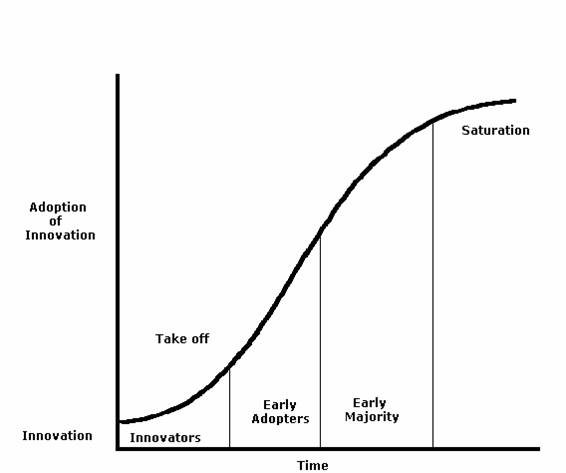
Figure 2.1 The
Innovation Adoption Curve
(Adapted
from Rogers, 1983)
This
research links to Roger’s diffusion of innovation theory in that it views the
virtual class as an integrated technological and educational innovation within
conventional tertiary education.
Goldenfarb
(1995) similarly used Roger’s diffusion of innovation theory at the University
of Melbourne, Australia, where a campus wide information system (CWIS) was
implemented.
Another
change model to provide overall structure for implementing the virtual class
infrastructure in a conventional tertiary educational institute is the Lewin
and Schein’s model for organizational change (Stair, 1992:396). They propose
the following stages:
1. Scouting: Identify potential areas or systems that may need change
2. Entry: Stating the
problems and the goals
3. Diagnosis: Gathering
data and determining resources required
4. Planning: Examining alternatives and making decisions
5. Action: Implementing the decisions: decisions were followed through
in a consistent manner
6. Evaluation: Determining whether the changes satisfied the initial
objectives and solved the problems identified
7. Termination: Transferring the ownership of the new / changed system
to the users and ensuring efficient operation.
Nixon
(1996:13) identified four pre-conditions for successful change in educational
institutes as
(i)
the importance of collegiality and the need for mutually supportive
relationships with colleagues;
(ii)
the importance of having a clear sense of where their institution was
going; a sense of its priorities and
long-term commitments;
(iii)
the need for structures to support their development as teachers and
writers; and
(iv)
the need to resolve tensions between their teaching responsibilities
and research commitments.
It needs to
be tested whether these apply to networked education in conventional tertiary
education.
Innovation
in conventional tertiary education – as with most innovations - takes place
within the context of the organizational and management structures. According
to Daft (1989:274) “... organic organizations encourage a bottom-up innovation
process” which is seen as typical for technological innovation. This position
aligns itself with Roger’s diffusion theory that also proposes a bottom-up
approach when the innovation starts from outside management. Daft (1989:274)
however also indicates that administrative innovations follow a top-down direction
of change within a mechanistic management structure. Daft (1989:570) observes
that “… the trend over the last thirty years has been toward more organic
structures” which he partly attributes to “… greater environmental uncertainty
and nonroutine technologies”. In contrast, as has been illustrated above, it
seems that conventional management of tertiary education does not provide the
required organic structures that foster innovation. Fullan (1991:349) refers to
this dilemma as the tension of “… combining individual and institutional
development...” and the necessity of having both in tandem for successful
educational change
2.4.3 Managing technological innovation
Taking cognisance of the culture of an educational institute when
implementing technological innovation seems to be critical as Pettit and Hind
(1992:119) contest "… change strategies which ignore the specific cultural
context do so at the risk of creating massive conflict." The “culture” of
an organisation refers to “…the values, beliefs, practices, rituals, and
customs of an organization” (Marquardt, 1996:24).
Access is an issue that relates deeply to the implementation of the
virtual class in conventional tertiary education. Ljoså (1992:91) raised the concern
of equitable access to computer mediated education. Ljoså asserts that
"every time we introduce a new technology in a distance education system,
we run the risk of introducing a new barrier to participation and learning”. Bates
(1983:283) points to the ease of access as an important criterion for the
success of technologies in future distance education. Equity of access poses as a major issue for networked education as
it requires students to use the Internet or intranets and related tools for
participating in courses. Mason (1999:86) highlights this issue in the European
context as follows:
And although the rhetoric about virtual education is that it will extend
to the disadvantaged, the remote, the housebound, and the unemployed, those who
are signing up for virtual education are the advantaged, the upwardly mobile,
the “over-employed” (i.e, those who are already incredibly busy), and the well
educated. There is evidence from practitioners that virtual education is more
appropriate and more successful for the advantaged learner: one who is
motivated, has good learning skills, and has easy access to technology.
Technological innovation carries a threat to the privacy of the
individual, which needs to be managed using appropriate mechanisms like user
identification. Tapscott (1996:33) describes the magnitude of this management
challenge in relation to the information highway that “…has the chilling
potential to destroy privacy in an unprecedented and irrevocable manner… As
human communications, business transactions, working, learning, and playing
increasingly come onto the Net, unimaginable quantities and types of
information become digitized and networked. How can we safeguard privacy in an
economy that is digital?”
The review of the literature regarding managing technological innovation
in tertiary education indicates that it may use the traditional or the
prototyping SDLC approaches, Lewin and Schein's change model, the TIES model or
Roger's diffusion model to provide structure to the change process. It does not specifically relate these
approaches to the implementation of networked education in conventional
tertiary education.
It often requires a bottom-up and top-down process, use an organic
control process, address values and beliefs of staff, focus on core issues in
education and ensure management support. It needs to engage academics, frame
university operations in academic terms, ensure ownership and ensure that
educational and policy decisions precede technological decisions. It needs to
cater for changing professional roles through training and support, and can use
an integrated, parallel or distributed approach to institutionalise technology.
Although various models exist for course development, it proposes the use of a
team-model consisting of a sponsor and highly specialised team members,
including subject specialists, specialists in instructional design, media,
technical production, editors and gatekeepers. It also needs to carefully
consider the internal culture of the institute. It further needs to manage WWW
technologies and consider access of students to courses.
The
literature points to technological innovation in general within tertiary
education. It needs to be tested whether the above apply to the implementation
of networked education in conventional tertiary education.
2.5 Roles and Skills of Individuals
Change in
conventional tertiary education seems to be largely dependent on inducing
change among academic staff since they are the primary institutional agency for
directly effecting teaching. Tillema (1995), in dealing with the issue of
reform, searched the literature that primarily deals with teachers within the
schooling sector, and he believes that the messages also appear relevant to
academics. He points out that historical studies, based largely on experience
in schools, show that 'top down' attempts to achieve educational reform have
failed, and suggests that they will be doomed to failure until they 'confront
the cultural and pedagogical traditions and beliefs that underlie current
practices and organizational arrangements' (Goodman 1995:2). Goodman's work
points to the largely unexamined influence of traditions and belief systems as
sources of resistance to reform.
Szabo et al. (1997) call it the
"empowerment" phenomenon since "ADS [alternative delivery systems] require
ownership (commitment, not just compliance) on the part of those who will
ultimately implement it". Molinaro and Drake (1998) similarly found in a study
of successful educational reform in a secondary school in Canada, which might
be applicable also in conventional tertiary education, that This school's
success could be ascribed to the fact that it recognized that teachers are at
the crux of successful educational reform. Therefore, teachers have been given
the freedom to grow and develop.
In
implementing the virtual class
infrastructure in conventional tertiary education, it therefore seems necessary to address the
concerns and perceptions of academic staff in the light of the need for
changing their attitudes and to ensuring ownership by academic staff (Evans and Franz, 1998 April; Taylor, Lopez and
Quadrelli, 1996); this, however, needs to be verified.
Tillema
(1995) similarly points to two significant management issues to be addressed in
educational reform in education in general, namely focusing on core issues and
engaging academics in the reform process. In describing these two management
issues, he sounds a word of caution as to attainability. Consensus about
educational reform, particularly at the schooling level, requires consideration
of two central issues. Firstly, as identified by Goodman (1995), is the need to
address core issues. Secondly, for reform to adequately address these issues,
it must be based on the development of 'learning communities': the actual
process of reform must engage academics in local communities of discourse about
their educational practices. It would obviously be an advantage to involve
multiple perspectives -- academics, academic managers and support staff -- in those
communities. Whether these two issues can be adequately addressed within a
sector and with individuals experiencing an identity crisis remains uncertain.
The existence of such an identity crisis, suggests a challenge to core issues.
Whether that challenge can be translated into an opportunity is still to be
seen. This literature suggests that there is little reason for optimism, but
that there is increasing understanding of how this might be achieved.
The role of
the teacher in networked education is changing (Collis, 1998; Thompson, 1997 June; Zepke, 1998; Leslie, 1994).
There is a perception that the teacher will become more like a facilitator than
being a provider of information (Hodgson, Mann and Snell, 1987; Mason, 1998; O'Donnell, 1996). Luke (1997:12) explores
the notion of ‘net work” as “the new kind of intellectual and institutional
labour needed to transform the existing national/industrial/traditional
university into an informational operation with new
transnational/postindustrial/innovative capabilities ”; the term “net work”
focuses on “how thoroughly academic work is changing.”. This research also
addresses the changing role of academic work in the virtual class and finds
some positive links with Luke’s (1997) concept of “net work”. This study, however, relates the changing
role of the academic to an Internet and intranet based environment and
furthermore places it within the context of conventional tertiary education.
Academic
staff in particular has a strong resistance to change since it deals with
changing traditional beliefs and practices.
Taylor, Lopez and Quadrelli (1996) found in a study of two big
Australian Universities that “research on conceptual and belief change has
found a strong resistance to change.” A study by Tillema (1995:312) concluded
that:
...the
knowledge structures of professionals are very difficult to change by mere
presentation of information. Conceptual change, and training as a means to
achieve it, needs to engage the pre-existing ideas, orientations, ways of
thinking and perspectives of professional teachers; otherwise the hegemony of
those knowledge structures will remain unchallenged.
Szabo,
Anderson and Fuchs (1997) developed a specific change model called the
training, infrastructure and empowerment system (TIES) for implementing
alternative delivery systems at the University of Alberta in Canada. They
similarly commented that "the driving force behind TIES stems from the
conviction that bringing people to actually change their practices with respect
to new teaching approaches is extremely difficult."
Training
of academic staff is critical in the implementation of the virtual class. Szabo
et al. (1997) holds that "the
three sequential stages of innovation are play, use, and creativity."
Their TIES model uses the following five phases: Vision Building,
Identification of Departments, Development of TIES Workshop and Modules, TIES
Leadership Task Force (TLTF), Training and Follow Up Support.
The level
of resistance of staff to integrating networked education in their teaching in
learning will need to be gauged.
In order to
ensure long term involvement of academic staff, it seems important to ensure
that the scholarship of teaching is recognised and appreciated, because this is
where the impact of the virtual class is probably most visible (Nixon, 1996). Unless this happens,
academic staff might not be motivated to pursue networked education (Barnard, 1997; Taylor, Lopez and Quadrelli,
1996). In referring to academic staff Nixon (1996:13) identifies "…
the need to resolve tensions between their teaching responsibilities and
research commitments" as one of the four pre-conditions for successful
change in educational institutes towards networked education. Mason (1999:86) highlights this issue in the
European context as follows:
However,
in those countries that are in the forefront of virtual teaching (e.g., the
U.K.), there is a severe workload issue that needs attention. Many academics
are under great pressure to produce research results at the same time as
deliver courses to vastly increased numbers of students.
New definitions of "contact time" or "office time"
(Barnard, 1997; Johnston and Challis, 1994) points to alterations required in
the workload formula for teachers in networked education. Exactly what these changes are will need to
be researched. This management strategy aligns itself to an assumption in
post-industrial organisations that wages are no longer paid for time that a person
gives to an organisation but rather for doing a job or rendering a service”
(Handy, 1985).
Bates (1984b:227) asserts that “… the introduction of new technology in
distance education requires major changes in professional roles”. Bates (1984b)
points to the need for specialised roles and the need for academics to gain the
skills and knowledge for effective use of the new technologies, and the
requirement for extensive training. These aspects would be amplified when
managing the implementation of networked education with its ICT base and range
of technical options. Mason (1998:157) asserts that the new technologies in
global education point to “… a new role for the teacher, for the student and
for course material. It centres on the construction of knowledge by the
student... a teacher as facilitator… information is no longer something to
organise, transmit and memorise, but something to work with, think with,
discuss, negotiate and debate with partners”.
Academic staff may act as the content experts in the course development
team. (Holmberg, 1995:135) contends that “…the various tasks are divided
between a group of highly specialized team members, among them subject
specialists, specialists in instructional design, media, technical production
etc. and editors”. Paquettee, Ricciardi-Rigault, Paquin, Liegeois and Bleicher
(1996, June) describe the team roles in terms of "five actor
categories", namely learner, trainer, content-expert, manager and
designer. Katz and Tushman (1997:331) further highlighted the importance of the
role of gatekeepers in the “… effective transfer and utilization of external
technology and information”. Gatekeepers can be defined as key individual
technologists who have a strong connection to both external sources of
information and internal colleagues.
Katz and Tushman asserts that boundary spanning gatekeeping has been
recognized as one of the more important elements of effective leadership in
Research, Development, and Engineering (i.e., RD&E) settings. Roberts
(1997:584-585) identifies four critical innovation roles, namely that of idea
generators (those who come up with ideas), ideas-exploiters (those who do
something with the ideas generated), the gatekeepers (special communicators who
are the link-pins and bring external information messages into the project group)
and sponsor or coach (who provides encouragement and assist in finding
resources). Furthermore, Roberts describes gatekeepers as “…human bridges [who]
join technical, market, and manufacturing sources of information to the
potential technical users of that information”.
The above
aspects do not particularly address the implementation of networked education
in conventional tertiary education but provide pointers to possible
implementation approaches and strategies.
2.6 Structure
In terms of an organisational structure to support the implementation of
technological innovation, Taylor, Lopez and Quadrelli (1996) propose three
possible implementation approaches of "flexible delivery options" in
higher education:
The integrated approach with a central unit managing the
integration of teaching and learning with IT, emphasising support for
professional development in educational and information technologies and
linking it to university goals. The parallel approach, creating an IT-based
teaching and learning unit which operates separately and in parallel with
existing staff development units. The distributed approach, which is more
'bottom up' and devolves responsibility for IT-based teaching and learning
developments to local innovators across a range of faculties and units.
The
team-concept in management and organisational structure is proposed by Peters
(1988) for the modern organisation in order to be more responsive. Peter Drucker (1998:125) asserts that because
information-based organisations consist of knowledge specialists, “… the modern
organization cannot be an organization of boss and subordinate. It must be
organized as a team”. Hayes and
Watts (1986:34) describe work in the post-industrial firm as work that “… will
be undertaken in small, semi-autonomous, task-oriented units linked by
computers to a central base”. Tapscott
(1996:54) indicates that “…the business team is central to the new enterprise”.
The specialized skills needed to develop technology based learning
materials further point to the rationale for using development teams. Bates
(1993a:232) asserts that producing good quality technology based learning
materials “…will require people who can combine good pedagogic practice with an
understanding of the strengths and weaknesses of different media and
technologies”. Garrison (1989:98&117) points to “…course design teams… as
the accepted model in distance education” and that the British Open University
uses course development teams extensively. Holmberg (1995:98) confirms the
predominant course-team model in distance education and that the main advantage
of this model is that it operates to high professional standards. Garrison
however also indicates that in distance education this model is not always
considered “…feasible or appropriate for all distance education enterprises”.
Holmberg (1995:135) described the drawbacks of the team model as impeding
personal approaches and also dealing with knowledge as a finished product
instead of a complex process of “knowledge under development”. A team approach for developing electronic
course materials was proposed by a DEC working party (1989:34) consisting of
members of Monash University and Gippsland Institute in Australia who agreed
that "the Institute should move quickly to accept the course team as the
basic unit for course development and delivery". Taylor, Lopez and
Quadrelli (1996) who investigated the relationships between diversification in
modes of delivery, use of ICT, academics' teaching practices, and the context
in which those practices are employed, in two of the three large universities
in Brisbane, namely Griffith University and the Queensland University of
Technology strongly recommends that teams should be used when developing more
flexible modes of delivery.
Organisational
structure is not removed from organisational culture. Taking cognisance of the
culture of an educational institute particularly is an important aspect of
change management. Szabo et al.
(1997) point out that "critics of education, of
which there is no short supply, often contend that: students are poorly
prepared (for the work force), education has become bureaucratized, politicized
and centralized...". Garrison (1989:38) points out that education
“…is experiencing a shift from formal, centralised, and segmented operations”.
The impact
of implementing networked education within the organisational structure within
conventional tertiary education has not been resolved.
2.7 Technology
The
virtual class can take many forms but is based per the definition above on ICT.
It might occur as on-line education using the Internet or an intranet, meeting
in virtual reality as telepresences, through Internet based video-conferencing
or HyperReality. "Virtual reality (VR) is a computer-based technology which
provides visual, auditory, and tactual stimulation from a real-time computer
generated world-while severely restricting sensory input from the real world.
The person interacts with this artificial works as if it were the real world" (Chambers, Mullins, Pantelidis, Gay
and Loeffler, 1996 June:729). HyperReality can be defined as “… the technology
that seeks to blend virtual reality with physical reality. It inter-relates
virtual reality and real reality in a way that appears natural and seamless.”
(Tiffin, 1997 April:6).
The specific manifestation of the
virtual class referred to in this study is when the virtual class is
predominantly based on Internet or intranet technologies. The writer describes
this expression of the virtual class with the term: networked education.
The library
particularly needs to be transformed to provide most of its services
electronically and to provide increased access to external electronic resources
rather than local paper-based materials (Barnard,
1997; Odlyzko, 1994). Tiffin (1996a,
November:1) contends that it “…is libraries which anchor the location of
universities and preserve the form of curricula” and the electronic base of the
new library has the implication “…that
knowledge can be accessed from anywhere at any time” (Tiffin, 1996a,
November:2).
In contrast
with the virtual class, conventional tertiary education is not based on ICT but
on a physical infrastructure that includes transport, media, electricity,
buildings, and clothing. Computer technologies are often used in a very limited
way for course delivery. The description of Richardson (1979:123) seems still
applicable to the role of information technology (IT) in conventional tertiary
education:
…they are ill prepared to
respond and are falling ever farther behind in responding to the needs of an
increasingly complex and rapidly changing social order, this is nowhere more
evident than in the field of information technology where they have failed
utterly to develop the institutional forms and curricula which would prepare
students to function effectively in a post-industrial society”.
Networked education can impact negatively on the mobility of course
materials. ICT has made geographical proximity and time constraints irrelevant
for the teacher and student (National Center for Higher Education Management
Systems, 1995; WA Telecentres, 1995). "Distance" in the virtual class
is no longer defined in terms of physical proximity but in response time
(Negroponte, 1997 June). However, in a personal conversation with a staff
member on the British Open University campus (April 1998), it was related to
the writer that the most significant loss students experienced from paper-based
to networked education is the mobility of the study materials which now resided
on computers. This naturally impacts on the mobility of the students. Mason
(1999-86) highlights this issue in the wider European context:
One of
the interesting facts about technology-based virtual teaching as opposed to
traditional distance teaching is that it is less
flexible. (Traditional distance education in Europe consists of print-based
materials plus tutorials in local study centres). Reading from screen, having
to study near a computer with network access, and certainly carrying out
collaborative work online—all these factors make a course less flexible than
reading specially prepared study texts.
Managing
technological innovation in education needs to consider the wider implications
for education. Caladine (1993:7), who reviewed the literature on non-traditional
modes of delivery in higher education using state-of-the-art technologies,
indicates that the extensive use of ICT in education “...poses previously
unencountered problems in pedagogy and andragogy”. Bates (1992:265) contends
that “… technological decisions need to be preceded by policy and educational
decisions...”
The World
Wide Web (WWW) would seem to play a central role in networked education. Mason
(1998:156) indicates that the “current revolutionary possibility centres on the
Web” but indicates that the WWW might be “oversold as an educational tool”.
Taylor, Lopez and Quadrelli (1996) point to the important role of technology in
distance education by referring to Caladine's (1993:10) three generations of
open and distance education:
The first is 'correspondence
teaching', characterised by the use of a single medium -- text -- and the
postal service as a means of delivery. This remains a central mode of ODE
delivery. The next generation involved 'multimedia distance education' -- of
which the Open University (United Kingdom) is one of the best-known exponents.
Typically this involves the use of text resources supplemented by interaction
with tutors, either in face-to-face settings or via telecommunication
technologies. He refers to this approach as an 'industrial model' (1993: 10) of
distance education, alluding to the high fixed costs involved in producing the
teaching/learning resources, and relatively low variable costs associated with
supplying those resources to any single student. As a result of this ratio,
there is significant pressure to maximise student enrolment in any subject
offering. The third generation involves 'interactive multimedia distance
education' (1993: 10). Here the emphasis is on the use of CIT to facilitate
interaction, and as a medium for information delivery. This approach 'allows
courses to be custom designed for relatively small numbers of students'.
Any innovation, especially if it has the dimensions of a paradigm shift like the virtual class (Tiffin and Rajasingham, 1995), faces the classic problem that “…whenever a new technology is introduced, be it printing press or a horseless carriage, individuals’ first inclination is to use it as they used the traditional technology it replaces” (Means, 1994:3). In networked education this approach is evident in electronic versions of class handouts being presented as “on-line courses”, or providing students with extensive content in courses without linking to the vast resources on the WWW. Conventional tertiary education needs to contemplate the new management approaches that the wide implementation of the virtual class might require.
ICT can
change the nature of distance education. Bates (1992:265) foresaw that
“technology will change the nature of the distance learning experience”.
It is clear
from the literature that the management of the library will change
dramatically. It is furthermore important in the implementation of networked
education in conventional tertiary education that policy and educational issues
determine technology decisions. It remains unclear however from the literature
review what the management issues regarding technology are when implementation
networked education in conventional tertiary education.
This literature review
points to the necessity to pursue the two research questions:
A. How does one manage the implementation of the virtual class
infrastructure in conventional tertiary education?
B. How does
one manage the operations of the virtual class?
The
methodology that was used to address these research questions is now
outlined.