Uys, P.M. (2000). Towards the Virtual
Class: Key Management Issues in Tertiary Education. Unpublished
PhD thesis, Victoria University of Wellington, New Zealand. Available
online: http://www.globe-online.com/philip.uys/phdthesis
CHAPTER 9
MANAGING THE OPERATIONS OF THE VIRTUAL CLASS:
NETWORKED EDUCATIONAL MANAGEMENT
In Chapter
8 the findings relating to the first research question, "How does one manage the implementation of the virtual class
infrastructure in conventional tertiary education?" were presented.
In Chapter
9 the findings related to the second research question "How does one
manage the operations of the virtual class?" are reported. The research
findings address the element “Management Processes” within
the MIT90 schema (see Figure
1.3).
In Chapter
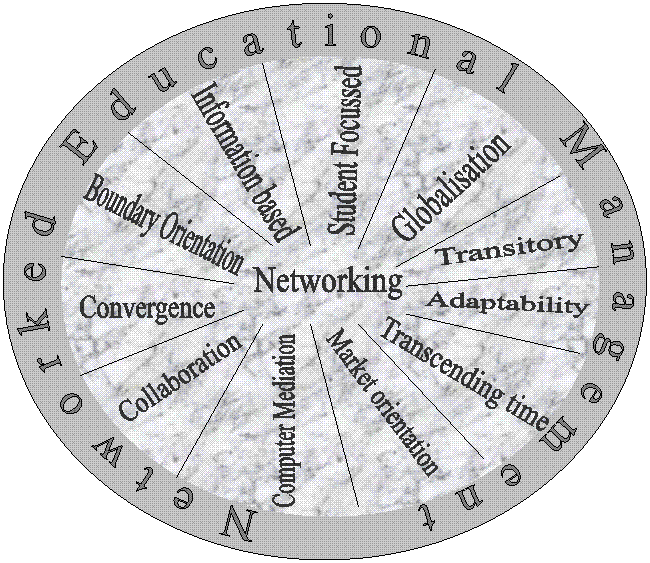
9 the author tentatively proposes a new educational management paradigm for
managing the operations of virtual class: networked
educational management (see
Figure 9.1). The twelve dimensions of networked educational management can be
seen as the essential characteristics for managing the operations of the
virtual class.
These
dimensions are a synthesis of the characteristics of managing the operations of
the virtual class as reported in the four research cycles (4.3.2, 5.3.2, 6.3.2 and 7.3.2). The discussion in
this Chapter relates these characteristics to the theoretical underpinnings of
this research.
The term networked educational management is
chosen since a central aspect of education in the virtual class and the
management of such education seems to be the connectivity or networking
that it facilitates across the boundaries of space and time. This term
correlates with “network management” (Limerick and Cunningham:1993)
and terms that authors like Tapscott (1996)
("internetworked organisation"), Beare and Slaughter (1993)
(“network organisation”), ”
Networked educational management is proposed as an integrated management
system for the operations of the virtual class. The networking dimension is therefore central to networked educational
management as it also functions to connect all the other dimensions (Figure
9.1). The integrated approach is based on the premise in systems theory that “a system
is a whole that cannot be taken apart without loss of its essential
characteristics, and hence must be studied as a whole” (Ackhoff, 1972:40). It
also relates to Michael Porter's emphasis
on integration in order to achieve competitive advantage in organisations (Pastore, 1995, October 1).
Twelve dimensions
of networked educational management are described below:
9.1 Networking
9.2 Student focussed
9.3 Globalisation
9.4 Transitory
9.5 Adaptability
9.6 Transcending time
9.1 Market orientation
9.2 Computer mediation
9.3 Collaboration
9.10 Convergence
9.11 Boundary orientation
9.12 Information based.

10
9.1 Networking
Networked
educational management postulates that a distributed model of management is
appropriate for networked education at both learning and institutional level.
Networking is therefore regarded as the central premise of networked
educational management. The distributed nature of networked educational
management is based on the new connectivity within networked education, the
distribution of learning and control, the distributed nature of the Internet
and intranets, and the globalisation of education.
9.1.1 Networked
management of learning
Managing
the connectivity that networked education facilitates, is a key difference
between managing the conventional class and managing the operations of the
virtual class and hence calls for a distributed
management in the virtual class. One of the most significant differences
between conventional education (whether it is correspondence or on-campus) and
networked education seems to be the connectivity
that networked education facilitates. It bridges the boundaries of both space
and time. It connects or networks student and student, teacher and student,
student and resource, teacher and resource, past and present, independent of
geographical or time differences.
This
connectivity within networked education and its management links to Nipper’s
(1989:64) concept of “third generation distance education”, in which the essence
is “interactive communication facilities”. Nipper contrasts this connectivity
with low interaction among students and teachers in the first generation
“correspondence teaching” (Holmberg, 1995:3) and second generation “multi-media
distance teaching”. Hawkridge (1995:8) contends that “the greatest difference…
between the old and new media is their capacities to sustain two-way
communication that aids learning”.
On-line
communications advance networking among students and teachers, which Hodgson, Mann and Snell (1987) refer to
as “expert networking”. Networked courses can provide both synchronous and
asynchronous on-line communication facilities. On-line video and voice
conferencing, Internet Relay Chat (IRC), shared whiteboard facilities and other
real-time interactive applications are being explored in education and
commerce, while asynchronous facilities like electronic mail and hypermail
threaded message boards are commonly used in networked education. Part of
networked educational management is managing the new dynamics of communication in a virtual environment (Gundry and
Metes, 1997).
Control of
the learning and the actual on-line learning and teaching materials are
distributed among both
local and distance students, using the same interface (that is to say a Web
browser) because of the convergence of learning modes that traditionally have
been called “distance education” and “on-campus education” through networked
education. This convergence is described below (see 9.10) and imply that the management of learning is no longer
linked to physical locality (on-campus or off-campus), but distributed to study
networks comprising local, distance, national and international students that
operate as virtual teams (Jarvenpaa
and Leidner, 1998; Lipnack and Stamps, 1997).
9.1.2 Networked
management of the institute
The
management model at institutional level in conventional tertiary education is
one of tension between a centralised administrative approach and a
decentralised academic approach in which the centralised, bureaucratic
(Garrison, 1989; Paul, 1990) and hierarchical
dimensions (Middlehurst, 1993) seem to be uppermost. Conventional tertiary
education has been highly stagnant in
its practice and perception of management and seems to be highly resistant to
change in this domain (Patterson, 1997; Trow, 1996).
Conventional
management of tertiary education struggles with the desperate need to reform
its management because of the external environment, but is often ineffective in
its endeavours because of this internal tension. Against this background, Cohen
and March (1974) depict the modern university in the extreme as an organised
anarchy.
Networked educational management proposes less
centralised control in line with private enterprise, which has been transformed
to greater decentralization and less bureaucratic management approaches
(Drucker, 1998) in order to respond
more effectively to change (Beare and Slaughter, 1993).
There is a
real challenge to create a congruity between centralised and decentralised
management aspirations in tertiary education (Bates, 2000; Paul, 1990). A similar tension within the
organisation of information systems activities has been transcended by the use
of distributed networks like intranets and the Internet. Organisations
initially used (and, where appropriate, today still use) a centralised approach
(based on mainframes) that focused on centralised control and economies of
scale, but did not address the local needs of users and departments effectively
(Schultheis and Sumner, 1989:565). Decentralised approaches (where appropriate,
such as home users, still in use today) then followed (facilitated by personal
computers) in which local control and processing were pre-eminent, but created
inefficiencies and incompatibility with the central standards and philosophies
(Schultheis and Sumner, 1989:568). The solution was distributed processing (through networks like intranets and the
Internet), used “to distribute some data processing activities to users, but to
maintain centralized control over other activities… (this) means that both
computer power and the data can be distributed to local user sites... can also
mean distributing responsibility for other computing activities to the user ” (Gibson and Hughes, 1994:558; Schultheis and Sumner,
1989:569). The same applies to communication systems where the use of
distributed networks like intranets and the Internet created a distributed communications model. In the
oral traditions before Guttenberg's press of 1452, a centralised model of
communication was most feasible. The text tradition, which followed the
revolution that the printing press caused, brought with it the decentralisation of communication
through paper distribution (Innis,
1972). The intranet and the Internet, however, facilitate
communications from any locality and distributes the control of the
communications throughout the network (for example, electronic mail can be sent
by anybody to anybody else connected to the network within an institute or globally).
The Internet creates a global distributed communications model while intranets
create an institutionally distributed communications model.
Networked
educational management emulates the distributed networked systems it is based
on. The management style reflects the distributed nature of the systems in and
through which it operates. Paul (1990) argues for this congruity when stating
that an institution that is dedicated to the values and practice of open
learning needs to have a management style that is open. Networked educational
management will thus be based on a clear set of guiding principles which forms
the basis for all decision making at all levels, while using and encouraging
delegation widely to distribute power and authority (Paul, 1990).
Networked
educational management further aligns itself with Luke’s
(1997:2) notion of ‘net work” as “the new kind of intellectual and
institutional labour needed to transform the existing national/ industrial/
traditional university into an informational operation with new transnational/
postindustrial/ innovative capabilities ”.
The
globalisation of education may furthermore necessitate collaboration and
partnerships. These partnerships can exist to ensure the local support of
distance students in networked education, to address accreditation and
certification issues (see Chapter 8)
or for more effective participation in networked education. Institutes might
therefore find themselves physically or logically distributed through
partnerships and collaboration with other national and international
institutes. This calls for a distributed
management system in education: networked educational management. Networked
educational management is a response to the need identified by (Morrison, 1995)
to interact on "learning highways" across all borders.
Networked
educational management has its control, power and resources thus distributed
throughout the organisation. The ICT base of networked educational management
facilitates an organisational model that moves away from centralised control.
The decentralisation of control aligns itself to the view of Bates (1984a),
Garrison (1989) and Peters (1993)
that new technologies offer the possibility of an alternative model to the
large, centralised and specialised distance education system in the post-industrial society.
Networked
educational management contends that a distributed model of management of
conventional tertiary education is appropriate for networked education, which
is based on the Internet or intranets. Networked educational management links
with the distributed emphasis of “open management”,
being energised by value-driven leadership, as proposed by Paul (1990)
and with the distributed models both in information systems activities and
communications. Networked educational management aligns itself to the newer
forms of distance education that Rumble (1992) describes as a highly
distributed system.
Networked educational management further conforms to
two of the ten major transformations (or megatrends) in society
identified by Naisbitt (1982), namely a transformation from centralisation to
decentralisation (in effect distribution) and from hierarchies to networking.
Networked educational management links through its distributed nature to the
idea of the new organisation that empoweres
individuals to manage their own networking towards a common objective
(Limerick and Cunningham, 1993).
In
contrast to a mechanistic control
process, networked educational management has an organic control
process (Burns and Stalker, 1961) in which “knowledge and control of tasks are
located anywhere in the organization” (Daft, 1989:1). Networked educational
management aligns with an organic control structure in which the employees
contribute to the tasks of the department, tasks are altered and redefined
through the interactions of employees and there is less hierarchy of authority
and relevant control. In an organic control structure there are also few rules,
while knowledge and control of tasks are distributed throughout the
organization and communication is predominantly horizontal (Daft, 1989).
Learning organisations (Marquardt,
1996:1) similarly “make greater organizational use of employees at all levels
of the organisation”. Networked educational management will ensure
conformity to central principles and values and simultaneously encourage
diversity. Active progression towards the virtual class opens an institute to
the impact of the distributed nature of the new educational technologies
(specifically the Internet and intranets). Networked educational management
encourages the distribution of objectives, control, power and resources
throughout the institute, and indeed among its
students (see 9.2 below).
Networked
educational management being based on a distributed model,
can therefore ensure conformity to central principles and standards while
simultaneously encouraging diversity and thus transcends the tension between
the centralised administrative management and decentralised academic management
approaches. Instead of bureaucracy and anarchy, networked educational
management may contribute in a philosophical way to harmony within tertiary
education.
The
organisational structure which could embody the notion of networking is one in
which centralised and decentralised management need to be integrated (Bates,
2000). Networked educational management
could find expression in an organisational model as described by Bates where a
fairly large professional center work with small flexible units of technical
support and generalist educational technology support within each faculty (or
school).
Networked
educational management can further enable tertiary education to use a “network structure” which is used in private enterprise to
outsource some or part of its essential functions (Drucker, 1995; Robbins and Barnwell, 1998). Teaching can be
outsourced in networked education to teachers who may be anywhere in the world.
Administration can be outsourced to external organisations that process for
instance on-line enrolments, assessments, student records and computer systems.
Research aspects can be outsourced through international collaboration (see 9.9 below). The control of learning is essentially “outsourced” or
distributed to the students in networked education due to their central role
described below.
9.2 Student
Focussed
The shift
in networked education from a national to a global educational focus (see 9.3
below) has created a controlling position for the student in the virtual class.
The global reach of networked education, the
distributed nature of the Internet, the increase in private enterprise
participation and the growth of transnational educational collaboration shift
the focus of education away from the nation state. In this paradigmatic shift
the focus and control transfers to the student who can select from various
international offerings, access Websites and people across cultural, national
and philosophical boundaries, while constructing their own learning and meaning
through a constructivist educational approach (Mason, 1998:157).
The global nature of the virtual class gives students a new, extensive
choice of locally and internationally offered courses. Networked
education makes it technically possible for students to engage in networked
courses from different institutes of their choice in order to gain a
qualification. This calls for increased critical
analysis skills of students to make the appropriate choice as well as for
transnational accreditation and certification (see 9.11 below). The
student now has various teachers accessible by e-mail and they may be
geographically located anywhere in the world (
The learners in the virtual class have the ability to access other
students, lecturers and resources globally (Tiffin, 1997 April). The virtual class through the use of
educational technologies like the Internet, which is a global (Wizards, 1997)
and expanding phenomena (Internet Software Consortium, 1999b), bridges national
borders and occurs in a “space” which is accessible from anywhere in the world
where access to the Internet is possible (Uys, 1998 April). This means that
anybody in the world with a telephone connection can access the Internet (even
though it might mean making an international call).
Networked educational management has to deal with the student in the
controlling position since networked education is based on ICT which per se has the potential to provide more
control to the student (Garrison, 1989; Bates, 1994). Peters
(1993:43) points to an assumption of management in a post-industrial society in
which control will occur through “employee self-control”, which he interprets
as referring to the student. Peters (1993:52) postulates that
learners could well “…insist on determining themselves what and how to learn”
which is increasingly common in networked education.
Networked education further enables the instructional designer to
consider the individuality of every student by catering for different learning
styles, different ways of navigating a course and individualised presentation
through adaptive hypermedia systems (Brusilovsky, 1996). The constructivist
approach has been propagated as a fitting approach in networked education. The central
tenet of the constructivist approach is that "…the world is constructed by the individual" (Boyle, 1996 June:751).
Constructivism is a philosophical approach in which it is argued that since
knowledge is socially and culturally constructed (
In networked education on-line publishing is extremely easy. Students in
networked education, in contrast to the conventional student, can with ease be
on-line providers and publishers themselves by using facilities like hypermail
threaded discussion boards, on-line journals and newsgroups (Uys, 1997b June). The student
in networked education can further study at
their own choice of pace, place and time and may enrol on-line using
"anywhere - any time" enrolment (as discussed above).
The central
role of the student correlates with the new role of the teacher as facilitator
in networked education (discussed in Chapter 8). Zepke (1998:179) states that “…the teacher’s role is a limited one… the
role includes - facilitating students learning by communicating and empathising
with them; structuring knowledge and arranging a reasonable workload; helping
students develop, change and critique their own learning structures”. In
networked educational management the student is in control.
In this
regard networked educational management could be seen
as linking to a “network structure” (Robbins and Barnwell, 1998) in which the control of learning is
essentially “outsourced” or distributed to the student based on the principles
and facilitated by the processes described above.
9.3 Globalisation
The global nature of the virtual class is possible because the new
educational technologies, in particular the Internet, facilitate and lead
naturally to the globalisation of education
Networked education has an integral distance education component and
links therefore to the globalisation possibilities in education, which distance
education per se makes possible
(Evans and Nation, 1993). The rationale for global courses could be for
educational institutes to extend its market particularly into developing
nations (Evans and Nation, 1993) or socio-political, technological and
purely educational grounds (Mason, 1998). Globalisation
is also seen as a generic feature of later modernity (Evans and Nation, 1993)
which is occurring in many areas like the
economy (Holland, 1987; Tapscott, 1999) and communications (
Networked education has a strong global disposition also because it is
information-based (Drucker, 1989). The global nature of the virtual class means that institutes in tertiary
education can project themselves into a global educational market of providers
and students which places new demands on management.
It is
therefore important for each conventional tertiary educational institute,
besides considering participating in networked education, to employ appropriate
strategies to survive and prosper. Conventional tertiary education might
provide personalised attention through smaller groups, excellent social
interaction possibilities on campus, focusing on addressing the needs of the
local work-market, addressing the specifics of the local culture, as well as increasing
the quality of their education and building a reputation for excellence in
target areas. These strategies could be built into the organisation's long term
objectives. Institutes participating in the virtual class might further need to
focus on establishing a specific niche in the international educational market.
Networked educational management through its global nature also addresses
the management of relationships with collaboration and consortium partners (see
9.9 below). It also address the new competitive international educational
market since competition can come from everywhere in the digital economy (Tapscott, 1996).
Networked educational management therefore also needs to authentically address
cultural differences in an international educational market and arena (see 9.7 below).
9.4 Transitory
Control is
an integral part of management (Newman, Warren, McGill, 1987) that is hugely
impacted by the transitory nature of the operations of the virtual class.
Networked educational management acknowledges a decrease in control, more
uncertainty and therefore an increased in risk in the management of digitised
education (Tapscott, 1996).
The central
position of the student as described above (under
9.2) and the changing nature of the student body contributes to an
uncontrollability of huge proportions, which challenges the essence of
conventional educational management and have to be addressed in networked
educational management. The virtual class is unbound in space and time -
networked education allows the student to study any time and anywhere. Networked education provides students with the
flexibility of studying at their own pace and also at their choice of place.
Networked education further allows students to either study
independently in a more flexible mode or as part of a group in a more
structured manner.
The
transitory nature of networked educational management is linked to both the
transitory nature of the technological environment and that of the change
process. The environment in which networked education in tertiary education
occurs at the beginning of the new millennium has been described as
exceptionally dynamic and volatile (Tapscott, 1996). The introduction of computers in education is seen in
revolutionary terms by some (Drucker, 1989). Even the nature of the
change process from conventional to networked education itself is not stable
(Morrison, 1995).
The global
dimension of networked educational management furthermore increases the
boundaries of the institutes using networked education and exposes them to be
impacted by more factors and influences from a turbulent international
environment. The boundaries of the
networked educational organisation (see
9.11 below) are also becoming wider
and more fluid.
In the
emerging information or knowledge society, education has to further contend
with an exponential growth of the amount of new information available for use
by organisations, governments, and businesses and people (Nugent, 1996). The
growth in the Internet continues to be exponential (see Figure 1.1) while there are furthermore sustained,
revolutionary changes in the ICT that undergird networked education (Bates,
1995:45; Szabo et al., 1997). In the
increasingly digitised environment of networked education, networked
educational management needs to allow for less control and more risk-taking
(Tapscott, 1996).
Networked
educational management takes cognisance of the immediacy of information that is
one of the themes of the new economy. Tapscott (1996) refers to information
immediacy as a critical factor in establishing the transitory nature of the new
enterprise as a real time enterprise. Networked educational management thus
facilitates the operations of a real time tertiary educational institute.
Web-based
materials are further especially fluid due to the ease of publication and the
state of continuity of Web-based materials as demonstrated by Farrell (1999:2)
"Due to the nature of the World Wide Web and the re-structuring of home
pages by Web masters, the addresses might change by the time readers try to
access the referenced sites". Lennon and Maurer (1996, June) emphasised the importance of managing the
hyperlinks embedded in on-line materials and pointed to the use of specialised software to automate this process. In
networked education the materials and teaching process is in a state of
continuity in contrast to the state of discontinuity of materials in
conventional tertiary education. Once a course is on the WWW, it remains
available and no special arrangements are needed to keep it continually
available - special arrangements however have to be made to discontinue its
availability. Effectively managing the discontinuity of on-line materials is
necessary to meet student expectations and provide ongoing support, and in so
doing avoiding that the institute comes in disrepute. The virtual class thus
needs special approaches to ensure a seamless discontinuity like de-registering
the materials with the search engines and guides, replacing the course
materials with clear notices to that effect or contacting those whom the
institute know have bookmarked the materials.
The dynamic nature of on-line materials require tight change control
systems in networked educational management while at the same time addressing
the flexibility of on-line materials that can be changed continuously and
immediately. This is different from using other publishing mediums like paper
or CD-ROM. The distributed nature of networked educational management can
address this tension (as described in 9.1 above).
9.5 Adaptability
The
turbulent and dynamic internal and external environment described above calls
for networked educational management to be highly adaptive. It connects to the
concept of learning organisations (Marquardt,
1996) in which management needs to be highly adaptive. Networked educational
management is organised along a flat hierarchy and is seamless and boundaryless
like learning organisations (Marquardt,
1996). Esquer and Sheremetov (1999,
July)
further points to a consensus that successful universities of the future will
be those that operate with high flexibility.
The team
approach in course development in networked education (described in chapter 8)
also leads to high level of flexibility in networked educational management
regarding project management and collaborative approaches (Daniel, 1998).
There is also a strong requirement for flexibility within the software and
hardware for developing on-line materials itself due to the inherent
flexibility of web based materials (see
9.4 above). Management of networked
education also needs to be flexible in the approach to acquiring and discarding
ICT in order to grow with the continuing developments in the undergirding
ICT.
An adaptive approach is also required in managing the learning
environment through instructional design. Adaptive hypermedia systems achieve
personalised presentation (Brusilovsky, 1996).
This means that educational material is presented in an individualised
and possibly unique way to students on the basis of mapping systems that are
created for each individual student.
On-line enrolment and Web-based study makes "anywhere - any
time" enrolment technologically possible, but it might not be feasible to
implement it in a totally open way due to the complexities it create for administration (see Chapter 8). The potential openness in the enrolment processes
and procedures that the virtual class allows need to be exploited.
JIT
teaching (see 9.6 below), that is teaching that can change rapidly and
immediately based on the needs of students and is available when students need
it (Tiffin and Rajasingham, 1995; Marquard, 1996; Mason,
1998) calls for the management of teaching to be
particularly adaptive.
The factors
above point to a high level of adaptability that is required in networked
educational management in relation to the administrative, academic and
technological management of the virtual class. Peters (1988) believes that the
modern business organisation needs to be far more decentralised and responsive
due to the more unpredictable and competitive environment; this is also
applicable to the management of an educational organisation that embraces networked
education.
9.6 Transcending Time
This
dimension of networked educational management deals with the immediacy of networked education, the impact
of the adaptability of networked educational management (see 9.5) on time, and the ability of networked education to
transcend time through the asynchronous
components of networked education.
Networked
educational management deals with an immediacy that Tapscott (1996) identifies
as one of the themes of the new economy. This is also the case in networked
education as Web based materials (be it on the Internet of intranet) can be
updated continually and immediately. Just as immediacy within enterprises
facilitates just-in-time (JIT) shipping and manufacturing (Tapscott, 1996:63),
it leads in networked education to JIT teaching - teaching that can change
rapidly and immediately based on the needs of students and is available when
students need it (Tiffin and Rajasingham, 1995; Marquard,
1996; Mason, 1998). This can be managed
manually or in conjunction with adaptive teaching systems (Brusilovsky, 1996
June; Carver, Howard and Lavelle,
1996 June)
Networked
educational management addresses the immediacy of resources and people in
networked education. A hyperlink to a source on the Internet or an intranet
provides an immediacy that is not possible in conventional education. Hyperlinks provide seamless transfer to pages
within the networked course as well as to global information sources on the
Internet. The practice in networked education to provide links to electronic
mail addresses or discussion groups across time zones leads to the sense of the
immediacy of people. Adding to this immediacy are programs like ICQ (2000) and
Yahoo Messenger (2000) which can indicate when other members of an on-line
discussion group access the Internet.
Flexibility
is prevalent in the virtual class also through the ability of students to study at their own choice of pace and
time and also has the advantage of synchronous communication activities when
required. The virtual class further facilitates the option for students
to either study independently in a more flexible mode or as part of a group in
a more time-constrained manner.
On-line enrolment and Web-based study makes "anywhere - any
time" enrolment technologically possible (as discussed above) and in this
way transcends the time factor in the enrolment process. This flexibility
challenges the control emphasis of administrative systems. Efficient
administrative management that caters for this flexibility might be achieved
through using grouping and pacing. Students define their study goals at
enrolment. When studying to obtain a formal qualification a more structured
approach can be followed but when studying for professional development only, a
more flexible approach can be employed. Students might also enrol in a course
that has been specifically designed in conjunction with a specific sector of
industry in which case the industry dictates the structure of the course.
Students can then be grouped based on their purpose of study and their progress
monitored against their stated goal, while following the related administrative
processes. While the learner might need to be closer to the centre of the
educational formula, the other necessary factors to make the formula work like
effective administration, must be appreciated and taken into account when
managing networked education.
9.7 Market
Orientation
A market
orientation in networked educational management is required because of dramatic
changes in the competitive nature of the tertiary educational market, and also
because of the changing nature of the student body. Networked education needs
to match the needs of an information society (
Drucker (1985)
asserts that innovation needs to be focused on the market and driven by the
market. This also needs to be the case with the management of networked
education as an educational innovation.
Entrepreneurship
is no longer the domain of private enterprise but critical to ensure the
validity of conventional tertiary education. Drucker (1985) maintains that the
development of the modern university is a case study in entrepreneurship.
Networked educational management therefore incorporates entrepreneurship.
Tapscott
(1996) contends that in the digital environment, competition comes from
everywhere. This seems also the case in tertiary education where any institute
in the world using networked education becomes a potential competitor in the
local educational market. The extent of collaboration as described (see Chapter 2) further points to the
requirement in market orientation in educational management.
The virtual
class further seems to be an enabling factor in the increasing proximity
between industry, entertainment and education that impact on long term
strategies of growth and survival of conventional tertiary education. Tapscott
(1996) notes convergence as one of the themes of the new economy. He holds that
new media is the dominant sector in the new economy, which are formed through
the integration of computing, communications, and content industries such as
tertiary education. This change could have extensive organizational, economic
and cultural effects on post-compulsory education (Evans and Nation, 1993).
Corporate
Universities are emerging (Drucker,
1989) for example
Management
within networked tertiary education will increasingly have to take the
principles of adult education (andragogy) into account. Drucker (1989) identifies continuing education as a
new requirement for education in the knowledge society (p. 243). Education is becoming more of a lifelong endeavour than a few years stint
after school. Spender (1996b, September) asserts that the whole society is
becoming the student body and many in this extended student body will be drawn
to the open and flexible nature of networked education.
The market orientation of networked educational
management implies that entering international educational markets where
English is not the first language when networked courses are in English, needs to be addressed. Providing assistance to
non-native English speakers - ideally on-line - needs to be integrated in
networked education. If not, the translation of courses and presentation
through adaptive hypermedia systems need to be considered.
Networked educational management is embedded within the (internal)
culture of an educational organisation (Drucker, 1998). Networked education however exposes both teacher and
student to inter-cultural exchanges in Internet based learning communities that
could impact on the unity of an organization (Gundry
and Metes, 1997).
Cultural
sensitivity and alignment need to go beyond mere language translation. Woodhouse (1999) points out that
education is not culturally neutral. In the virtual class with its
global character, the importance of culture as a significant determinant in how
students desire to learn, how the content should be structured and how the
learning experience should be facilitated must be appreciated in the management
of the virtual class. Students may choose
to study close to home because of convenience or physical security factors, but
culture may also contribute to this choice. Dealing with foreign cultures needs
to be managed with care and requires teachers to have knowledge about cultural
differences and sensitivities for these differences. This can be easily
overlooked in networked education where communications often exclude clues to
the culture of the communicators like pronunciation, moral values, and physical
appearance.
Offering courses globally has implications for the
pricing of these courses since conventional tertiary education is often
subsidised by government and therefore differentiates between fees for local
students and those outside its geographical area. In the virtual class the fee structure
however needs to take the local target market of the student into account in
order to be competitive in that specific market - networked education therefore
calls for differential pricing.
Managing
networked education therefore needs to be relevant to the market in which the
trends, threats of competitors and the needs of students are paramount.
9.8 Computer Mediation
In
embracing networked education, an organisation also embraces the ubiquitous use
of ICT, as networked education is the expression of the virtual class when
teacher, learner, problem and knowledge interact through Internet and intranet
based technologies. Networked educational management therefore is highly
computer mediated.
In a
systems based approach, using the MIT90 schema (see figure 1.3), the computer-mediated nature of networked
educational management impacts on strategy, roles and skills of individuals,
management processes and organizational structure. In this environment the
management in all its fractal dimensions will be largely computer enabled for
instance through electronic communications, reporting, tasking and delegation,
project management and class management. The reality
in conventional tertiary education is that instructional design often excludes graphic design and ICT design. In
networked education however, instructional design in practice generally also
includes graphic design as well as ICT design. The scope of instructional
design in practice therefore in the virtual class is wider and thus different
from the practice in conventional education. The ubiquitous use of ICT
in institutes which uses networked education extensively,
thus requires higher levels of computer and information literacy of academic an
administrative staff as well as their students.
Widespread
participation by on-campus students in networked education could naturally
increase the demand for access to on-campus ICT. The convergence of traditional on-campus education and distance education
could therefore require a decrease in spending on lecture theatres and an
increase in spending on extending computer facilities like computer
laboratories and the availability of intranet access in more public areas like
libraries
An
extensive set of technologies, which have become transparent through their
ubiquitous integration into every-day life and through our frequent use,
constitutes the infrastructure of conventional on-campus or distance education.
The technologies and systems necessary for instance for a typical conventional
lecture include transport, media, electricity, air conditioning, buildings,
ducting, clothing, food preparation, piping, waste systems and so forth. The
virtual class also requires an extensive infrastructure that parallels that of
the conventional class but are constructed digitally (
A specific
management issue in the planning of the computer-user interaction is to take
ergonomics of the physical interface and the equipment used to interact with
the ICT into account. It is necessary for
both the teacher and the student in networked education to manage this aspect
of the computer-user interaction in order to avoid the possibility of
repetitive strain injuries (RSI) - also called operational overuse syndrome
(OOS). The institute has a responsibility to create awareness and to provide
the necessary knowledge and skills to both the teacher and the student in
networked education to manage the computer-user interaction appropriately.
Computer mediated collaboration in networked education has become
widespread (Bates, 1993b). A new requirement for management in the information or
knowledge society is managing the dynamics
of communication in a virtual environment (Gundry and Metes, 1997). Tapscott
(1996:55) highlights networking and collaboration as a vital modern management
issue. Networked educational management therefore needs to include the
particular challenges in the management of computer mediated collaboration such
as dealing with anonymity, authenticity and the lack of traditional
communication clues.
Networked
educational management for technology managers incorporates the phenomena that
some people when they don’t have the skills to work effectively online, may blame the technology (Gundry and Metes, 1997).
Technology managers need to be able to point to available training
opportunities and support mechanisms for mastering the new ICT (as discussed in
Chapter 8).
Networked
education uses the tools of the emerging information or knowledge society as
the educational tools. At this stage these tools are however not only in its
infancy and undergoing revolutionary changes, but the full complement of what
is required is not fully established. In the current phase of networked
education, there are often realisations of totally new technologies needed (
Networked educational management therefore strategically manages ICT as
essential, critical elements of networked education. Michael
Porter (Pastore, 1995, October 1) points
out that the best way to think about ICT is
not as a separate entity, but as integral to what makes a company unique in all
its activities.
9.9 Collaboration
Collaboration
is central to many dimensions of networked educational management.
Collaboration among institutes is due to the pressure of increased competition
through the wider global reach of networked education. It is founded on the
networking dimension and relates to its boundary orientation in that
institutional and transnational boundaries are transcended through increased
collaboration.
Tapscott (1996) points to collaboration and networking as central
management issues also applicable in education. It is becoming common for
conventional tertiary educational institutes that wish to progress along the
path of networked education to link up with others working in this field and
correlates with one of Fullan’s (1991) six themes of educational change
namely to establish alliances. Many universities
and colleges are indeed positioning themselves for effective participation in
distance and particularly networked education through collaborations on
institutional level as in Universitas 21
(1999), ECIU (1999), NUDC (1999), CENIC (1999), ADEC (1999) and METEOR
(Indramalar, 1999 April 23). This seems to confirm Michael Porter's emphasis on clustering within
competitive industries (Caulkin, 1990).
The
collaboration is however no longer exclusively that of educational institutes.
It could include private enterprise, entertainment industry players and other
(Evans and Nation, 1993). Networked educational management, being based on ICT,
would have to contest with an openness of huge proportion (Garrison, 1989).
This openness increases collaboration opportunities with other institutes and
could lead to large learning systems that could well be a network of
institutions (Forsythe, 1984).
Through
collaboration, networked educational management links
to the form of organisational design called a “network structure” in which
outsourcing is used extensively (Robbins and Barnwell, 1998). Drucker (1995:68) identifies outsourcing as
a central example of managing in what he calls the “networked society”.
Essential educational processes can be outsourced (as described above) through
wide collaboration with other institutes facilitated by the Internet and other
digital technologies.
The
possibilities and ease of student collaboration are also enhanced through
synchronous and asynchronous on-line communications that lead to increased
connectivity. Electronic mail, CHAT, hypermail threaded message boards and the
like provide opportunities for students to collaborate in cost-effective ways
with each other and others external to the student body. Hodgson, Mann and Snell (1987)
refer to student and teacher collaboration as “expert networking”. Through the
new technologies discoveries can be shared, as well as developments and
reference materials.
Collaboration
furthermore pertains to instructional design for networked education where a
team orientation is prevalent in development. The research indicated that a
multi-disciplinary team is required in the design and development of networked
education because of the need for educational, graphic design and communication
and information technology perspectives. This is in contrast to instructional
design in conventional tertiary education that is often a solo activity of an
individual lecturer (discussed in Chapter 8).
The
team-concept is one that is proposed in a more generic sense in private
enterprise by Peters (1988), Drucker
(1998), Hayes and Watts (1986) and Tapscott (1996). The learning and
development teams in networked education however display the characteristics of
a virtual team; that is a group of people working towards a common goal in a
computer-enabled environment where they are removed from each other in physical
space (and often in time). Therefore understanding how a virtual team operates
is necessary in managing the on-line learning of students and the development
of networked education.
Collaboration and exchanges with others in the field nationally and
internationally do however require strategic planning and management as well as
resourcing for instance to acquire and install the ICT to be used for
interacting with others, travelling and conference costs, obtaining applicable
literature and facilitating exchange agreements.
9.10 Convergence
The
convergence that networked educational management need to address finds
expression on the institution level as well as the more detailed learning
levels.
On
institutional level this convergence is increasingly among educational
institutions, enterprise, entertainment and the like (Evans and Nation, 1993).
The convergence that networked educational management needs to address is related to it being computer mediated. ICT is fundamental to the operations of networked education (as described in 9.8 above). Bates (1995) points to the convergence of telecommunications, television and computing as an important technology trend for the distance-teaching organisation (p. 45), while Tapscott (1996) highlights convergence of computing, communications, and content industries as one of the themes of the new economy. Networked educational management needs to manage a new integration or convergence of computing, communications, and educational content.
Networked
educational management deals with a new convergence of on-campus and distance
learning which has been made possible through networked education particularly
with the advent of intranets and the Internet. Garrison (1989:117) notes that this convergence is “…blurring the boundaries between
conventional and distance education”. Bates (1984a) also suggests that many
dual mode institutes will emerge as conventional education move into distance
education This is due to an increase in the ease and feasibility of
simultaneously offering a networked course to on-campus students as well as to
distance students. With the same interface (that is a Web browser), networked education and teaching materials are available
to both local and distance students. Students can evaluate each other's on-line
published materials, do group assignments together and form informal study groups.
The shape that this convergence might take can vary. Teaching and learning
materials for instance can be placed on-line as well-designed networked
courseware which include on-line communication facilities, different navigation
paths, catering for different learning styles, access and pointers to other WWW
resources and exercises. The local students may also have face-to-face
tutorials to work through exercises and may sit tests and exams in a physical
building. Distance students also have access to the on-line materials but have
on-line real-time tutorials, may attend some workshops on the physical campus,
and do their assignments on-line. Berge and Schrum
(1998:31) contends that “it is important to recognize that on-campus programs
and courses may often use the same resources and infrastructure as those
delivered to students at a distance”..
The synergy
that networked education brings is that both local and distance students can
participate in the processes of the same course occurrence in a real and
meaningful way through synchronous and asynchronous on-line communications
(Bates, 1984a; Lundin, 1993). This
convergence of learning modes which traditionally have been referred to as
“distance education”, "extra-mural education", “on-campus education”
or "face-to-face" education means that both learning control as well
as on-line learning and teaching materials are distributed to both local and
distance students using the same interface that is a Web browser. Dhanarajan (1998) and Lundin (1993) questions in
the context of open and flexible learning whether it still make sense to draw a
distinction between distance and conventional education. Networked
educational management through its networking dimension addresses this
convergence and makes the virtual class “mode-independent”. Networked education
therefore creates the possibility for conventional tertiary education to
realise the benefits of dual-mode institutions like flexibility and an extended
range of courses (Evans and Nation, 1993).
The
convergence on macro- and micro-level does not necessarily mean conformity.
Networked educational management is based on a distributed or networked model
(described in 9.1 above) and can therefore couple centralised (strengthening
conformity) and decentralised (encouraging divergence) management approaches.
Networked educational management can ensure conformity to central principles
and standards as Evans and Nation (1993) contend, and simultaneously encourage
diversity (Frederick, 1993; Negroponte, 1997
June).
9.11 Boundary
Orientation
Networked education opens the boundaries of an organisation and make
it more vulnerable to the external environment (Middlehurst, 1993). The
external environment for conventional tertiary education includes its
customers, its competitors and beneficiaries. Networked educational management
therefore needs to address the expanded need for effective boundary management.
An emphasis on boundary management
correlates with the organization of the future proposed by Peters (1988a),
Tapscott (1996) and Daft (1989). It also correlates with the importance to
develop boundary roles as an essential element of effective network management
(Limerick and Cunningham, 1993), as well as the notion that the learning organisation is boundaryless
(Marquardt, 1996).
The extensive use of the Internet in networked education further leads to
an extension of the boundaries of an organisation’s academic and administrative
systems. Networking now often transcends national boundaries (see 9.3 and 9.9 above) so that the Global Alliance for Transnational Education
(GATE, 1999) describes the current educational environment as the “…new
borderless educational arena”.
A major
boundary management issue in networked education is to provide adequate access
to courses. Spender (1996, August) asserts
that the borderless information environment is not open to all the peoples of
the world because of access and equity issues. Terms often used in regard to
equity of access are those who are "information rich" and those who
are "information poor" - which often leads to social and financial
impoverishment (Hope, 1998). Not only is access to the virtual class limited
through inadequate access to appropriate ICT and Internet costs, but also through
computer illiteracy which needs to be addressed through training and support
systems (discussed in Chapter 8).
The ongoing changes in ICT have been creating a seemingly unending spiral
of regular upgrades to software and hardware, which leaves many students
wanting when they desire to access networked education. There are initiatives
to address these issues like Cybercafes, Internet access in public spaces like
libraries, arranging adequate on-campus computer access, collaboration with
other educational institutes to provide access to remote student as well as
Telecentres which are widely used in Australia (WA Telecentres, 1995) and
Europe and growing in Africa (Naidoo and Schutte, 1999:90). "Drop-in" computer labs can be provided
for on-campus students participating in networked education via the intranet
and computers can be placed in public access areas like the library. The
cost of access to networked education also needs to be addressed. The institute can endeavour to negotiate
favourable contracts for Internet access and ICT on behalf of their students.
Networked courses further need to be designed with the lowest possible
"footprint", which is the required technology on the student's side.
This includes designing networked education so that students in networked
education can stay off-line for most of their study time,
while naturally have to be on-line for communications. This can be achieved
through compressing a course into a single file for the student to download. Even with
the smallest “footprint” on the students’ side, it might still be necessary to
be able to provide a hardcopy or off-line softcopy of the course materials.
With increased access and extended boundaries comes an increase in the
possibility of abuse, which highlights another boundary management issue:
ensuring security of the ICT systems in networked education (discussed in
Chapter 8). Addressing accreditation and certification across national
and academic status barriers however, is a prominent issue in boundary
management of the virtual class (described in Chapter 8).
The boundaries in administrative systems supporting networked education
can also be transcended in networked educational management through on-line
applications and on-line enrolments that use the asynchronous mechanisms of
networked education like electronic mail and on-line forms. It can remove the
typical bottlenecks and physical queuing that frequently occur during the
application and enrolment periods in conventional tertiary education.
9.12 Information based
Information
management in networked education is critical because the virtual class deals
with the movement of bits of information rather than atoms (Negroponte, 1995).
The virtual class is further interconnected with the
information or knowledge society as it can be seen as the educational response
to the needs of the information society.
Managing
real information overload in the virtual class has become a serious challenge
for both students and teachers (Gundry and
Metes, 1997; Marquardt, 1996). This dimension of networked educational
management is closely linked to Drucker’s
(1995) concept of the information-based organisation. The vast resources on the World Wide Web, on-line databases, newsgroups,
threaded message boards with evolving discussions, discussion lists (like
Listservs), and increasing volumes of electronic mail creates information
overload and stress, if not managed properly. Developing critical analysis
skills and increased information literacy
(as discussed in Chapter 8) will become increasingly important as the
information or knowledge society and networked education, as the corresponding
educational paradigm grows. Victor
(1999, July) further asserts that information overload can be addressed through
the effective use of information architecture while Gundry and Metes (1997) points to the positive role that communication
protocols and filtering devices can play.
Part of effective information architecture is the use of relational
or object-oriented database approaches for data management in networked
education (Gibson and Hughes, 1994; Lobodzinski and Williams, 1996 June; Lennon
and Maurer, 1996 June; Schultheis, and Sumner, 1989) of which Hyperwave 1998)
is an example. Many networked education software packages take the notion for
granted that course elements ("course objects") are to be stored in
flat directory structures as a series of files. HTML files as well as media
elements and scripts are stored on servers in an organised flat directory
structure which is reminiscent of how data was stored before the emergence of
databases. Using a series of files can be an effective initial strategy to
rapidly engage in networked education, but does not in the long run constitute
effective data management. Relational databases and object-oriented databases
have emerged as effective, sound and popular ways of storing data in computer
systems (Schultheis, and Sumner,
1989; Stair, 1992). It reduces data
redundancy (duplication), increases data sharing while improving data
consistency, data independence (data are separate from its definition) and data
administration and control (Schultheis, and Sumner, 1989:224).
The need
for self-discipline and continuity of motivation of student is amplified in the
virtual class due to its virtual nature, being information-based. The
traditional prompts such as physical materials on a desk, or scheduled class
times are often absent. Networked educational management includes effective
instructional design using appropriate multi-media, effective monitoring of
participation through computerised or manual tracking, asynchronous and in
particular synchronous communications (Mason, 1999 July). These mechanisms can
play a positive role in enabling the student to successfully address the
virtuality of the information dimension in networked education.
Networked educational management as it relates to the library has to
address the largely electronic information base of the new library. The fact
that the library as physical device is not required in the virtual class has
huge implications for conventional tertiary education regarding their mobility,
flexibility, capital costs and competitiveness.
The information base of the virtual class also underlines the solemn
management issues of ensuring privacy of personal information and security of
ICT systems underlying the virtual class (as discussed in Chapter 8).
Networked
education is based on information exchanges. Drucker (1998) describes the shift from the command-and-control
organisation to the information-based organisation as the third major evolution
in the concept and structure of organisations since modern business enterprise
first arose. Networked educational management aligns itself to this
evolution and exercises control through
information and communication and not through bureaucracy (Garrison,
1989).